

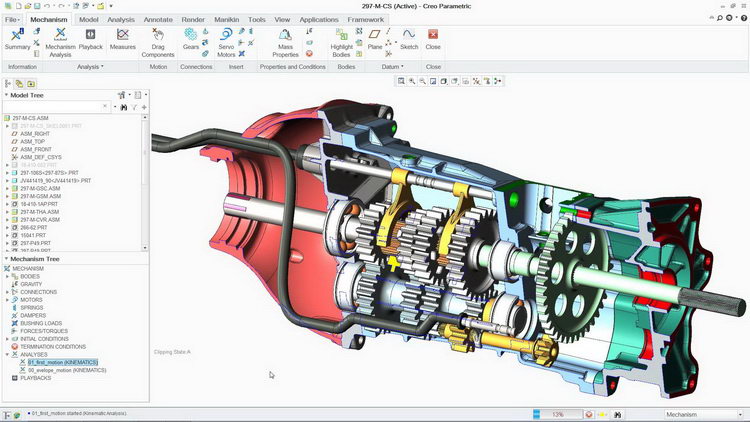
Download PTC Creo 13.4.1 – Advanced CAD Software for Engineering Design
PTC Creo is a comprehensive suite of computer-aided design (CAD) applications developed by PTC Inc. It is engineered for professionals in the product design and manufacturing sectors, offering robust capabilities for mechanical engineering tasks. As a direct descendant of Pro/ENGINEER, Creo 12.4 continues to provide advanced modeling techniques and aims to streamline the product development lifecycle for discrete manufacturers.
Overview of PTC Creo
Introduction to Creo
PTC Creo represents a powerful evolution in CAD technology, building upon the legacy of Pro/ENGINEER. Developed by PTC Inc., this software suite is a cornerstone for engineers and designers in the mechanical and manufacturing industries. Its primary focus is to facilitate sophisticated product design through a unified, integrated environment. The software suite is designed to handle complex projects, offering a seamless workflow from initial concept to detailed manufacturing documentation.
Key Features and Capabilities
Innovative Design Tools
PTC Creo offers a versatile set of tools to support diverse design methodologies and complex engineering challenges. It combines parametric and direct modeling approaches within a single environment, allowing users to adapt their workflow to specific project needs. This flexibility is crucial for rapid design iteration and managing intricate product assemblies.
- Parametric Modeling: Enables creation of intelligent models where design changes automatically update related features, ensuring design intent is maintained throughout the development process.
- Direct Modeling: Allows for intuitive manipulation of geometry, facilitating quick edits and modifications, especially when working with imported data or concept designs.
- Simulation and Analysis: Integrated capabilities for performing structural, thermal, and motion analysis help engineers validate designs early in the development cycle, reducing the need for physical prototypes.
- Generative Design: Advanced algorithms help explore multiple design alternatives based on specified constraints and objectives, optimizing designs for performance and manufacturability.
Data Interoperability and Integration
A significant advantage of PTC Creo is its robust approach to data interoperability, a key feature that allows seamless collaboration and data exchange within product development teams. This capability is essential in today’s complex manufacturing ecosystems, where multiple software tools are often employed.
- Direct CAD Data Translation: Creo can directly import and work with CAD data from various other systems, such as SolidWorks and CATIA, without the need for traditional file conversion processes, thus preserving data integrity.
- Model-Based Definition (MBD): Enables the creation and sharing of 3D product models that contain all manufacturing information, reducing reliance on 2D drawings and improving clarity.
- Integrated Collaboration Tools: Features facilitate seamless sharing of design data and feedback among team members and external partners, streamlining the review and approval processes.
Applications in Mechanical Engineering
PTC Creo serves as a pivotal tool across numerous applications within mechanical engineering and manufacturing. Its comprehensive feature set supports the entire product development lifecycle, from conceptualization to detailed design and production planning. The software is adept at handling complex geometry and large assemblies, making it suitable for demanding engineering projects.
- Product Design: Facilitates the creation of detailed 3D models for components and complex assemblies across various industries.
- Manufacturing Process Planning: Supports the simulation and optimization of manufacturing workflows, including tooling design and assembly line balancing.
- Analysis and Simulation: Enables engineers to perform rigorous testing on virtual prototypes to assess performance, durability, and safety under various operating conditions.
- Technical Documentation: Assists in generating detailed drawings, bills of materials, and other essential documentation required for production and quality control.
Comparative Analysis with Competing Software
PTC Creo competes in a market with established CAD solutions like SolidWorks and CATIA. Its distinct advantages often lie in its integrated approach and sophisticated handling of complex assemblies and parametric relationships.
While SolidWorks is generally perceived as user-friendly for smaller to medium-sized businesses, Creo 12.4 provides a more scalable and powerful platform for complex product development that may involve very large assemblies or intricate parametric dependencies. Compared to CATIA, Creo often emphasizes a more consolidated and adaptable workflow, particularly benefiting from its continuous data interoperability and strong parametric design capabilities without the steep learning curve sometimes associated with CATIA.
Real-world Use Cases and Success Stories
The advanced capabilities of PTC Creo have been instrumental in driving innovation and efficiency for numerous companies, particularly within demanding sectors like automotive and aerospace.
- Automotive Industry: Manufacturers utilize Creo for designing intricate vehicle components, from engine parts and chassis to advanced electronic systems, ensuring precise fitment and performance. Its simulation tools are critical for validating designs against rigorous safety and performance standards.
- Aerospace: In aerospace applications, Creo assists in the development of complex aircraft structures and systems. The software’s ability to handle large, highly detailed models and maintain design integrity is paramount for creating efficient and reliable aerospace components.
- Consumer Goods: Companies leverage Creo to design and optimize a wide range of consumer products, focusing on aesthetics, ergonomics, and manufacturability to maintain a competitive edge in fast-moving markets.
Updates and New Features in Version 13.4.1
PTC Creo builds upon its established foundation with enhancements aimed at improving user experience and expanding design capabilities. While specific details for version 13.4.0 were not extensively detailed in the research, ongoing development typically focuses on refining existing tools and introducing advancements inspired by user feedback and evolving industry needs.
Based on the history of Creo releases, users can anticipate incremental improvements in areas such as performance for large assemblies, enhanced simulation accuracy, and expanded options for direct modeling and data interoperability. These updates collectively support the software’s role in providing a consistent and powerful environment for mechanical engineering projects.
Frequently Asked Questions
What are the main features of PTC Creo?
PTC Creo offers a range of features including parametric modeling, direct modeling compatibility, finite element analysis, and extensive tooling for design visualization and simulation. It integrates seamlessly with data from other CAD programs, enhancing productivity for engineers and designers.
How does PTC Creo handle data from other CAD systems?
PTC Creo supports direct importing of CAD files from various systems like SolidWorks and CATIA, enabling designers to work effectively without losing data integrity or needing extensive conversions.
In which sectors is PTC Creo primarily used?
PTC Creo is predominantly used in the manufacturing and design sectors, particularly for companies engaged in product design for discrete manufacturing, automotive, and aerospace industries.






Reviews
There are no reviews yet.