
Download Siemens Simcenter FloTHERM 2412 – Advanced Thermal Simulation Software for Electronics
Siemens Simcenter FloTHERM is a pioneering thermal simulation software developed by Siemens AG, aimed at analyzing heat transfer in electronic systems. As a leading EDA tool, it provides essential capabilities for thermal management within the electronics, HVAC, and broader engineering sectors. The software is instrumental in simulating the complex thermal dynamics of both internal and external heat transfer, enabling engineers to validate designs before physical prototyping.
Introduction to Siemens Simcenter FloTHERM
Overview of Thermal Simulation in Electronics
Effective thermal management is paramount in modern electronic design, directly impacting component longevity, system reliability, and overall performance. Overheating can lead to reduced efficiency, premature failure, and compromised user experience. Siemens Simcenter FloTHERM addresses these challenges by offering a robust platform for detailed thermal analysis. This software is crucial for engineers who need to predict and mitigate thermal issues early in the design cycle, ensuring that electronic components and systems operate within safe temperature limits.
Key Features and Capabilities of FloTHERM
Siemens Simcenter FloTHERM provides a comprehensive suite of tools for detailed thermal analysis, enabling engineers to simulate and understand the complex thermal behavior of electronic devices and systems. Its capabilities extend to modeling intricate heat transfer phenomena and various simulation scenarios relevant to electronic design.
- Heat Transfer Modeling: Accurately simulates conduction, convection, and radiation heat transfer within electronic assemblies and their surroundings.
- Fluid Dynamics Simulation: Performed hydrodynamic simulation to analyze airflow patterns, pressure drops, and heat exchange with cooling fluids or air.
- Internal and External Flow Analysis: Capable of modeling heat transfer in scenarios involving internal heat generation in components and the effects of external environmental conditions on electronic devices.
- Design Validation: Allows engineers to test multiple design variations and cooling strategies virtually, reducing the need for extensive physical prototyping and accelerating the development process.
- Component Libraries: Offers extensive libraries of electronic components with pre-defined thermal properties to streamline the simulation setup.
Industry Applications and Use Cases
Thermal Management in Electronics
Siemens Simcenter FloTHERM is extensively applied across various high-technology sectors where precise thermal control is critical. Its ability to handle complex fluid dynamics and heat transfer makes it an indispensable tool for developing reliable electronic products.
- Consumer Electronics: Used for optimizing thermal performance in devices such as laptops, smartphones, and gaming consoles, ensuring user comfort and device durability.
- Automotive Engineering: Essential for managing heat generated by electronic control units (ECUs), power electronics, and battery thermal management systems in vehicles, contributing to safety and performance reliability.
- Aerospace and Defense: Deployed for thermal analysis of sensitive avionics, communication equipment, and power systems, where extreme operating conditions and high reliability are required.
- Semiconductor Manufacturing: Utilized to analyze thermal effects within integrated circuits and packaging, supporting the design of more efficient and robust semiconductor devices.
File Format Support and Integration
Compatibility with CAD Systems
Seamless integration with existing design workflows is a hallmark of Siemens Simcenter FloTHERM, facilitating efficient data transfer and collaboration among engineering teams. The software supports a wide range of file formats and CAD systems commonly used in electronic design automation (EDA).
FloTHERM’s integration capabilities include:
- Support for industry-standard MCAD and ECAD data formats, enabling easy import of geometry and component data.
- Direct integration with popular CAD platforms, simplifying the transfer of design models and reducing the potential for data errors.
- Compatibility with formats such as IDF (Intermediate Data Format), PADS, and others derived from various MCAD solutions, ensuring broad applicability.
Comparison with Other Thermal Simulation Tools
Siemens Simcenter FloTHERM distinguishes itself in the thermal simulation landscape through its specialized focus on electronics and its robust integration capabilities. While many tools offer general thermal analysis, FloTHERM provides an optimized environment for addressing the unique challenges of heat transfer in complex electronic assemblies.
Key differentiators often cited include:
- A user interface specifically designed for thermal analysis of electronics, which can be more intuitive for EDA workflows compared to general-purpose CFD tools.
- Advanced modeling features tailored for electronic components, including detailed heat sink and board-level analysis tools.
- Strong interoperability with other Siemens EDA tools and third-party CAD software, facilitating a cohesive product development process.
User Experience and Interface Design
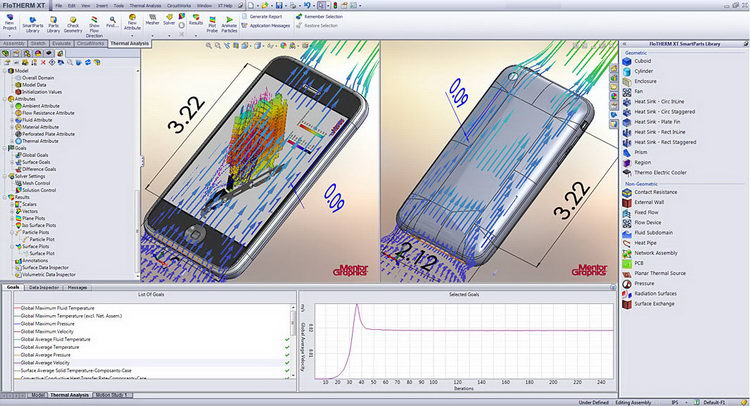
The user experience within Siemens Simcenter FloTHERM is shaped by its focus on streamlining the thermal analysis process for engineers. The interface is structured to guide users through the simulation workflow, from geometry import to results analysis, aiming for efficiency and accuracy.
Key aspects of the user experience include:
- An intuitive graphical user interface (GUI) that organizes simulation tasks logically.
- Features designed to simplify the creation and modification of complex thermal models, often found in electronic assemblies.
- Visualization tools that provide clear and detailed post-processing of simulation results, aiding in the interpretation of thermal behavior and identification of potential issues.
Frequently Asked Questions
What industries can benefit from using Siemens Simcenter FloTHERM?
Siemens Simcenter FloTHERM is particularly beneficial for industries engaged in electronics, where thermal management is critical for ensuring optimal performance and reliability of electronic components. This includes sectors like consumer electronics, automotive, and aerospace.
How does FloTHERM validate thermal simulations for electronics?
FloTHERM employs various validation techniques, including comparing simulation outcomes with experimental data, which helps ensure accuracy in predicting thermal behaviors for complex assemblies.
What file formats does Siemens Simcenter FloTHERM support?
FloTHERM supports an array of file formats including IDF, PADS, and those created by other MCAD systems, allowing easy integration and importation of designs.






Reviews
There are no reviews yet.