

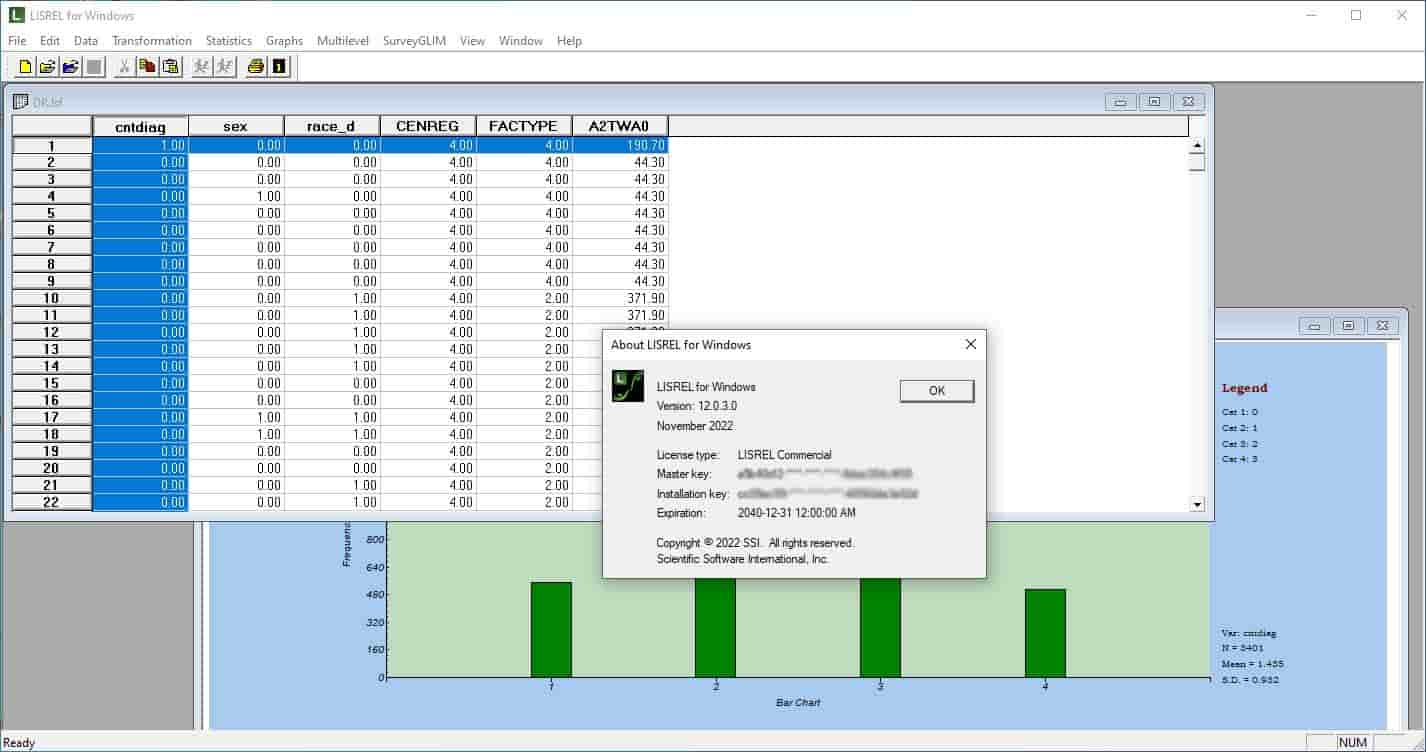
Download LISREL 12.0.3 – Advanced Statistical Analysis Software
LISREL 12.0.3 is an advanced statistical analysis software developed by Scientific Software International, Inc., designed for researchers primarily in the social sciences, academia, and related fields. This powerful application is renowned for its specialized capabilities in structural equation modeling (SEM) and path analysis, enabling users to perform complex statistical analyses and validate theoretical models with precision.
Introduction to LISREL
Overview of Structural Equation Modeling
Structural Equation Modeling (SEM) is a versatile multivariate statistical analysis technique that combines aspects of factor analysis and multiple regression analysis to test complex theoretical models. It allows researchers to analyze complex causal relationships among both observed and latent variables. The ability to simultaneously analyze these variables makes SEM, and by extension LISREL, an indispensable tool for rigorous theoretical and empirical research across various disciplines, particularly those dealing with non-directly measurable constructs.
Key Analytical Capabilities
Type of Analysis Supported
LISREL 12.0.3 offers a comprehensive suite of analytical tools tailored for advanced statistical modeling:
- Structural Equation Modeling (SEM): Enables the estimation and testing of complex relationships between observed and latent variables.
- Confirmatory Factor Analysis (CFA): Facilitates the validation of theoretical constructs by assessing how well specified factor models fit observed data.
- Path Analysis: Allows for the examination of direct and indirect causal effects among a set of variables.
- Covariance Analysis: Provides robust methods for analyzing and estimating covariance structures, forming the foundation for many SEM techniques.
Comparison with Other Statistical Software
While many statistical software packages exist, LISREL distinguishes itself through its specialized focus on structural equation modeling and related techniques. Unlike broader statistical software such as SPSS, which offers a wide array of descriptive and inferential statistics, LISREL is optimized for complex model testing and evaluation. This specialization allows LISREL users to delve deeper into validating theoretical frameworks, assessing latent variables, and performing intricate covariance analysis that might be more cumbersome or less direct in other packages.
Applications in Research and Industry
LISREL 12.0.3 finds extensive application in fields requiring sophisticated analysis of complex relationships and theoretical models. Its capabilities are particularly suited for:
- Social Sciences: Used extensively in psychology, sociology, political science, and organizational behavior to model human behavior, social structures, and individual attitudes.
- Academia and Education: Researchers in education utilize LISREL to study learning processes, student outcomes, and the impact of various pedagogical interventions.
- Medical and Health Research: Applied in epidemiology and public health to understand the complex interplay of factors influencing health outcomes and disease spread.
- Marketing and Consumer Behavior: Employed to analyze consumer decision-making processes and brand loyalty factors.
Unique Features of LISREL 12.0.3
Graphical Representation and Model Validation
LISREL 12.0.3 provides advanced graphical tools essential for interpreting complex models and their results. The software enables users to draw path diagrams that visually represent the theoretical models being tested. This graphical interface aids significantly in the interpretation of complex covariance structures and provides a clear visual aid for model validation, making it easier to identify direct and indirect effects and assess overall model fit. The output includes robust statistical measures for goodness-of-fit indices, enhancing the rigor of research findings.
Real-World Case Studies Using LISREL
Throughout its history, LISREL has been instrumental in numerous significant research projects. For instance, in organizational psychology, LISREL has been employed to validate models of job satisfaction and employee performance, incorporating latent variables such as leadership style and work environment. In educational research, studies have used LISREL to examine the complex relationships between socioeconomic status, school resources, and academic achievement. These applications underscore LISREL’s role in advancing theoretical understanding through empirical validation of intricate hypotheses.
Conclusion and Future of LISREL
LISREL 12.0.3 continues to be a cornerstone for researchers committed to advanced multivariate analysis and structural equation modeling. Its enduring relevance lies in its capacity to handle and test complex theoretical frameworks, which remains critical in fields like psychology, sociology, and education. As statistical methodologies evolve, LISREL’s robust capabilities in covariance analysis and latent variable modeling ensure its continued utility for scholars seeking to validate intricate research hypotheses and contribute empirically grounded insights.
Frequently Asked Questions
What is LISREL used for?
LISREL is primarily used for structural equation modeling, allowing researchers to analyze relationships among observed and latent variables effectively. It is particularly valuable in social sciences for validating theoretical models and conducting path analysis and covariance analysis.
How does LISREL compare to SPSS?
While both LISREL and SPSS are used for statistical analysis, LISREL specializes in structural equation modeling and complex factor analysis, offering advanced capabilities in model testing and evaluation that complement SPSS’s broader functionalities for general statistical analysis.
Can LISREL handle large datasets?
Yes, LISREL is capable of managing large datasets, which makes it suitable for comprehensive research studies and analysis involving multiple variables simultaneously, ensuring robust results for complex analytical tasks.







Reviews
There are no reviews yet.