

Download Esri CityEngine 2025.1 – Advanced Software for 3D Urban Design
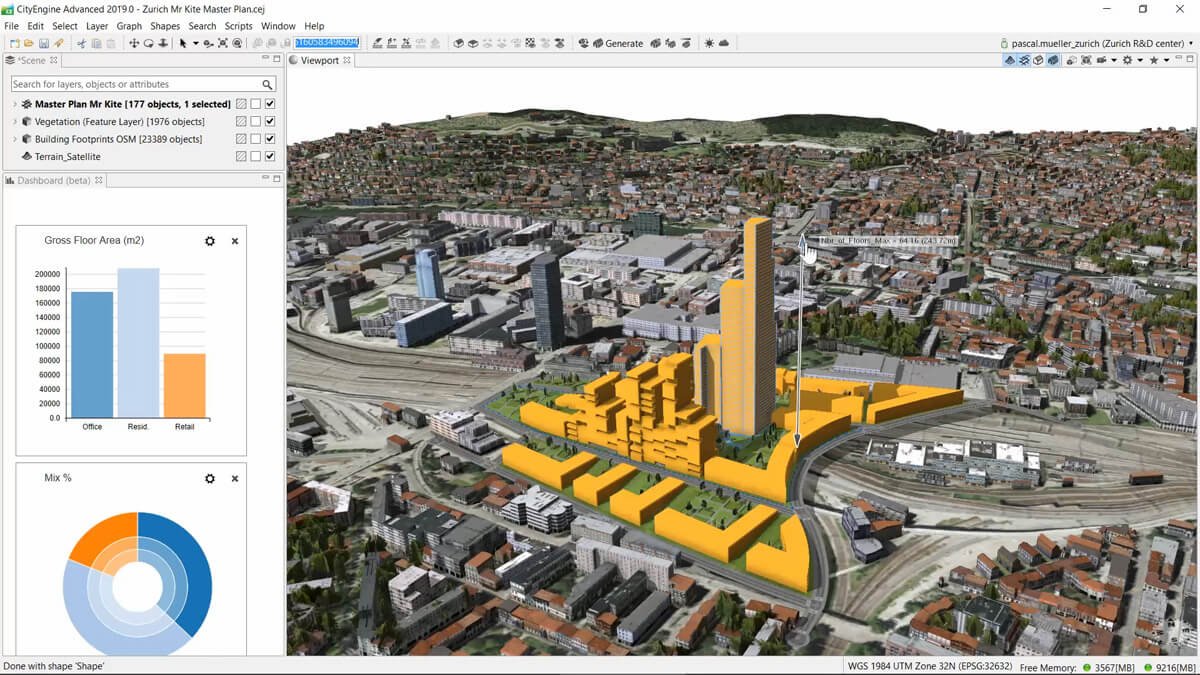
Esri CityEngine 2025.1 is an advanced 3D urban design software developed by Esri, tailored for professionals in urban planning, architecture, urban design, and geographical information systems (GIS). This powerful application facilitates the creation of detailed and realistic 3D city models through its unique procedural modeling approach, making it an indispensable tool for simulating and understanding urban environments.
Overview and Applications of CityEngine
CityEngine is recognized for its capability to generate extensive 3D urban environments using procedural modeling techniques. It is widely adopted in urban planning for cities across the globe, enabling designers and planners to accurately simulate existing and proposed urban landscapes. The software supports a broad array of workflows, from conceptual design to detailed visualization and data analysis, enhancing decision-making processes in urban development projects.
Key Features of Esri CityEngine 2025.1
- Procedural Modeling Capabilities: CityEngine’s core strength lies in its procedural modeling approach, which allows users to define rules and algorithms to generate complex urban structures and features. This method significantly enhances design efficiency and enables rapid iteration of urban layouts.
- ArcGIS Integration: Seamless integration with Esri’s ArcGIS platform allows users to leverage existing GIS data, such as cadastral maps, zoning information, and infrastructure layers, directly within CityEngine. This synergy ensures that 3D city models are georeferenced and contextually accurate for comprehensive urban data management.
- CGA Rules Editor and Python Scripting: The software features a specialized Computer Generated Architecture (CGA) Rules Editor for defining procedural models. Additionally, Python scripting support provides advanced customization options, enabling users to automate tasks, extend functionality, and integrate CityEngine into larger workflows.
- Library of 3D Objects and KML Support: CityEngine includes a comprehensive library of ready-to-use 3D assets, such as buildings, vegetation, and street furniture, which can be incorporated into scenes to enhance realism. It also supports Keyhole Markup Language (KML) for easy data exchange and visualization in applications like Google Earth.
Benefits of Procedural Modeling in Urban Design
Procedural modeling in CityEngine offers a distinct advantage over traditional 3D modeling methods. Instead of manually constructing every element, users define generative rules that dictate how geometry is created, modified, and arranged. This rule-based system allows for the automatic generation of large-scale urban environments with consistent detail and facilitates easy modification of design parameters. Changes applied to the rules can propagate throughout the model, enabling rapid exploration of design alternatives and ensuring that complex urban fabric is produced efficiently and realistically.
Supported File Formats and Interoperability
Esri CityEngine is designed for robust interoperability within the design and GIS ecosystem. It supports a wide range of industry-standard file formats, including CAD formats like DWG and DXF, GIS formats such as Shapefiles and Geodatabases, and common 3D formats like FBX, OBJ, and Collada. Compatibility with KML further enhances its ability to integrate with visualization platforms. This broad file format support ensures that CityEngine data can be easily shared and utilized by other software applications, streamlining collaborative workflows in architecture, engineering, and construction (AEC) projects.
Real-World Applications and Case Studies
- Urban Planning Projects: CityEngine is instrumental in large-scale urban planning initiatives worldwide. For instance, cities use it to visualize proposed developments, assess zoning compliance, simulate traffic flow impacts, and analyze urban sprawl, providing stakeholders with clear 3D representations of complex urban scenarios.
- Architecture and Landscape Design: Architects and landscape designers employ CityEngine for context-aware design, enabling them to place new structures within accurate urban surroundings. This capability helps in understanding the visual impact of a project, optimizing site placement, and ensuring designs harmonize with the existing cityscape or natural environment.
Comparison with Similar Urban Planning Software
Compared to general-purpose 3D modeling software, Esri CityEngine distinguishes itself through its specialized focus on urban environments and its powerful procedural modeling engine. While other 3D urban design tools might offer advanced visualization or direct modeling, CityEngine’s unique strength lies in its ability to generate and manage large-scale urban data procedurally, deeply integrating with GIS workflows. Its direct linkage with ArcGIS provides a level of geospatial data fidelity and analysis capability that is often unparalleled in competing solutions, making it particularly suited for city-scale planning and management.
Frequently Asked Questions
What are the main advantages of using Esri CityEngine for urban planning?
Esri CityEngine provides advanced 3D modeling capabilities using procedural techniques, enabling urban planners to create accurate simulations of city environments. Its integration with ArcGIS enhances data management, while its extensive library of 3D objects streamlines the design process for complex urban planning projects.
How does CityEngine integrate with other GIS tools?
CityEngine is designed to work seamlessly with ArcGIS and supports various GIS data formats, allowing urban designers to utilize geospatial data effectively in their 3D models. This integration empowers users to perform spatial analysis and improve planning outcomes by connecting 3D visualization directly with underlying geographic information.
Can CityEngine be used for environmental simulations?
While CityEngine focuses primarily on urban modeling, its procedural capabilities allow for the integration of landscape features, making it suitable for preliminary environmental simulations related to urban development, such as solar studies or wind flow visualization. However, specialized environmental simulation tools may offer more detailed and comprehensive analyses.





Reviews
There are no reviews yet.