

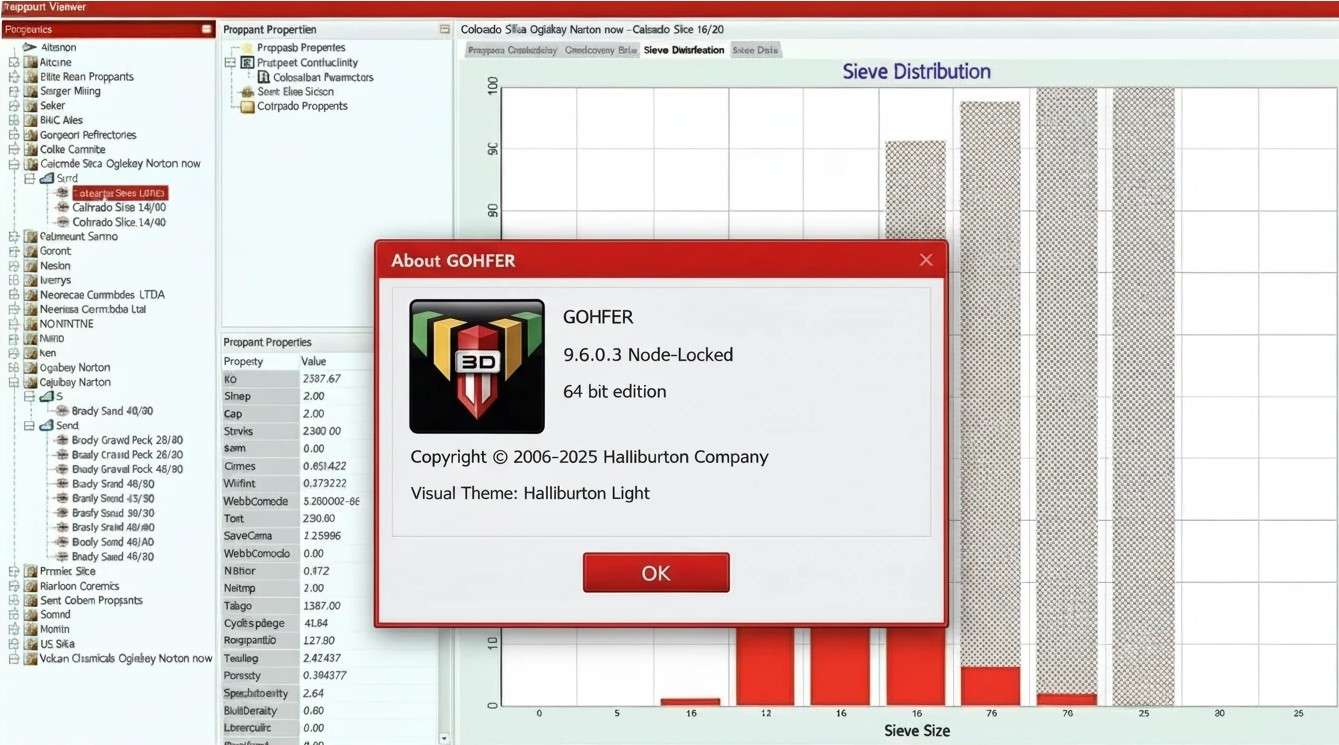
Download GOHFER 9.7 – Advanced Hydraulic Fracture Simulation Software
GOHFER is a specialized hydraulic fracture simulator developed by Barree & Associates, in collaboration with Stim-Lab (a Core Laboratories company). This sophisticated software is designed for the petroleum industry, focusing on advanced modeling of hydraulic fracturing processes within oil and gas reservoirs. It enables engineers to simulate complex geometries and fracture dynamics, making it a crucial tool for reservoir modeling in hydrocarbon exploration and production.
Overview of GOHFER
Introduction to the Software
GOHFER is a leading hydraulic fracture simulator engineered to provide detailed insights into the complex physical processes occurring during hydraulic fracturing operations. Developed through collaboration and extensive validation, the software addresses the intricate interactions between injected fluids and the surrounding rock formations. Its primary purpose is to accurately model fracture propagation, stress distribution, and resulting reservoir behavior, supporting critical decision-making for well stimulation in the oil and gas sector.
Key Features and Capabilities
Fracture Dynamics Modeling
GOHFER excels in simulating the intricate behaviors of hydraulic fractures within geological formations. The software can model the initiation and propagation of multiple fractures, accounting for complex geometries and the influence of natural fractures. It offers detailed analysis of fracture surface area, width, height, and length, providing engineers with a comprehensive understanding of fracture network development.
Fluid and Solid Interaction Analysis
A core capability of GOHFER is its advanced fluid-structure interaction analysis. This feature allows for the simultaneous simulation of fluid flow dynamics within the fractures and the mechanical response of the rock mass. By coupling these phenomena, the software provides a more realistic depiction of how fluid pressure affects fracture opening and propagation, and how the solid mechanics of the formation influence fluid flow, crucial for accurate modeling of fracturing events.
3D Stress Modeling
The software incorporates robust 3D stress modeling capabilities, representing the in-situ stress tensor in three dimensions. This detailed stress analysis is vital for understanding fracture containment, re-orientation, and the potential for creating complex fracture networks. By accurately modeling stress distributions and variations, GOHFER enables more precise predictions of fracture geometry and its impact on reservoir conductivity.
Applications in the Oil and Gas Industry
GOHFER 9.6 finds extensive application across various facets of the oil and gas industry, particularly in unconventional resource development. Professionals utilize it for designing and optimizing hydraulic fracturing treatments in tight gas and oil reservoirs. Case studies often highlight its use in predicting fracture extent and complexity, analyzing proppant transport and placement, and evaluating the effectiveness of different fracturing fluid systems. Furthermore, its ability to model multiple fracture initiations aids in the design of multi-well pad fracturing strategies, optimizing recovery from complex geological formations.
Comparison with Other Simulation Tools
Compared to other fracturing simulation software, GOHFER is distinguished by its explicit modeling of 3D stress tensor distribution and its comprehensive coupling of fluid flow with solid mechanics. While many simulators focus on 2D or simplified 3D representations, GOHFER’s strength lies in its ability to handle complex fracture geometries and interactions across multiple initiation sites, supported by extensive laboratory validation. This makes it particularly valuable for scenarios requiring high fidelity in fracture dynamics and fluid-solid interaction analysis, differentiating it from tools with more generalized approaches.
Future Developments and Research Initiatives
Ongoing research and development efforts related to GOHFER 9.6, often driven by its parent company Core Laboratories, focus on enhancing its predictive capabilities and computational efficiency. These initiatives typically involve refining the algorithms for fluid-rock interaction, improving the simulation of complex fracture network growth, and potentially integrating advanced geomechanical modeling techniques. Continuous validation against laboratory experiments and field data remains a cornerstone of its development, ensuring that the software keeps pace with the evolving demands of the petroleum industry and the scientific understanding of hydraulic fracturing.
Conclusion
GOHFER 9.6 stands as a powerful and indispensable tool for petroleum engineers and geoscientists involved in hydraulic fracturing. Its advanced capabilities in modeling fracture dynamics, fluid-solid interactions, and 3D stress distributions provide critical insights for optimizing well performance and reservoir management. Developed by Barree & Associates and Core Laboratories, GOHFER’s validated approach ensures reliable simulation results, making it a cornerstone for professionals aiming to maximize hydrocarbon recovery through effective fracturing strategies.
Frequently Asked Questions
What is GOHFER and what does it simulate?
GOHFER is a hydraulic fracture simulator that models fluid and solid interactions during the hydraulic fracturing process. It allows engineers to simulate complex reservoir geometries and fracture dynamics, providing detailed insights into how fractures propagate and interact within the reservoir rock.
How does GOHFER compare with other fracturing simulation software?
GOHFER is distinct in its capability to accurately model 3D stress and fracture behaviors, providing insights that many other software options do not support. Its validation through extensive laboratory testing gives it a strong reliability advantage in simulating complex fracture initiation and propagation scenarios.
Can GOHFER handle multiple fracture initiation sites?
Yes, GOHFER can simultaneously model multiple fracture initiation sites, enabling detailed analysis of complex reservoir interactions and performance outcomes. This capability is crucial for understanding the collective impact of staged fracturing in large reservoir volumes.




Reviews
There are no reviews yet.