

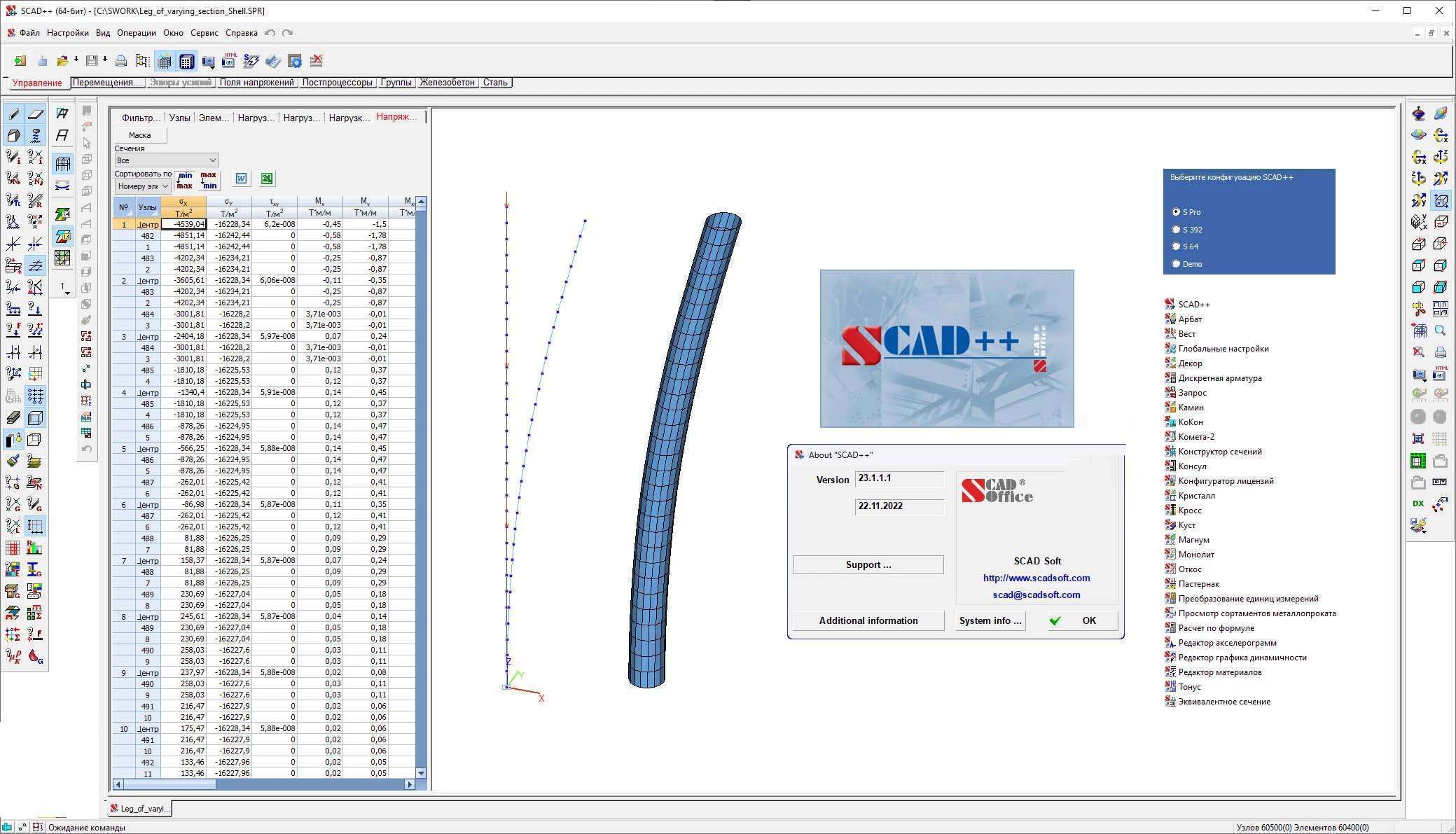
Download SCAD Office 23.1.1.1 – Advanced Software for Structural Design
SCAD Office 23.1.1.1 is a comprehensive software suite tailored for the detailed calculation and design of steel, reinforced concrete, and other structural materials. It serves professionals in structural engineering, civil engineering, and the construction industry, offering integrated solutions for complex design challenges. The software suite is recognized for its continuous evolution, featuring significant improvements in user interface and computing power, alongside its robust analytical capabilities.
Introduction to SCAD Office
Overview of the Software’s Purpose
SCAD Office represents a sophisticated collection of tools designed to streamline the process of structural analysis and design. It aims to provide engineers with a powerful, integrated environment for handling a wide range of structural engineering tasks. With its foundation built on advanced computational methods, SCAD Office supports the creation of reliable and efficient designs for diverse construction projects, from commercial buildings to complex infrastructure.
Key Features and Capabilities
Core Applications within SCAD Office
The SCAD Office suite is comprised of several integral applications, each dedicated to specific aspects of structural engineering. These programs work synergistically to deliver a complete workflow from initial design to final analysis:
- SCAD: The primary application for finite element analysis and structural design of various building types.
- CRYSTAL: Specializes in the design and analysis of steel structures, offering detailed checks and calculations.
- ARBAT: Focuses on the analysis and calculation of complex spatial structures and foundations.
- Verifications Modules: Additional components that perform specific checks and ensure compliance with engineering codes.
Utilization of Finite Element Method (FEM)
Importance and Advantages of FEM in Structural Engineering
At its core, SCAD Office leverages the finite element method (FEM) for its computational engine to perform structural analysis. FEM is a powerful numerical technique that discretizes complex geometries into smaller, manageable elements. This approach allows for highly accurate simulations of how structures behave under various loads and conditions.
The advantages of using FEM in structural engineering include its ability to model intricate shapes, handle varied material properties, and accurately predict stress, strain, and displacement. This makes it indispensable for analyzing the integrity and performance of sophisticated structures, a critical requirement in modern civil and structural engineering projects.
Compliance and Certifications
SCAD Office is notably certified for compliance with a range of significant engineering standards, including various GOST and SNiP regulations. This adherence to established codes is crucial for ensuring the safety, reliability, and quality of engineering designs. These certifications provide end-users with confidence in the software’s outputs, validating that analyses and designs meet rigorous regulatory requirements prevalent in the civil and construction sectors.
Applications in Real-World Engineering Problems
SCAD Office finds extensive application in the design and analysis of critical infrastructure and building projects. Its comprehensive features enable engineers to tackle complex challenges in the construction of various structures.
- Office Buildings and High-Rises: Used for calculating wind loads, seismic activity, and structural integrity of multi-story buildings.
- Bridges and Overpasses: Applied for the analysis of vehicular loads, environmental stresses, and overall structural stability in bridge construction.
- Industrial Facilities: Employed for designing and verifying the robustness of factories, power plants, and other industrial structures subject to heavy operational loads.
Comparison with Other Structural Analysis Tools
Compared to other structural analysis tools, SCAD Office distinguishes itself through the breadth of integrated applications within a single suite and its continuous evolution of user interface and computational abilities. While many software packages focus on specific aspects of analysis, SCAD Office offers a more holistic approach, incorporating multiple specialized programs. Its certification against GOST standards also positions it as a reliable choice for projects requiring strict adherence to specific regional codes, differentiating it further in the competitive landscape of finite element software.
Frequently Asked Questions
What types of structures can I design with SCAD Office?
SCAD Office is equipped to handle the design of a wide array of structures, including steel, reinforced concrete, and wooden structures. Its versatile calculation programs are specifically tailored for each material type, ensuring comprehensive design capabilities for diverse engineering needs.
How does SCAD Office ensure compliance with engineering standards?
The software ensures adherence to rigorous engineering benchmarks through its certification for compliance with GOST standards and other relevant regulations. This commitment to recognized safety and quality benchmarks guarantees that designs meet the demanding requirements of the engineering community.
What is the finite element method and why is it used in SCAD Office?
The finite element method (FEM) is a sophisticated numerical technique employed by SCAD Office to approximate solutions for complex structural problems. By dividing structures into smaller elements, FEM enables the software to conduct detailed structural analyses, ensuring efficiency and accuracy in predicting material behavior under stress and load.




Reviews
There are no reviews yet.