

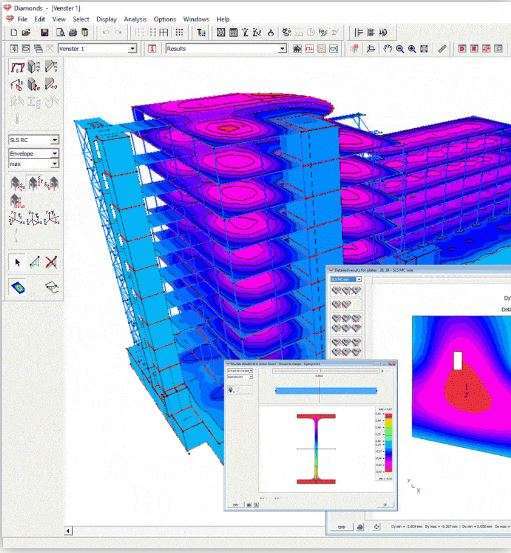
Download BuildSoft Diamonds 2026 – Advanced Software for Structural Analysis
BuildSoft Diamonds 2026 is a specialized finite element analysis software developed by BuildSoft, engineered for the intricate demands of civil engineering and structural design. This powerful application provides structural engineers with advanced tools to perform detailed analyses and designs of various structural components, emphasizing accuracy and productivity with its user-friendly interface.
Overview of BuildSoft Diamonds 2026
Introduction to the Software
BuildSoft Diamonds 2026 serves as a comprehensive solution for structural analysis and design, catering to civil engineers and structural designers. Its primary advantage lies in its robust finite element analysis capabilities, delivering precise results for complex structural challenges. The software is designed to streamline the workflow of engineers, from initial modeling to final verification, ensuring efficiency and reliability in project execution.
Applications in Civil Engineering
This structural engineering tool is primarily utilized in the design and analysis of a wide array of structures. Its application spans across residential, commercial, and industrial construction projects. Key applications include:
- Design and analysis of steel structures, including connections and frameworks.
- Detailed analysis of concrete structures, such as beams, slabs, columns, and walls.
- Assessment and design of timber structures.
- Evaluation of complex 3D structural systems and geometry.
Key Features and Functionalities
Finite Element Analysis Capabilities
At its core, BuildSoft Diamonds 2026 leverages the finite element method (FEM) to conduct sophisticated structural analyses. This method is crucial for understanding how structures behave under various load conditions. The software facilitates detailed structural analysis by:
- Performing complex load combinations and analyses, including static and dynamic loads.
- Conducting buckling verification for stability assessments.
- Calculating precise deflection calculations to ensure serviceability.
- Analyzing stress distribution across different structural elements.
User-Friendly Interface and Modeling Tools
BuildSoft Diamonds 2026 is recognized for its intuitive graphical interface, which simplifies the process of creating complex structural models. The software empowers users with effective modeling tools, allowing for:
- Easy definition of structural geometry and boundary conditions.
- Efficient input of material properties and cross-section data.
- Visual representation of model data, loads, and results.
- Streamlined workflow from conceptualization to detailed design.
Extensibility with Additional Modules
Beyond its core functionalities, BuildSoft Diamonds 2026 offers extensibility through various specialized modules, enabling engineers to address highly specific design requirements. These modules enhance the software’s capabilities to cover advanced analysis scenarios:
- Fire resistance analysis to assess structural performance under elevated temperatures.
- Seismic analysis for designing structures capable of withstanding earthquakes.
- Analysis of moving loads, critical for bridge design and other infrastructure.
- Additional modules for specific material behaviors or structural systems.
Real-World Case Studies
BuildSoft Diamonds 2026 has been instrumental in the successful execution of numerous challenging engineering projects. For instance, its application in the design of complex steel frameworks for high-rise buildings allows engineers to accurately predict behavior under extreme loads and ensure structural integrity. Similarly, intricate concrete bridge designs benefit from the software’s precise analysis of load distribution and material stress, ensuring both safety and optimal material usage. These real-world applications underscore the software’s utility in tackling demanding civil engineering challenges.
Comparison with Other Structural Analysis Tools
When compared to other structural analysis tools, BuildSoft Diamonds 2026 distinguishes itself through a combination of factors tailored to structural engineers. While many finite element analysis software options exist, Diamonds prioritizes an accessible and efficient user experience alongside its robust analytical power. Its key differentiators lie in its streamlined workflow for typical structural engineering tasks, its comprehensive suite of analysis tools focused on steel, concrete, and timber structures, and its extensibility through specialized modules that deepen analytical capabilities without overwhelming the user.
Conclusion
BuildSoft Diamonds 2026 stands as a vital structural engineering tool for professionals seeking precision, efficiency, and reliability in their design analysis work. Its powerful finite element analysis capabilities, coupled with a user-friendly interface and extensibility, make it an indispensable asset for modern civil engineering projects. By enabling engineers to thoroughly analyze and design various structural components, BuildSoft Diamonds 2026 contributes significantly to the safety and innovation in construction.
Frequently Asked Questions
What types of structures can I analyze with BuildSoft Diamonds 2026?
BuildSoft Diamonds 2026 allows users to analyze steel, concrete, and timber structures, including frames, beams, slabs, and more complex 3D structures. It supports a wide range of geometries and load conditions typical in civil engineering projects.
How does the finite element method improve structural analysis in Diamonds?
The finite element method breaks down complex geometries into smaller, manageable parts called elements, allowing for precise calculations of structural performance under various loads and conditions. This detailed discretization enables accurate stress, strain, and deflection predictions, crucial for ensuring structural integrity.
Can BuildSoft Diamonds 2026 integrate with other engineering tools?
Yes, BuildSoft Diamonds 2026 is designed to integrate smoothly with various engineering tools, facilitating a seamless workflow and enhancing collaborative projects in structural design. This compatibility ensures that data can be effectively shared across different stages of the engineering process.


Reviews
There are no reviews yet.