

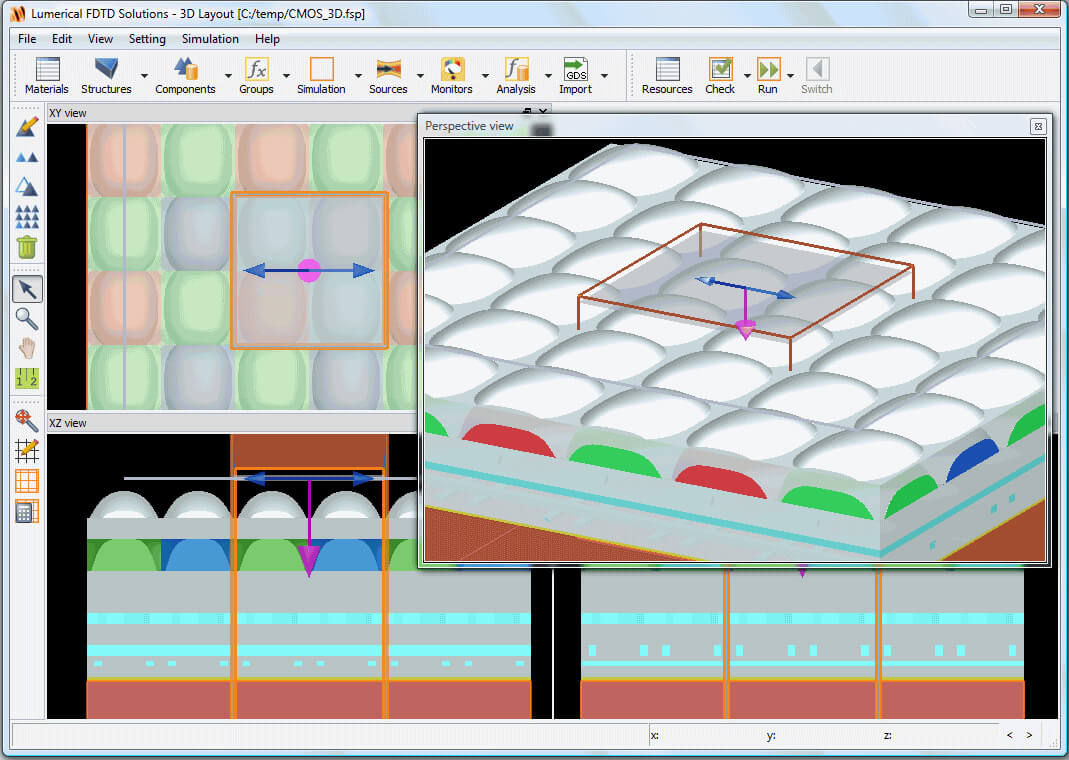
ANSYS Lumerical 2026 R1.2 – Advanced Numerical Simulation Platform for Computational Photonics and Optoelectronic Device Design
Lumerical is recognized as one of the most advanced numerical simulation platforms for computational photonics, developed for modeling light-matter interactions at the nanoscale and designing optoelectronic devices and photonic integrated circuits (PICs) . The software provides a comprehensive suite of electromagnetic, semiconductor, and quantum solvers within an integrated environment and is regarded as an industry standard in optical telecommunications, integrated photonics, sensors, and advanced optoelectronics .
Lumerical enables multiphysics analysis of optical systems using precise numerical methods including Finite-Difference Time-Domain (FDTD), Eigenmode Expansion (EME), Finite Element Method (FEM), and semiconductor Drift-Diffusion equations . This capability allows researchers to simultaneously examine the electromagnetic, electrical, thermal, and quantum response of a structure—an essential feature for designing next-generation nanophotonic devices .
Ansys Lumerical 2026 R1.2 is the latest release of this software, announced on June 26, 2026, offering several significant enhancements across the platform
Primary Users
ANSYS Lumerical 2026 R1.2 is designed for photonics engineers, optoelectronic researchers, semiconductor physicists, and PIC designers who require precise numerical modeling of light-matter interactions at the nanoscale. It serves professionals who:
-
Design passive photonic components including waveguides, grating couplers, MMI splitters, and ring resonators
-
Develop active optoelectronic devices such as lasers, VCSELs, modulators, photodetectors, and optical amplifiers
-
Perform multiphysics analysis that couples optical, electrical, thermal, and quantum effects within a unified environment
-
Conduct photonic integrated circuit (PIC) design with integration into EDA workflows
-
Leverage inverse design via the new lumopt2 Python API for automated device optimization
Main Applications in Photonic Design
The ANSYS Lumerical software suite is widely adopted for its utility in several critical areas of photonic design:
- Integrated Photonics: Facilitates the design and analysis of complex photonic integrated circuits (PICs), enabling the creation of smaller, faster, and more energy-efficient optical devices for telecommunications and computing.
- Laser Design: Supports the simulation of various laser types, allowing for the precise control of optical properties and optimization of performance parameters.
- Photovoltaics: Aids in the development of advanced solar cell technologies by simulating light absorption and charge transport mechanisms, leading to improved energy conversion efficiencies.
- Optoelectronics: Enables the analysis and design of components that interface between electrical and optical domains, crucial for applications like sensors, modulators, and detectors.
Key Features & Capabilities
Solver Portfolio
Lumerical includes a comprehensive set of solver modules for different photonic and optoelectronic design tasks :
| Solver Module | Primary Application |
|---|---|
| FDTD | 3D finite-difference time-domain for nanophotonic devices |
| MODE (varFDTD, EME, FDE) | Waveguide design and propagation analysis |
| STACK | Multi-layer optical thin-film simulation |
| RCWA | Periodic grating structures and metasurfaces |
| CHARGE | Semiconductor transport (drift-diffusion) |
| DGTD | Discontinuous Galerkin time-domain for complex geometries |
| FEEM | Finite element eigenmode solver |
| HEAT | Thermal transport simulation |
| MQW | Multi-quantum well gain modeling |
| VCSEL | Vertical-cavity surface-emitting laser design |
Integrated Multiphysics Workflows
Lumerical provides seamless multiphysics workflows that couple optical, electrical, thermal, and quantum simulations :
-
Electro-Optic Modeling: CHARGE and FDTD/MODE coupling for modulators and photodetectors
-
Thermo-Optic Modeling: HEAT and FDTD coupling for temperature-dependent optical responses
-
Quantum Well Modeling: MQW integration with CHARGE and MODE for active device design
PyLumerical and Automation
Lumerical offers a Python-based API for workflow automation, fully compatible with the PyAnsys ecosystem. It integrates with FDTD, MODE, Multiphysics, INTERCONNECT, and other Ansys tools, enabling simplified multiphysics workflows .
INTERCONNECT and qINTERCONNECT
-
INTERCONNECT: Photonic integrated circuit (PIC) design and system-level simulation environment
-
qINTERCONNECT: Quantum photonic circuit simulation extension
Foundry Compatibility and Layout Integration
Lumerical supports import and export of standard IC layout formats including GDSII, OASIS, and STEP files . The layout geometry wizard (available on Linux) enables importing component layouts from Cadence Virtuoso or Synopsys OptoCompiler™, supporting workflows from Lumerical 2026 R1.2 and OptoCompiler 2026.03-SP1 onwards .
Comprehensive Material Database
Lumerical includes an extensive material library with models for semiconductors, metals, dielectrics, and gain media . Multi-coefficient, broadband, and scriptable material definitions allow accurate modeling of a wide range of photonic materials.
What’s New in Lumerical 2026 R1.2
The 2026 R1.2 release introduces significant enhancements across the Lumerical platform :
New Inverse Design Module: lumopt2
-
A modernized Python API for inverse design, built for greater flexibility, improved usability, faster results, and expanded capabilities
-
Available directly through the PyLumerical installer with a compact scripting interface requiring fewer lines of code than previous versions
-
Built-in classes for mapping arbitrary Lumerical object properties to optimization parameters, including specialized support for closed-curve parameterization in PIC design
-
Custom figure of merit support using the
autogradPython library, combining port mode-coupling efficiency and field intensity results






Reviews
There are no reviews yet.