

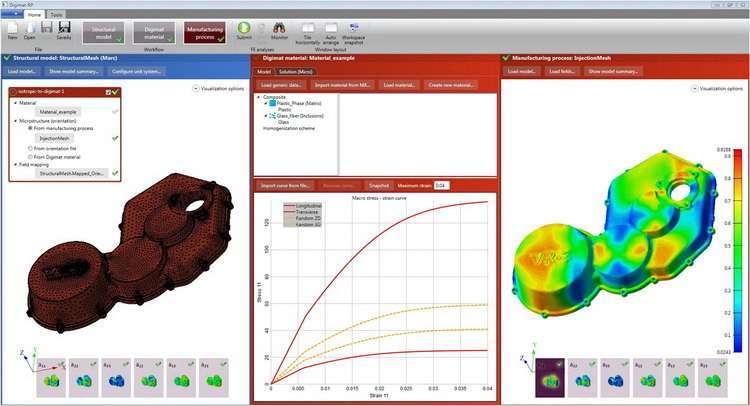
Download MSC Digimat 2025.2 – Advanced Composite Materials Simulation Software
MSC Digimat 2025.2 is a specialized engineering software developed by MSC Software Corporation, designed for the comprehensive simulation of composite materials. It focuses on multi-scale modeling and the analysis of nonlinear micromechanical behaviors. This advanced solution is crucial for engineers and designers across various industries, including aerospace, automotive, and medical device manufacturing, who rely on accurate predictions of material performance.
Introduction to MSC Digimat
Overview and Historical Context
MSC Digimat emerged as a powerful tool for simulating the complex behavior of composite materials. Originally developed by e-Xstream engineering, the software’s capabilities in multi-scale modeling and micromechanical analysis quickly established its importance. Following the acquisition of e-Xstream engineering, MSC Software, a global leader in simulation software, integrated Digimat into its extensive portfolio, further enhancing its reach and development. This evolution has solidified MSC Digimat’s position as an indispensable resource for professionals working with advanced materials.
Applications in the Composite Materials Industry
Target Industries and User Profiles
The intricate nature of composite materials necessitates specialized simulation tools applicable across a wide array of demanding sectors. MSC Digimat provides engineers with the precise analytical capabilities required for these applications.
- Aerospace: Used for designing lightweight yet robust components for aircraft and spacecraft, optimizing structural integrity and fuel efficiency through detailed analysis of composite parts.
- Automotive: Facilitates the development of advanced vehicle structures, enhancing safety and performance by simulating the behavior of composite materials under various stress conditions.
- Medical Devices: Supports the creation of specialized medical equipment and implants where material biocompatibility and mechanical reliability are paramount.
- Industrial Goods & Shipbuilding: Applications include the engineering of durable and high-performance components for heavy machinery and marine vessels.
- Sports Equipment & Trains: Enables the design of innovative and high-strength components for sporting goods and railway applications, focusing on performance and safety.
Key Analytical Capabilities
Multi-Scale Modeling Techniques
MSC Digimat excels in multi-scale modeling, enabling engineers to simulate material behavior across different levels of detail, from the microscopic structure to the macroscopic component. This approach is fundamental to understanding the complex interactions within composite materials.
- Micromechanical Analysis: Mimics the behavior of constituents like fibers and matrices at the micro-level to predict the overall response of the composite material.
- Macroscopic Simulation: Bridges micro-level insights to macro-level performance, allowing for the simulation of parts and structures using standard Finite Element Analysis (FEA) solvers.
- Nonlinear Material Behavior: Accurately captures the complex, nonlinear responses of composite materials under various loading conditions, including plasticity and damage evolution.
- Progressive Damage Modeling: Simulates the initiation and propagation of damage within composite structures, predicting failure modes and material degradation over time.
Features and Tools for Engineers
Integration with FEA structures
The seamless integration of MSC Digimat with established Finite Element Analysis (FEA) workflows is a cornerstone of its utility for engineers. This interoperability ensures that advanced material insights derived from Digimat can be directly applied within broader structural simulations.
- FEA Solver Integration: Works with popular FEA solvers, allowing users to import material models into their existing simulation environments for comprehensive structural analysis.
- Material Model Export: Facilitates the export of detailed, validated composite material models that accurately represent the material’s behavior to FEA software.
- Design Workflow Optimization: Streamlines the design process by reducing the need for extensive physical testing and enabling rapid virtual prototyping of composite components.
- Comprehensive Material Database: Offers access to a wide range of material models and properties, supporting diverse composite materials, including thermoplastics and thermosets.
Performance and Technical Considerations
MSC Digimat is engineered to handle complex simulations, demanding significant computational resources to accurately model the intricate behaviors of composite materials. Its performance is directly tied to the complexity of the multi-scale models and the size of the FEA structures being analyzed.
- Computational Intensity: Advanced micromechanical analyses require substantial processing power and memory to achieve realistic simulation results.
- Parallel Processing: Leverages multi-core processors and parallel computing techniques to accelerate simulation times, making complex analyses more feasible.
- Scalability: Designed to scale from small-scale material testing simulations to large-scale component analyses, adapting to varying project requirements.
- Data Management: Efficiently manages large datasets generated during multi-scale simulations, ensuring data integrity and accessibility for engineers.
Real-World Success Stories
MSC Digimat has been instrumental in driving innovation and efficiency in numerous engineering projects across its target industries. By providing deep insights into composite material performance, it allows for the development of lighter, stronger, and more reliable products.
- Aerospace Component Design: Enabled engineers to design composite airframe structures that significantly reduced overall aircraft weight, leading to improved fuel efficiency and performance.
- Automotive Lightweighting: Supported the development of composite automotive body panels and chassis components, enhancing vehicle dynamics and meeting stringent emissions standards.
- Advanced Medical Implants: Facilitated the simulation of novel composite biomaterials for medical implants, ensuring biocompatibility and long-term mechanical stability within the human body.
- High-Performance Sports Equipment: Contributed to the design of composite components in racing bicycles and athletic gear, optimizing strength-to-weight ratios for elite performance.
Comparison with Competitors
While several software solutions exist for materials simulation, MSC Digimat distinguishes itself through its specialized focus on composite materials and its advanced multi-scale modeling capabilities, a key differentiator in the market.
- Advanced Multi-Scale Analysis: Digimat’s core strength lies in its sophisticated multi-scale approach, offering a more in-depth understanding of composite behavior than tools focused solely on macroscopic analysis.
- Industry Validation: Its robust modeling techniques and algorithms have been validated across numerous industry applications, providing a high degree of confidence in simulation results.
- Integrated Workflow: The ability to connect detailed material behavior directly into FEA workflows streamlines the design and analysis process for engineers working with composites.
- Dedicated Composite Focus: Unlike general-purpose simulation software, Digimat is purpose-built for composites, offering a depth of functionality specifically tailored to the nuances of these materials.
Frequently Asked Questions
What types of materials can be modeled with MSC Digimat?
MSC Digimat is specifically designed for composite materials, focusing on nonlinear micromechanical behaviors in a variety of materials, including plastics and advanced composites used across multiple industries for demanding applications.
How does MSC Digimat integrate with other engineering tools?
MSC Digimat integrates seamlessly with Finite Element Analysis (FEA) tools, allowing users to incorporate complex material models into broader engineering simulations for enhanced design accuracy and a more efficient overall workflow.
In which industries is MSC Digimat commonly used?
MSC Digimat is prevalent in industries such as aerospace, automotive, and medical devices, supporting a diverse range of applications that require precision in composite material simulation for advanced product development.






Reviews
There are no reviews yet.