

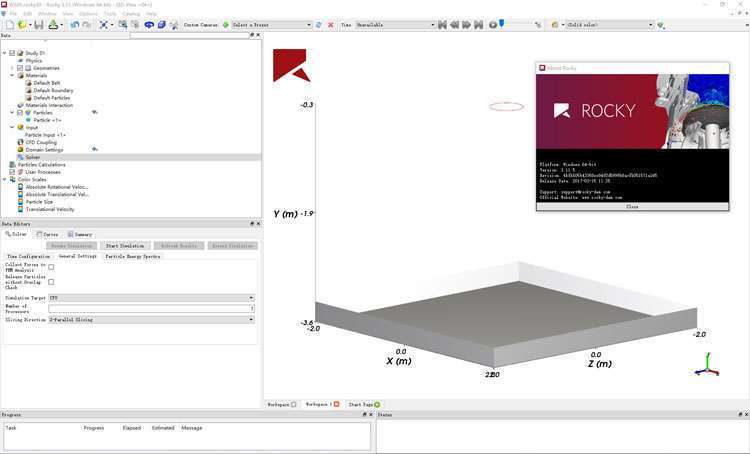
Download ESSS Rocky DEM 2023 – Advanced Particle Simulation Software
ESSS Rocky DEM 2023 is an advanced particle simulation software developed by ESSS, designed for mechanical engineering and manufacturing applications. It specializes in discrete element modeling to analyze the behavior of granular materials, providing critical insights for industries involved in bulk material handling and process simulation. This software aids professionals in understanding complex particle dynamics to optimize designs and operational flows.
Introduction to Rocky DEM
Overview and Purpose
Rocky DEM is a powerful tool for simulating the physical behavior of granular materials. Its core function revolves around discrete element modeling (DEM), allowing engineers to visualize and analyze how individual particles, or collections of particles, interact and move within a system. This makes it an essential application for mechanical simulation software users who need to predict the performance of processes involving powders, grains, or other particulate matter.
Key Features and Capabilities
Multi-Processing and Performance Optimization
A standout feature of Rocky DEM is its advanced multi-processing capability. The software is engineered to harness the power of multiple graphics processing units (GPUs), significantly accelerating simulation times and enabling the analysis of much larger and more complex datasets than traditional CPU-based methods. This optimization is crucial for handling intricate particle dynamics and achieving rapid results in demanding engineering workflows.
Particle Behavior Modeling
Rocky DEM excels at accurately modeling complex particle interactions. It accounts for a wide range of physical phenomena, including gravitational impacts, collisions, friction, and inter-particle forces. Different particle shapes, sizes, and material properties can be defined, allowing for highly customized simulations that reflect real-world scenarios with precision. This detailed approach to particle dynamics is central to its effectiveness in predicting material flow and behavior.
Applications Across Industries
The capabilities of Rocky DEM extend across numerous industrial sectors that rely on the handling and processing of bulk materials. Its precise analysis of particle flow and behavior provides distinct advantages in optimizing designs and preventing operational issues. Key industries benefiting from this technology include:
- Mining and Minerals Processing: Simulating the flow of ore, coal, or other bulk minerals in chutes, feeders, and conveyors to prevent blockages and optimize transport efficiency.
- Pharmaceuticals: Analyzing the behavior of active pharmaceutical ingredients (APIs) and excipients during tableting, blending, or filling processes to ensure product quality and consistency.
- Food Processing: Modeling the movement of grains, powders, or other food particulates in handling equipment to maintain integrity and prevent segregation.
- Chemical Manufacturing: Simulating catalyst flow, powder mixing, and particle attrition in reactors and processing equipment.
- Heavy Equipment Design: Assessing material flow and wear characteristics in components such as augers, spreaders, and mixers.
Real-World Case Studies
Rocky DEM has been instrumental in solving complex engineering challenges across various applications. For instance, simulations have been conducted to optimize the design of bulk material handling systems in mining operations, reducing downtime caused by material bridging and flow issues in hoppers. In the pharmaceutical sector, Rocky DEM has been used to analyze the flowability of powders for tablet presses, ensuring uniform die filling and consistent tablet weight. These case studies highlight the software’s practical utility in achieving tangible improvements in process efficiency and product quality through detailed particle simulation.
Comparison with Other Simulation Tools
While various simulation tools exist for mechanical engineering, Rocky DEM distinguishes itself through its dedicated focus on discrete element modeling and its exceptional performance optimization. Unlike general-purpose engineering simulation software, Rocky DEM is purpose-built to handle the complexities of particle dynamics. Its key differentiator lies in its ability to leverage multi-graphics processing, offering superior speed and capacity for large-scale particle simulations compared to tools primarily relying on traditional CPU processing. This makes it a specialized and highly effective solution for bulk material flow analysis and particle behavior modeling.
Conclusion
ESSS Rocky DEM 2023 stands as a vital tool for modern mechanical and manufacturing engineers requiring precise analysis of granular materials. Its ability to perform detailed discrete element modeling, coupled with significant performance enhancements through multi-processing, enables accurate prediction of particle behavior in complex industrial scenarios. By providing deep insights into bulk material flow dynamics, Rocky DEM empowers professionals to optimize designs, enhance operational efficiency, and ensure product quality across a wide range of industries.
Frequently Asked Questions
What is Rocky DEM used for?
Rocky DEM is utilized for simulating the behavior of granular materials and their flow. It is particularly useful in industries such as mining and pharmaceuticals where understanding particle dynamics is crucial for optimizing material handling processes and predicting system performance.
How does Rocky DEM improve simulation accuracy?
Rocky DEM enhances simulation accuracy by effectively modeling particle interactions under various conditions and forces. Its advanced algorithms account for gravitational impacts, collisions, and material properties, resulting in highly realistic and dependable particle flow simulations.
Can Rocky DEM handle large datasets effectively?
Yes, Rocky DEM supports multi-processing capabilities, allowing users to run simulations with large datasets efficiently through the use of multiple graphics cards. This significantly reduces computation time and enables the analysis of more complex scenarios.






Reviews
There are no reviews yet.