

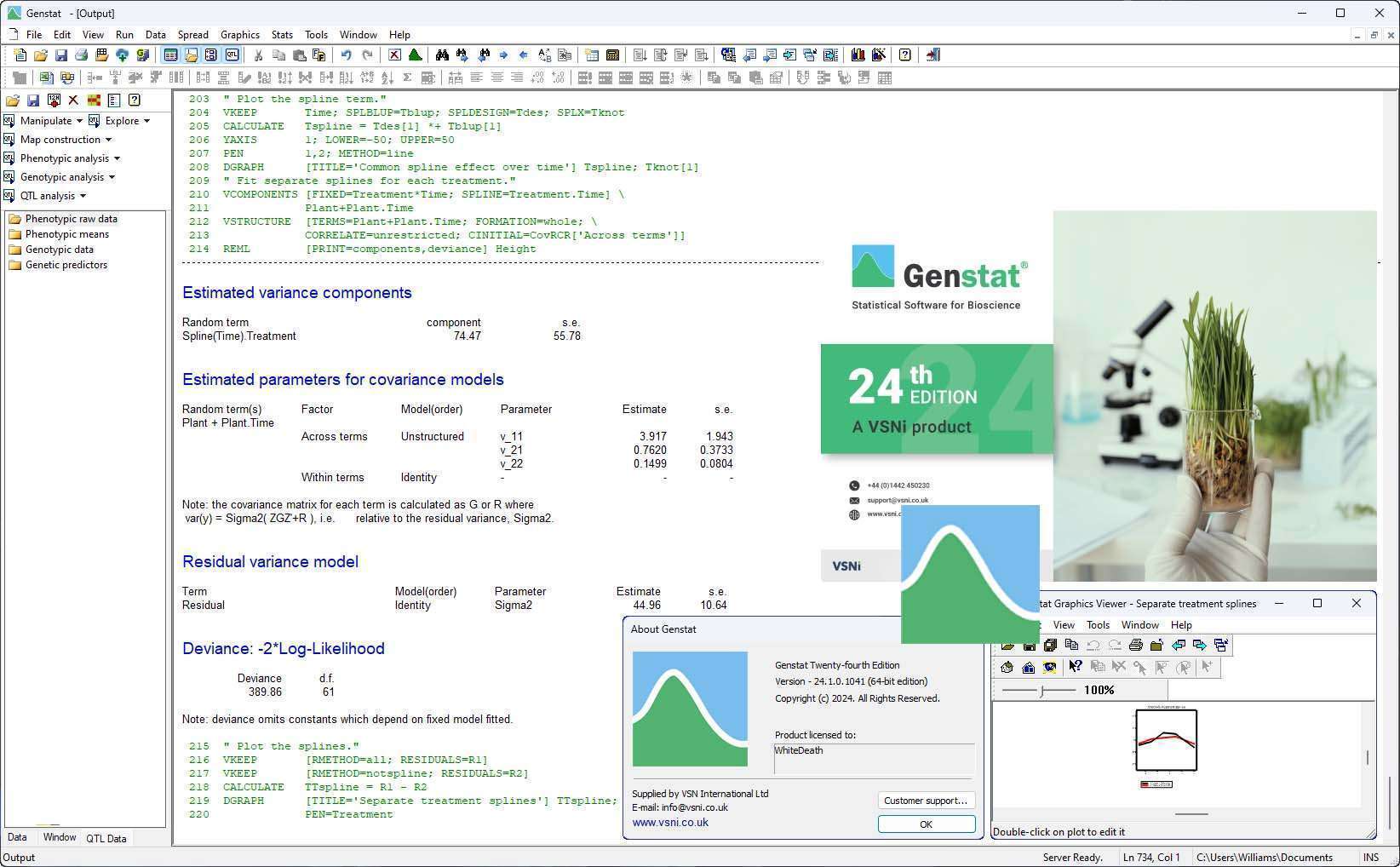
Download Genstat 24.1 – Advanced Statistical Analysis Software
Genstat 24.1 is a powerful statistical software package developed by VSN International (VSNi), designed for comprehensive data analysis. Originally created by Rothamsted Research in 1968, Genstat has evolved to offer extensive capabilities, making it a preferred tool for researchers in agriculture, plant science, forestry, animal science, medicine, and other scientific disciplines. Its modular design and advanced features, including robust linear mixed models and sophisticated graphical functions, support rigorous analysis, particularly in experimental design.
Introduction to Genstat
Genstat is a leading statistical software package renowned for its extensive analytical power and specialized features tailored for scientific research. With a history dating back to its development at Rothamsted Research, Genstat has consistently provided researchers with the tools needed for complex data interpretation. The software is integral to conducting in-depth statistical analysis, enabling scientists to derive meaningful insights from their experimental data across a wide spectrum of research fields.
Comprehensive Statistical Tools and Features
Genstat 24.1 provides a wide array of statistical functionalities crucial for rigorous scientific inquiry. Its design emphasizes both depth and breadth in analytical methods, empowering users to tackle complex datasets and experimental designs with confidence.
ANOVA and Mixed Models Capabilities
At the core of Genstat’s analytical power are its advanced capabilities for Analysis of Variance (ANOVA) and Linear Mixed Models. These tools are essential for analyzing data from complex experimental designs, allowing researchers to account for various sources of variation and fixed or random effects. Genstat facilitates the setup and interpretation of these models, making it a critical component for researchers in fields like agriculture and medicine where precise statistical evaluation is paramount.
Unique Graphical Functions and Data Visualization
Genstat offers a suite of unique graphical functions designed for effective data visualization. These features allow users to create a wide range of plots, from simple scatter plots to sophisticated multi-panel graphs, aiding in the exploration and presentation of data. This emphasis on visualization helps researchers identify trends, outliers, and patterns that might be missed with purely numerical analysis, supporting a more comprehensive understanding of experimental results.
Applications Across Various Research Fields
The versatility of Genstat software makes it an indispensable tool across numerous scientific domains. Its robust statistical capabilities are leveraged by professionals to solve complex analytical challenges specific to their fields.
- In **agriculture and plant science**, Genstat is used for analyzing field trial data, assessing the performance of different crop varieties or treatments, and understanding genetic variations.
- **Animal science and forestry** benefit from Genstat’s ability to analyze large datasets related to breeding programs, growth studies, and resource management.
- In **medicine and clinical research**, the software supports the analysis of trial data, epidemiological studies, and the development of new treatments by providing powerful mixed models analysis.
- Beyond these core areas, Genstat is also applied in various other research settings that require accurate statistical interpretation and data visualization.
Real-world Use Cases and Success Stories
Genstat has been instrumental in driving significant research outcomes. Its specialized functionalities enable researchers to achieve reliable results and advance scientific understanding.
- In agricultural research, Genstat has facilitated the development of improved crop yields by enabling precise analysis of varietal performance trials.
- Clinical researchers have utilized Genstat’s mixed models to conduct robust analyses of longitudinal studies, leading to better insights into disease progression and treatment efficacy.
- Forestry management practices have been enhanced through the application of Genstat for analyzing growth patterns and optimizing resource allocation.
- The software’s granular control over experimental design allows for more accurate data collection and interpretation in complex biological experiments.
Comparative Analysis: Genstat vs. Other Statistical Software
Genstat distinguishes itself from other statistical analysis software through a combination of specialized features and user-centric design, particularly for scientific research applications.
- While many statistical packages offer broad functionality, Genstat excels with its integrated approach to experimental design and robust ANOVA and mixed models analysis, crucial for agricultural and life science research.
- Its graphical capabilities are often highlighted as superior, providing researchers with flexible and powerful tools for data visualization that are tailored to scientific presentation needs.
- Genstat’s modular structure allows for customization and efficient workflow management, catering to experienced statisticians and researchers familiar with complex analytical tasks.
Frequently Asked Questions
What are the key features of Genstat 24.1?
Genstat 24.1 offers a comprehensive suite of statistical tools including ANOVA, mixed models, and advanced graphical functions. It is designed to facilitate rigorous data analysis across various research fields, providing users with powerful options for both data exploration and in-depth statistical modeling.
In which industries is Genstat primarily used?
Genstat is predominantly used in agriculture, plant science, animal science, forestry, and medicine, allowing researchers to conduct detailed statistical analysis relevant to their fields. Its adaptability also supports applications in broader scientific research and data analysis contexts.
How does Genstat assist in experimental design?
Genstat provides sophisticated tools that allow researchers to create and analyze experimental designs efficiently. This ensures that statistical analyses are robust and reliable, assisting in the proper structure and interpretation of experimental data for more accurate scientific conclusions.






Reviews
There are no reviews yet.