

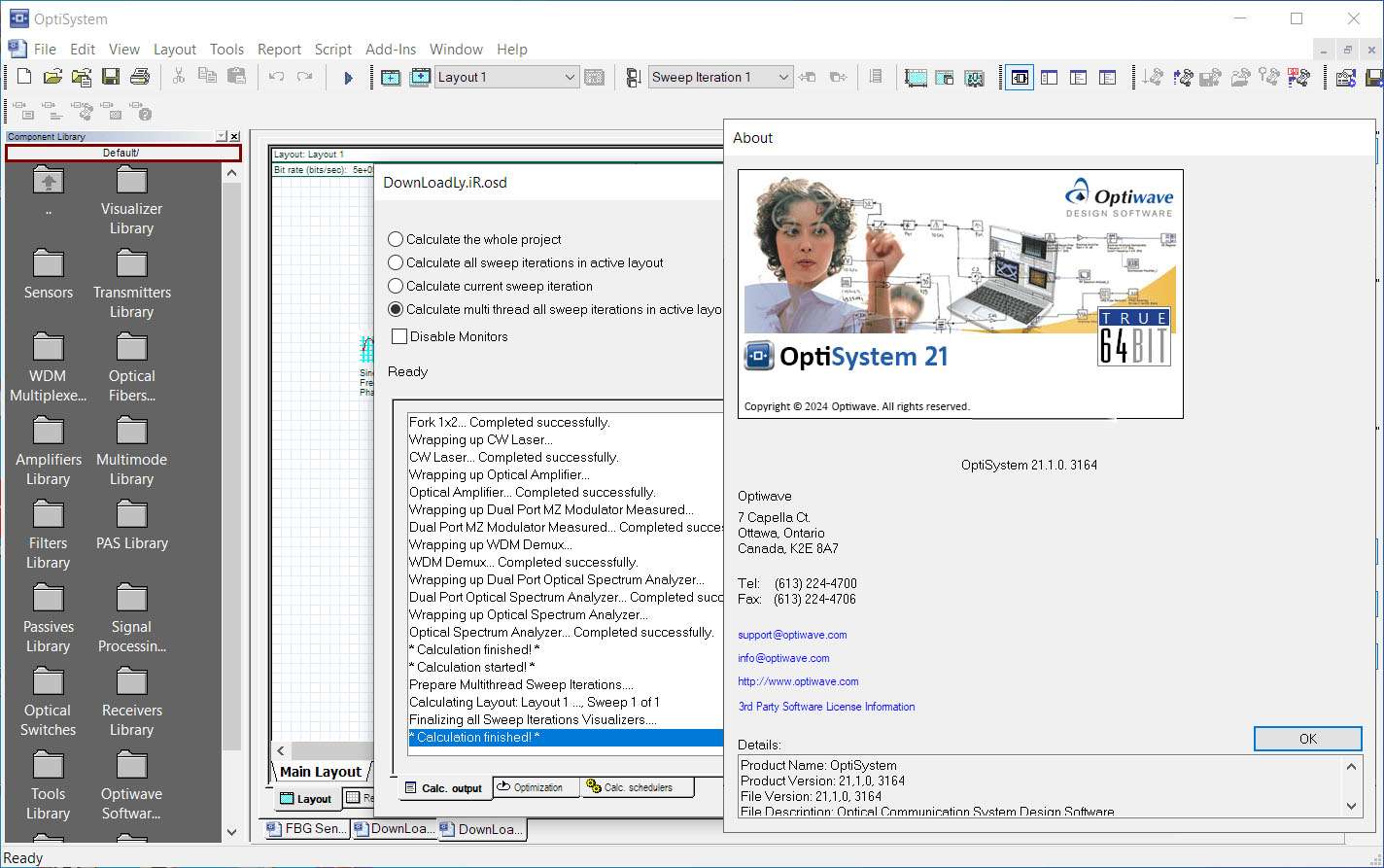
Optiwave OptiSystem 23.1: Complete Optical Communication System Design Software
Optiwave OptiSystem 23.1 is a comprehensive optical communication system simulation package for designing, testing, and optimizing virtually any type of optical link in the physical layer—from analog video broadcasting systems to intercontinental backbone networks . Developed by Optiwave Systems Inc. (founded 1994 in Ottawa, Canada), OptiSystem has evolved over three decades into the industry’s most powerful system-level simulator, built on realistic modeling of fiber-optic communication systems .
Version 23.1 introduces groundbreaking capabilities for emerging applications including quantum communication, LiDAR signal processing, unmanned aerial vehicles (UAVs), and machine learning-enhanced optical network management . The software features an extensive library of over 200 active and passive components, hierarchical design capability, seamless integration with MATLAB and Python, and advanced visualization tools for comprehensive system analysis . Whether designing high-speed transceivers, QKD systems, underwater FSO links, or next-generation 5G networks, OptiSystem delivers the accuracy, flexibility, and efficiency that modern photonic engineering demands.
???? Primary Users
This professional optical communication simulation software is designed for:
-
Optical Communication Engineers & Researchers designing, testing, and optimizing fiber optic communication systems .
-
Telecommunications & Network Architects simulating WDM networks, CATV systems, and long-haul transmission links.
-
Photonics & Optoelectronics Engineers developing optical amplifiers, transceivers, and advanced modulation schemes.
-
LiDAR & Sensor System Designers modeling free-space optics, vibration sensors, and UAV communication channels .
-
Academic Researchers & Educators teaching optical communications and conducting advanced photonic research.
⚡ Key Features & Capabilities
???? Component Library & System Design
Extensive Component Library:
-
Over 200 active and passive component models covering signal generation, transmission, amplification, and reception
-
Optical amplifiers (EDFA, Raman, SOA) including all rare-earth doped materials (Er, Yb, Pr, Tm, Ho)
-
Advanced modulation schemes: mQAM, PAMx, DPSK, mPSK, OFDM, Probabilistic Amplitude Shaping (PAS)
-
Fibers: single-mode, multi-mode, multi-core, dispersion-compensating, and specialty fibers
-
Transmitter components: lasers, modulators, pulse generators
-
Receiver components: photodetectors, filters, DSP blocks
-
Passive components: couplers, splitters, multiplexers, demultiplexers, filters
Hierarchical Design:
-
Drag-and-drop graphical interface for building optical links
-
True hierarchical definition of components and systems
-
Subsystem creation and reuse for complex network modeling
-
Parameterized components with wavelength-dependent characteristics
????️ Advanced Applications & Emerging Technologies
Quantum Communication (QKD):
-
Dedicated components for Quantum Key Distribution (QKD) simulation
-
Binary Sequence Visualizers for QKD (counts of 1s and 0s, matched bits between ports)
-
Support for quantum cryptography and secure communication research
LiDAR & Sensing:
-
New phi-OTDR component for vibration sensors (cascadable)
-
LiDAR signal analysis methods: time-of-flight, phase shift, Frequency Modulated Continuous Wave (FMCW)
-
Sensor modeling for structural health monitoring, intrusion detection, and distributed sensing
UAV & Free-Space Optics (FSO):
-
UAV channel modeling including wavefront evolution and wavefront monitoring
-
FSO weather condition component (wet/dry snow attenuation at different wavelengths)
-
Underwater free-space transmission simulation
-
Temporal and spatial scintillation modeling for atmospheric channels
???? Machine Learning & DSP Integration
Machine Learning Tool:
-
Single and multiple parameter training algorithms
-
Multi-level eye diagrams for enhanced optical communication system management
-
Machine learning-assisted channel equalization and optimization
DSP & Signal Processing:
-
Pre-emphasis component for compensating system limitations due to fiber, ADC/DAC in transceivers
-
Digital Optical Switch component with bit-sequence controlled switching
-
TDECQ Visualizer (Transmitter Dispersion Eye Closure Quaternary) with optimized filter coefficients
-
M-ary Raised Cosine Pulse Generator (non-power-of-two support)
???? Analysis & Visualization Tools
Performance Analysis:
-
Eye diagram analysis (multiple levels, pre/post equalization)
-
Bit Error Rate (BER) calculation and Q-factor estimation
-
Optical and electrical spectra analysis
-
Time-domain waveform visualization
-
Scatter plots and constellation diagrams
Result Management:
-
Dual Port Binary Sequence Visualizer for QKD applications
-
Parameter sweeps and optimization algorithms
-
Monte Carlo simulation for statistical analysis
-
Customizable result displays and export options
???? Interoperability & Scripting
External Tool Integration:
-
MATLAB component – Call MATLAB functions within OptiSystem, or call OptiSystem from MATLAB programs
-
Python Component – Script and extend functionality using Python
-
Co-simulation with Optiwave’s OptiBPM, OptiSPICE, OptiGrating, and OptiInstrument tools
-
VB scripting for project automation and batch processing
User-Defined Components:
-
Create custom components using VB, Python, or MATLAB scripts
-
Define component parameters, results, and layout views
-
Save and share custom libraries across projects
???? Channel Types
-
Single-mode fiber (SMF) with non-linear effects
-
Multi-mode fiber (MMF) support
-
Multi-core fiber (MCF) modeling
-
Free-space optical (FSO) channels
-
Underwater optical channels
-
Terrestrial atmospheric channels with weather conditions
???? Example & Learning Resources
Extensive Example Library:
-
Over 20+ new examples added with major releases
-
Quantum Key Distribution examples
-
LiDAR system design examples
-
5G front-haul and back-haul simulations
-
WDM network design examples
-
Sensor system demonstrations
???? What’s New in Version 23.1
OptiSystem 23.1 builds upon the major innovations introduced in OptiSystem 23.0 (released November 2025) . The 23.x release cycle represents a significant advancement, particularly in emerging technology applications.
Major Features from the 23.x Release:
-
UAV Channel Modeling – Wavefront evolution and wavefront monitoring capabilities for unmanned aerial vehicle communications
-
LiDAR Signal Processing – Three analysis methods: time-of-flight, phase shift, and FMCW
-
Quantum Communication Enhancement – Components and examples for quantum key distribution (QKD) systems
-
Machine Learning Tool Upgrades – Single/multiple parameter training, multi-level eye diagrams
-
phi-OTDR Component – Vibration sensor simulation with cascading capability
-
Pre-emphasis Component – Compensation for fiber and ADC/DAC limitations in transceivers
-
FSO Weather Modeling – Wet and dry snow attenuation calculation at different wavelengths
-
Binary Sequence Visualizer Enhancements – QKD-specific results (1/0 counts, matched bits)
-
Digital Optical Switch – Bit-sequence controlled switching
-
TDECQ Visualizer – Optimized filter coefficient reporting
???? System Requirements
Minimum Requirements
-
OS: Windows 10/11 (64-bit)
-
CPU: Multi-core processor (2.0 GHz or higher)
-
RAM: 8 GB
-
Storage: 5 GB free space (additional for project data)
-
Display: 1280 × 1024 resolution
-
Other: MATLAB Compiler Runtime (MCR) optional, Python 3.x for script components




Reviews
There are no reviews yet.