

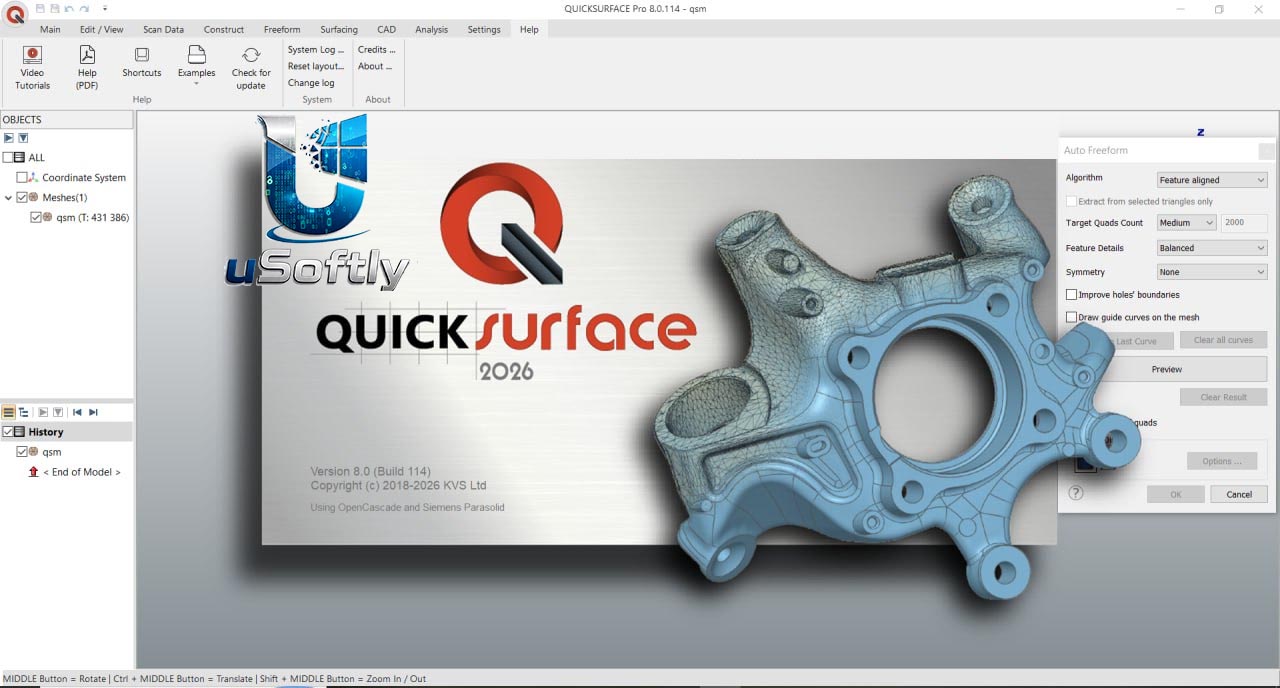
Download QuickSurface Pro 2026 v8.0 – Advanced Reverse Engineering Software for 3D Scan to CAD Modeling
+ Fix Auto Freeform (Powerful 3D Reverse Engineering Software)
QuickSurface QuickSurface Pro 2026 v8.0 is a specialized reverse engineering software developed by Datakit, designed for mechanical engineering and manufacturing professionals. This application expertly converts 3D scanned data, including STL meshes and PTX point clouds, into precise parametric CAD models. It serves as a critical bridge for users in product design, quality control, and reverse engineering workflows involving 3D scanning, enabling the seamless import of scanned data into traditional CAD environments.
Transforming 3D Scanned Data into Precise CAD Models
QuickSurface addresses the fundamental challenge of integrating raw 3D scan data into engineering workflows. Unlike applications that solely offer mesh editing, this software focuses on creating editable, parametric CAD models derived from scanned geometries. Its capabilities are particularly valuable in mechanical engineering and manufacturing sectors, where the accurate representation of physical objects is paramount for design, prototyping, and production. The software aids in enhancing the efficiency of processes that begin with non-CAD data by providing robust conversion and modeling tools.
Comprehensive Parametric and Hybrid Modeling Capabilities
Automatic Surfacing and Free Form Modeling
At its core, QuickSurface offers advanced parametric modeling features tailored for processed 3D scan data. The software supports a hybrid modeling approach, adept at handling both complex organic forms captured by 3D scanners and traditional prismatic shapes characteristic of mechanical designs. Its automatic surfacing capabilities rapidly generate NURBS surfaces from mesh data, significantly reducing manual effort in creating editable CAD geometry.
Dimensioning, Constraints, and Real-Time Deviation Control
Precision is a key aspect of QuickSurface’s functionality, facilitated by its integrated dimensioning and constraint tools. Users can apply geometric constraints to ensure design intent is maintained throughout the modeling process. A critical feature is the real-time deviation control, which allows engineers to monitor and manage the accuracy of the generated surfaces against the original scan data, ensuring models meet stringent quality standards.
Seamless Integration with Major CAD Platforms via Industry-Standard Formats
To ensure efficient downstream use, QuickSurface provides robust export capabilities for standard CAD file formats. The software supports IGES and STEP, industry-accepted protocols for data exchange between different CAD systems. This compatibility allows users to seamlessly import their converted and modeled data into popular CAD applications, such as SolidWorks, facilitating integration into established design and manufacturing pipelines without data loss or translation issues.
Essential Tools for Efficient Scan Data Preparation and Editing
Mesh Realignment and Geometric Primitive Extraction
Preparing raw scan data is often a prerequisite for effective modeling. QuickSurface includes tools for mesh realignment, helping to orient and clean up scanned data for better surface generation. Furthermore, the software can automatically extract basic geometric primitives like planes, cylinders, and cones directly from point cloud or mesh data. This function simplifies complex geometries, forming a foundation for more detailed parametric modeling and reducing the time required for manual reconstruction.
Advanced CAD Operations: Boolean, Trimming, Filleting, and Patterns
Beyond basic surfacing, QuickSurface offers a suite of advanced CAD operations that enable users to refine and finalize their models. These include robust Boolean operations for combining or subtracting solid bodies, trimming surfaces, applying fillets to soften edges, and creating patterns for repeatable features. These tools provide a comprehensive set of functionalities typically found in dedicated CAD modeling software, directly within the reverse engineering environment.
Application Examples in Mechanical Engineering and Manufacturing
QuickSurface finds extensive application across various engineering disciplines. Some primary use cases include:
- Reverse Engineering Legacy Parts: Recreating CAD models for components where original design data is lost or unavailable, ensuring continuity in production and maintenance.
- Product Design and Iteration: Capturing existing product geometries to inform new design iterations or modifications, leveraging scanned data for rapid prototyping and design exploration.
- Quality Inspection and Comparison: Generating precise CAD models from scanned parts to perform accurate comparisons against original design specifications, identifying deviations and ensuring quality control.
- Tooling and Mold Design: Utilizing scanned data of existing molds or tools to design new ones or make modifications, streamlining the manufacturing process.
Frequently Asked Questions
How does QuickSurface handle the conversion of 3D scan data to parametric CAD models?
QuickSurface employs hybrid parametric modeling techniques that merge automatic surfacing with free form modeling capabilities. This allows it to effectively convert raw STL meshes or PTX point clouds into fully editable CAD models. The software also incorporates real-time deviation control, ensuring that the accuracy of the resulting CAD model closely matches the original scanned data.
Which CAD file formats can QuickSurface export for downstream engineering use?
QuickSurface supports exporting CAD models in widely recognized standard formats, including IGES and STEP. These formats are essential for ensuring smooth data exchange and integration with virtually all major CAD systems, such as SolidWorks, on which many engineering teams rely for their design and analysis workflows.
What industries benefit most from QuickSurface’s reverse engineering tools?
The primary beneficiaries of QuickSurface’s advanced reverse engineering tools are found within mechanical engineering, manufacturing, and product design sectors. It is also extensively used in quality control departments where 3D scanning is integral to capturing complex part geometries for replication, analysis, or enhancement.






Reviews
There are no reviews yet.