

Download Rocscience RS2 2026 – 2D Finite Element Geotechnical Analysis Software
Rocscience RS2 is a specialized 2D finite element analysis (FEA) software developed by Rocscience Inc. for geotechnical and civil engineering professionals. It is designed to analyze stress, deformation, and stability in various surface and underground excavations. Within the Rocscience suite, RS2 serves as a critical tool for engineers tackling complex geological challenges in sectors like civil engineering, mining, and tunneling.
Overview of Rocscience RS2 and Its Role in Geotechnical Engineering
Rocscience RS2 is a leading 2D finite element analysis application tailored for geotechnical engineering. It provides engineers with the tools to simulate and analyze the behavior of soil and rock under various loading conditions. Its applications span the design and assessment of tunnels, slopes, dams, and other excavations, making it indispensable for ensuring the safety and efficiency of civil engineering and mining projects. As part of Rocscience’s integrated software solutions, RS2 facilitates a seamless transition to 3D analysis using RS3 where necessary.
Advanced Finite Element and Seepage Analysis Capabilities
RS2 employs advanced finite element methods to accurately model stress distribution and deformation in complex geological materials. The software allows for sophisticated analyses of material behavior, including plasticity and creep, under static and dynamic loads. Furthermore, its comprehensive seepage analysis capabilities enable engineers to model transient and steady-state groundwater flow through various geotechnical structures. This is crucial for understanding pore water pressure effects on stability, infiltration through dams, and groundwater drawdown in excavations.
- Finite element formulations for stress and deformation analysis.
- Modeling of soil and rock properties, including anisotropy and heterogeneity.
- Simulation of staged excavation and construction sequences.
- Transient and steady-state groundwater seepage analysis.
- Pore water pressure and effective stress calculations for stability assessments.
Modeling Slope Stability and Support Systems
A key strength of Rocscience RS2 lies in its robust slope stability analysis features. The software incorporates automated methods, such as the shear resistance reduction technique, to efficiently identify critical failure surfaces and calculate the factor of safety for slopes. RS2 also offers extensive options for modeling various geotechnical support systems. This allows engineers to simulate the performance of practical reinforcement measures, crucial for managing excavation risks.
- Automated slope stability analysis using shear resistance reduction methods.
- Calculation of factors of safety and identification of failure mechanisms.
- Modeling of sprayed concrete (shotcrete), geotextiles, and geosynthetic liners.
- Simulation of reinforcement elements like rock bolts, soil nails, and piles.
- Analysis of retaining structures, including walls and cribs.
Application for Surface and Underground Excavation Projects
RS2 is extensively utilized for analyzing both surface and underground excavations across various industries. In civil engineering, it aids in the design of foundations, tunnels, and retaining walls. For the mining sector, RS2 is applied to assess the stability of open-pit slopes and underground mine openings, including cut-and-fill stopes and block caving operations. The software’s ability to model staged construction is vital for simulating the complex realities of excavation processes.
- Analysis of open-pit mine benches and overall slope stability.
- Modeling of tunnel lining and reinforcement for underground transportation systems.
- Assessment of excavation sequences and their impact on surrounding ground.
- Design of stabilizing structures for deep excavations and levees.
- Stability analyses for dams, including embankment and concrete structures.
Integration with Rocscience RS3 and Project Continuity
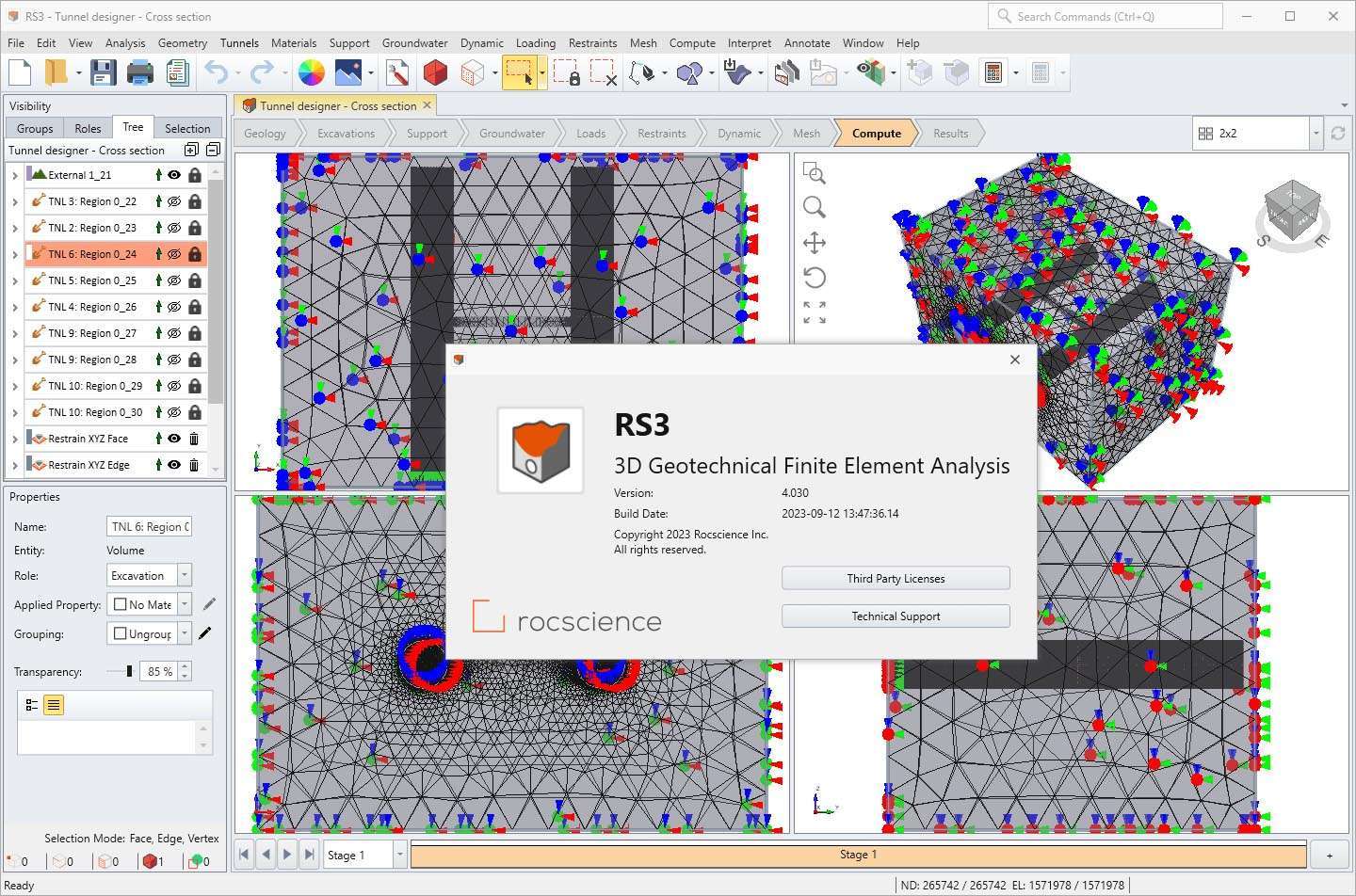
Rocscience RS2 is designed for seamless integration with RS3, Rocscience’s 3D finite element analysis software. This synergy allows engineers to transition from a 2D analysis in RS2 to a full 3D model in RS3 by simply extruding the 2D geometry. This capability facilitates a comprehensive geotechnical workflow, enabling detailed 3D analyses, complex mesh generation, and advanced dynamic simulations, while maintaining project data integrity throughout the process.
Technical Advantages and Industry Relevance
Rocscience RS2 is recognized for its precision in geotechnical analysis and its user-friendly interface. Features such as dynamic deformation scaling allow for clear visualization of analysis results, while local coordinate systems aid in modeling complex geometries. The software’s robust analytical capabilities and reliable results have led to its widespread adoption and acceptance in engineering projects globally, meeting rigorous industry standards for safety and performance analysis.
- High precision in simulating geotechnical behaviors.
- Intuitive graphical user interface for efficient modeling.
- Advanced visualization tools, including deformation scaling and contour plotting.
- Support for multiple material models and constitutive laws.
- Global acceptance and application in consultancy and project engineering.
Common Project Types Suitable for RS2
Rocscience RS2 is an essential tool for a range of geotechnical and civil engineering projects. Its specialized features make it particularly well-suited for analyses requiring detailed 2D finite element modeling of geological materials and structures.
- Tunnel design and support assessment for transportation and utility corridors.
- Slope stability reassessment and remediation planning for existing and new embankments.
- Dam seepage analysis and control strategies for water retention structures.
- Mining excavation safety assessments in open-pit and underground environments.
- Civil infrastructure planning, including bridge abutments and large excavations.
- Retaining wall design and analysis for construction projects.
Frequently Asked Questions
How does Rocscience RS2 assist in slope stability analysis?
Rocscience RS2 employs the shear resistance reduction method to automate slope stability analysis. This technique systematically identifies critical failure surfaces within the soil or rock mass and calculates the slope’s strength reduction factor, enabling engineers to precisely assess slope safety margins.
Can RS2 model groundwater flow in excavation projects?
Yes, RS2 includes dedicated seepage analysis tools that effectively model groundwater flow through various geotechnical structures such as dams, slopes, tunnels, and excavations. This capability helps engineers evaluate the critical impact of water on overall geotechnical stability and design effective dewatering or drainage systems.
What types of support structures can be modeled in RS2?
RS2 supports the modeling of a variety of essential geotechnical reinforcement and support elements. These include sprayed concrete (shotcrete), geotextiles, geosynthetic liners, rock bolts, soil nails, and piles, allowing for accurate simulation of how these elements contribute to the stability of slopes and excavations.



Reviews
There are no reviews yet.