

Download Crosslight APSYS 2025 – Advanced Semiconductor Device Simulation Software
Crosslight APSYS 2025 is a specialized TCAD (Technology Computer-Aided Design) software developed by Crosslight Software Inc., focusing on the advanced physical modeling of compound semiconductor devices. It leverages 2D and 3D finite element analysis to simulate electrical, optical, and thermal phenomena simultaneously, making it an essential tool for professionals in semiconductor device design, research, and manufacturing. This software plays a crucial role in fields such as optoelectronics, LED/OLED technology, solar cell development, and academic research in semiconductor physics.
Overview of Crosslight APSYS for Semiconductor Device Modeling
Originating from the National Research Council of Canada (NRC), Crosslight Software Inc. has established itself as a key provider of TCAD solutions. APSYS is a core offering within their suite, distinguishing itself by focusing on the complex physics of non-laser compound semiconductor devices. Unlike tools specialized for laser diodes or process simulation, APSYS is engineered to handle the intricate interplay of electrical, optical, and thermal characteristics within a single simulation environment. This comprehensive multi-physics approach ensures that designers can gain a holistic understanding of device behavior from the fundamental physical level.
Multiphysics Simulation Capabilities with Quantum and Band Structure Models
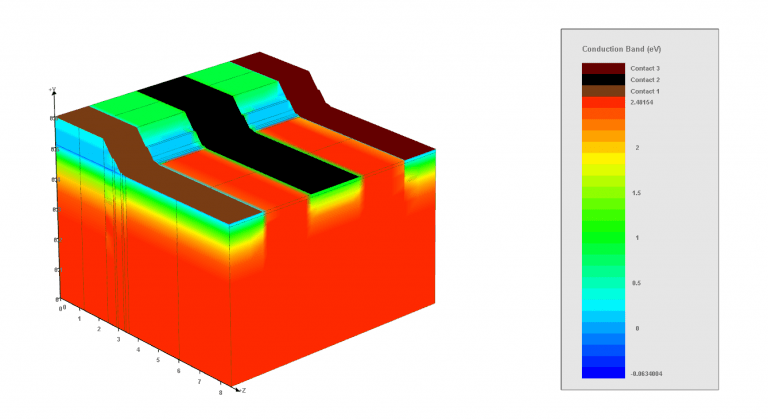
APSYS employs sophisticated numerical methods, including finite element and finite difference time domain techniques, to perform accurate 2D and 3D device simulations. Its capabilities extend to advanced physical modeling, enabling the incorporation of quantum mechanical effects and detailed band structure engineering. The software supports a wide array of physical models, such as:
- Drift-diffusion and hydrodynamic models for charge transport
- Heat transfer models for thermal management
- Quantum transport models for nanoscale devices
- Optical simulation models for light interaction
This robust framework allows for the simulation of complex physical phenomena, crucial for developing next-generation semiconductor devices.
Extensive Device and Material Libraries for Diverse Semiconductor Applications
Crosslight APSYS 2025 boasts extensive libraries that significantly enhance its versatility across various semiconductor technologies. The software is adept at simulating a broad spectrum of devices, including:
- Light-Emitting Diodes (LEDs, OLEDs, AMOLEDs)
- Solar Cells (organic, hybrid, multi-junction)
- Photodetectors
- Transistors (HEMT, HBT, MOSFET, GaN-based)
- Power Semiconductor Devices
- Electro-absorption Modulators
Complementing its device support, APSYS includes comprehensive databases of semiconductor materials, facilitating accurate modeling of compound semiconductors and alloys. This extensive material coverage, combined with advanced physical models, empowers engineers to design and analyze devices with high precision.
Typical Simulation Outputs and Industrial Validation
APSYS provides a rich set of simulation outputs, offering deep insights into device performance and behavior. Key results include:
- Electrical characteristics such as IV curves and AC parameters
- Spatial distributions of electric potential, fields, and carrier concentrations
- Thermal analysis, including heat maps and temperature profiles
- Optical field distributions and light propagation analysis
- Quantum mechanical properties like subband structures within quantum wells
- Transient simulations to analyze dynamic device responses
The software’s advanced convergence algorithms and numerical precision ensure results that are validated against industrial standards, making it a reliable tool for both research and product development.
Integration and Comparison within Crosslight’s Semiconductor Simulation Suite
Crosslight offers a comprehensive suite of TCAD tools, each specialized for particular device types. While APSYS excels in the multi-physics simulation of general semiconductor devices like LEDs, solar cells, and transistors, other tools within the suite serve distinct purposes. LASTIP is optimized for the simulation of quantum well laser diodes, focusing on optical emission characteristics. PICS3D provides advanced 3D modeling capabilities for optoelectronic laser devices. APSYS complements these tools by offering deep physical insights into a wide range of compound semiconductor devices not covered by laser-specific simulators.
Educational Resources and Practical Use Cases Included in APSYS 2025
Crosslight APSYS 2025 is bundled with a range of educational resources designed to facilitate user learning and accelerate development cycles. These resources include pre-configured simulation projects for common device types such as LEDs and solar cells, along with comprehensive tutorial videos and documentation. These materials are invaluable for academic users performing research and for industry professionals seeking to quickly master the software’s capabilities for specific applications, enabling a faster path from design to validated device prototypes.
Real-World Applications of APSYS in Semiconductor Industry and Research
The advanced simulation capabilities of APSYS find direct application in critical areas of the semiconductor industry and academic research. Professionals utilize APSYS for the meticulous design and optimization of high-efficiency LEDs and OLEDs, the development of next-generation solar cells with improved energy conversion efficiencies, and the creation of advanced photodetectors. In power electronics, APSYS aids in designing robust power semiconductor devices capable of handling high voltages and currents. Its precise modeling of complex physics makes it an indispensable tool for R&D teams aiming to push the boundaries of semiconductor technology and for academic institutions exploring fundamental semiconductor physics.
Frequently Asked Questions
What types of semiconductor devices can be simulated with Crosslight APSYS 2025?
Crosslight APSYS 2025 supports the simulation of a wide range of semiconductor devices including LEDs, OLEDs, AMOLEDs, organic and multi-junction solar cells, photodetectors, various transistors like HEMT and MOSFETs, power devices such as GaN-based components, and electro-absorption modulators.
How does APSYS handle multi-physics simulation for semiconductor devices?
APSYS simultaneously models electrical, optical, and thermal phenomena using finite element and finite difference methods in 2D and 3D, incorporating band structure engineering and quantum mechanical effects to provide comprehensive simulation results.
How is Crosslight APSYS different from other semiconductor simulation tools like LASTIP or PICS3D?
APSYS is specialized for non-laser semiconductor devices such as LEDs, solar cells, and transistors, focusing on simultaneous multi-physics modeling, whereas LASTIP targets quantum well laser diodes and PICS3D specializes in 3D modeling of optoelectronic laser devices.







Reviews
There are no reviews yet.