

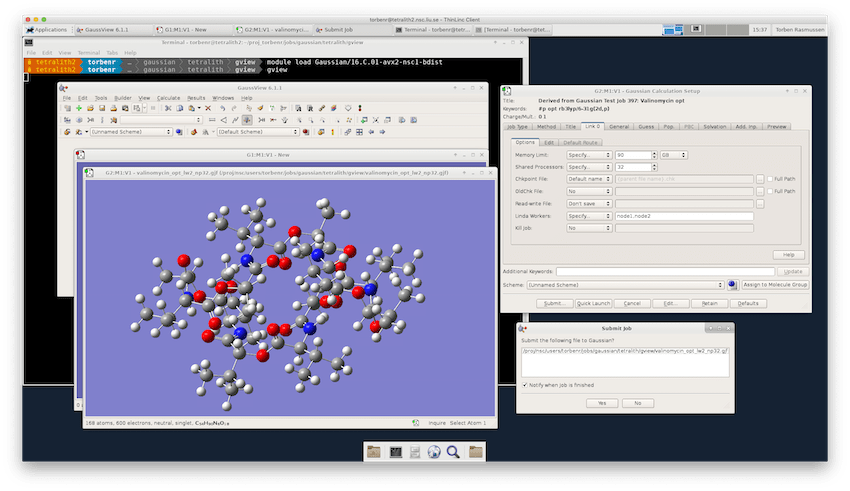
Download GaussView 6.1.1 – Advanced Molecular Visualization for Gaussian Software
GaussView 6.1.1 is a specialized graphical user interface developed by Gaussian, Inc. It serves as an essential companion to the Gaussian computational chemistry suite, greatly simplifying the preparation, execution, and analysis of complex electronic structure calculations. This molecular visualization software is crucial for researchers and scientists in computational chemistry, materials science, pharmaceutical R&D, and academic molecular modeling who require precise control and intuitive interpretation of quantum chemistry data.
Overview of GaussView and Its Role in Computational Chemistry
GaussView functions as an intuitive front-end for the powerful Gaussian computational chemistry package. Its primary role is to bridge the gap between complex numerical calculations and user-friendly visual interaction. By providing a graphical environment, GaussView empowers chemists and material scientists to build molecular structures, define calculation parameters, and explore the resulting data without needing to manually construct intricate input files or parse extensive numerical outputs. This significantly enhances workflow efficiency for individuals engaged in molecular modeling and quantum chemistry studies.
Building and Visualizing Molecular Structures with GaussView
The software offers a robust toolkit for molecular construction and manipulation. Users can employ intuitive drawing tools to assemble molecules atom by atom, defining bonds and molecular geometry with precision. GaussView enables interactive 3D viewing, allowing for seamless rotation, zooming, and navigation of molecular models. The interface supports a wide range of molecular elements and provides functionalities for detailed structure editing, ensuring that precise starting geometries can be easily created for computational analysis.
Setting Up Gaussian Calculations via GaussView
GaussView streamlines the creation of input files for Gaussian, the underlying computational engine. The interface provides guided options for setting up various types of calculations, including essential tasks such as energy minimization to find stable molecular geometries, vibrational frequency analysis to determine molecular stability and spectral properties, and more advanced computations. This simplifies the process of defining calculation keywords, charge and spin multiplicity, and solvent models, making complex quantum chemistry simulations more accessible.
Graphical Analysis of Computational Chemistry Results
Upon completion of Gaussian calculations, GaussView excels at transforming numerical output into comprehensible graphical representations. This feature is vital for interpreting the outcomes of sophisticated simulations.
Molecular Orbitals, Electron Densities, and Optimized Structures
GaussView allows for the visualization of key quantum mechanical concepts, such as molecular orbitals and electron densities. Users can view electron density maps and visualize the shape and energy levels of molecular orbitals. Furthermore, optimized molecular structures derived from calculations are displayed graphically, showing geometric changes and conformational pathways.
Spectral Data Visualization: IR, Raman, VCD, and Magnetic Properties
The software provides the capability to visualize various types of spectral data generated by Gaussian. This includes graphical representations of Infrared (IR), Raman, and Vibrational Circular Dichroism (VCD) spectra, aiding in the identification and characterization of molecules. Visualization of magnetic properties and related data is also supported, contributing to a comprehensive analysis of molecular behavior.
Data Plotting and Electrostatic Potential Mapping
GaussView enhances data interpretation through advanced plotting functionalities. Users can generate plots of various calculated properties, facilitating the analysis of trends and relationships. Additionally, electrostatic potential maps can be rendered, illustrating the distribution of partial charges across the molecular surface, which is critical for understanding chemical reactivity and intermolecular interactions.
Integration and Compatibility with Gaussian Software
The synergy between GaussView and Gaussian software is fundamental to its utility. GaussView is designed for seamless integration, acting as a direct interface to the Gaussian computational engine. It supports common file formats used by Gaussian, ensuring a smooth workflow from input preparation to result visualization. This tight coupling enables researchers to efficiently manage their computational chemistry projects, moving fluidly between building structures, running calculations, and analyzing outputs.
Typical Use Cases in Research and Industry
GaussView finds extensive application across academic and industrial research environments. In academic chemistry research, it is employed for studying reaction mechanisms, predicting spectroscopic properties, and exploring fundamental molecular behaviors. In the pharmaceutical industry, it assists in the design and optimization of drug candidates by modeling molecular interactions and predicting pharmacokinetic properties. Materials science researchers utilize GaussView for simulating and understanding the properties of novel materials, such as polymers, catalysts, and nanomaterials, contributing to the development of advanced technologies.
Frequently Asked Questions
What is GaussView used for in computational chemistry?
GaussView is a graphical interface that allows users to create molecular structures, set up Gaussian calculation inputs, and visualize the numerical results as graphs and 3D models. It streamlines the process of quantum chemistry computations, making complex simulations more manageable for researchers.
Which types of molecular properties can I visualize using GaussView?
GaussView supports visualization of molecular orbitals, electron density maps, optimized molecular structures, vibrational spectra like IR, Raman, and VCD, atomic charges, and electrostatic potentials, enabling comprehensive molecular analysis.
How does GaussView interact with the Gaussian software?
GaussView serves as a user-friendly graphical front-end to Gaussian, enabling easier input preparation and providing graphical visualization of Gaussian’s computational results, enhancing workflow efficiency between modeling and calculation.






Reviews
There are no reviews yet.