

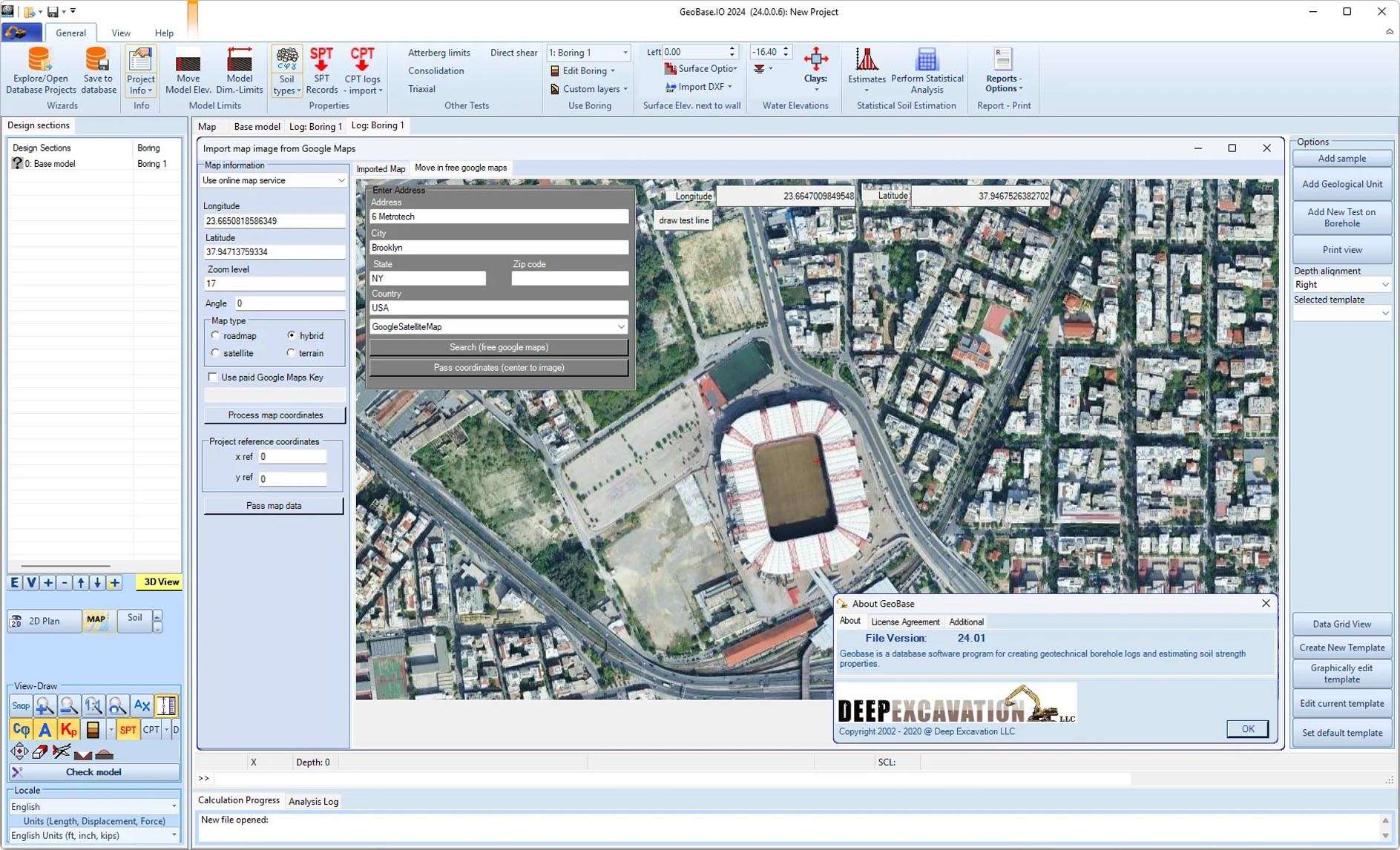
Download Deep Excavation GeoBase 2024 v24.0 – Advanced GIS Software for Civil Engineering
Deep Excavation GeoBase 2024 v24.0 is a specialized Geographic Information System (GIS) platform designed for civil engineering and geospatial applications. It provides professionals in civil engineering, urban planning, and infrastructure development with advanced tools for spatial data management, analysis, and visualization. This software is particularly engineered to support the complex requirements of deep excavation projects and broader geospatial modeling tasks, serving as a robust solution for managing and interpreting geographic information.
Overview of GeoBase 2024 in Civil Engineering and Geospatial Applications
GeoBase 2024 operates as a comprehensive GIS platform, specifically tailored to the demands of the civil and construction engineering sectors. It plays a crucial role in managing geographic data essential for deep excavation planning, detailed infrastructure development, and thorough environmental monitoring. The software integrates powerful analytical capabilities with intuitive visualization tools, enabling users to make informed decisions based on precise spatial insights.
Advanced Data Management and Spatial Analysis Capabilities
Multi-Format Data Support and Topology-Based Editing
GeoBase 2024 offers extensive support for a wide array of spatial data formats, ensuring interoperability within complex project environments. It can seamlessly handle standard formats such as shapefiles, geodatabases, and various CAD files, including DWG and DXF. Direct connections to spatial databases like PostGIS and Oracle Spatial are also supported, facilitating integrated data workflows. The software emphasizes data integrity through advanced topology-based editing tools, which enforce spatial relationships and rules, preventing common data errors.
Comprehensive Geoprocessing Tools and Workflow Automation
The software provides an extensive toolbox of geoprocessing functionalities crucial for spatial analysis in civil engineering. These include tools for overlay analysis, proximity analysis, surface analysis, and statistical computations. For complex or repetitive tasks, GeoBase 2024 features a visual programming environment, Model Builder, allowing users to automate intricate workflows without extensive coding. This enhances efficiency and ensures consistency in analytical processes across various infrastructure projects.
Cartography, Visualization, and 3D Spatial Analysis Features
High-Quality Map Production and Symbology
GeoBase 2024 is equipped with robust cartographic tools designed for the creation of publication-quality maps. Users can develop both static and interactive maps, employing advanced labeling techniques and sophisticated symbology to clearly represent geographic information. These features are essential for communicating project details, findings, and analytical results effectively to stakeholders.
3D Visualization and LiDAR Data Integration
The platform includes an integrated 3D scene viewer that enables advanced spatial analysis and detailed visualization. It supports terrain draping, line-of-sight computations, and the integration of city models. A key capability is its strong support for processing and visualizing LiDAR data, including point clouds, which is vital for creating high-resolution digital elevation models and detailed terrain analyses fundamental to deep excavation and infrastructure planning.
Innovations and Enhancements in the 2024 Release
The 2024 release of GeoBase introduces significant advancements, focusing on performance, user experience, and intelligent processing. Key enhancements include a modernized user interface for improved navigation and usability, alongside accelerated processing speeds achieved through the leveraging of multi-core CPUs and GPU acceleration. This version also integrates AI/ML algorithms to automate image classification and feature extraction, streamlining the analysis of large imagery datasets. Further innovations are noted in enhanced cloud and web integration capabilities, and updated geocoding and routing engines for more efficient spatial data operations.
Industrial Use Cases and Practical Applications of GeoBase 2024
Professionals utilize GeoBase 2024 across a range of critical applications within civil engineering and related fields. Its capabilities are instrumental in detailed land use planning, enabling informed decisions about development and zoning. The software facilitates complex network analysis for managing utility infrastructure, such as water, sewer, and power grids. Environmental monitoring benefits from its spatial analysis tools for tracking pollution, assessing impact, and managing natural resources. Furthermore, GeoBase 2024 serves as a vital decision-support tool for infrastructure projects, aiding in everything from initial site selection to long-term asset management and maintenance planning.
Frequently Asked Questions
What types of spatial data formats does Deep Excavation GeoBase 2024 support?
GeoBase 2024 supports a wide range of spatial data formats including shapefiles, geodatabases, KML, GeoJSON, CAD files such as DWG/DXF, and it can connect directly to spatial databases like PostGIS and Oracle Spatial. This broad compatibility ensures seamless integration with existing data sources and project requirements.
How does GeoBase 2024 utilize AI and machine learning in geospatial analysis?
The 2024 release integrates AI/ML algorithms to automate image classification and feature extraction, which streamlines processing large imagery datasets and enhances the accuracy of spatial data modeling. These intelligent capabilities help in rapidly identifying terrain features, infrastructure elements, and other crucial spatial data points.
Can GeoBase 2024 handle 3D visualization and analysis for complex terrain?
Yes, GeoBase 2024 includes an integrated 3D scene viewer for terrain draping, line-of-sight analyses, and working with 3D city models and LiDAR data to create detailed digital elevation models. This functionality is critical for understanding topographical challenges, planning excavation depths, and visualizing large-scale infrastructure projects in realistic three-dimensional space.




Reviews
There are no reviews yet.