

Download MSC CAEfatigue 2025.1 – Specialized Fatigue Life Prediction Software
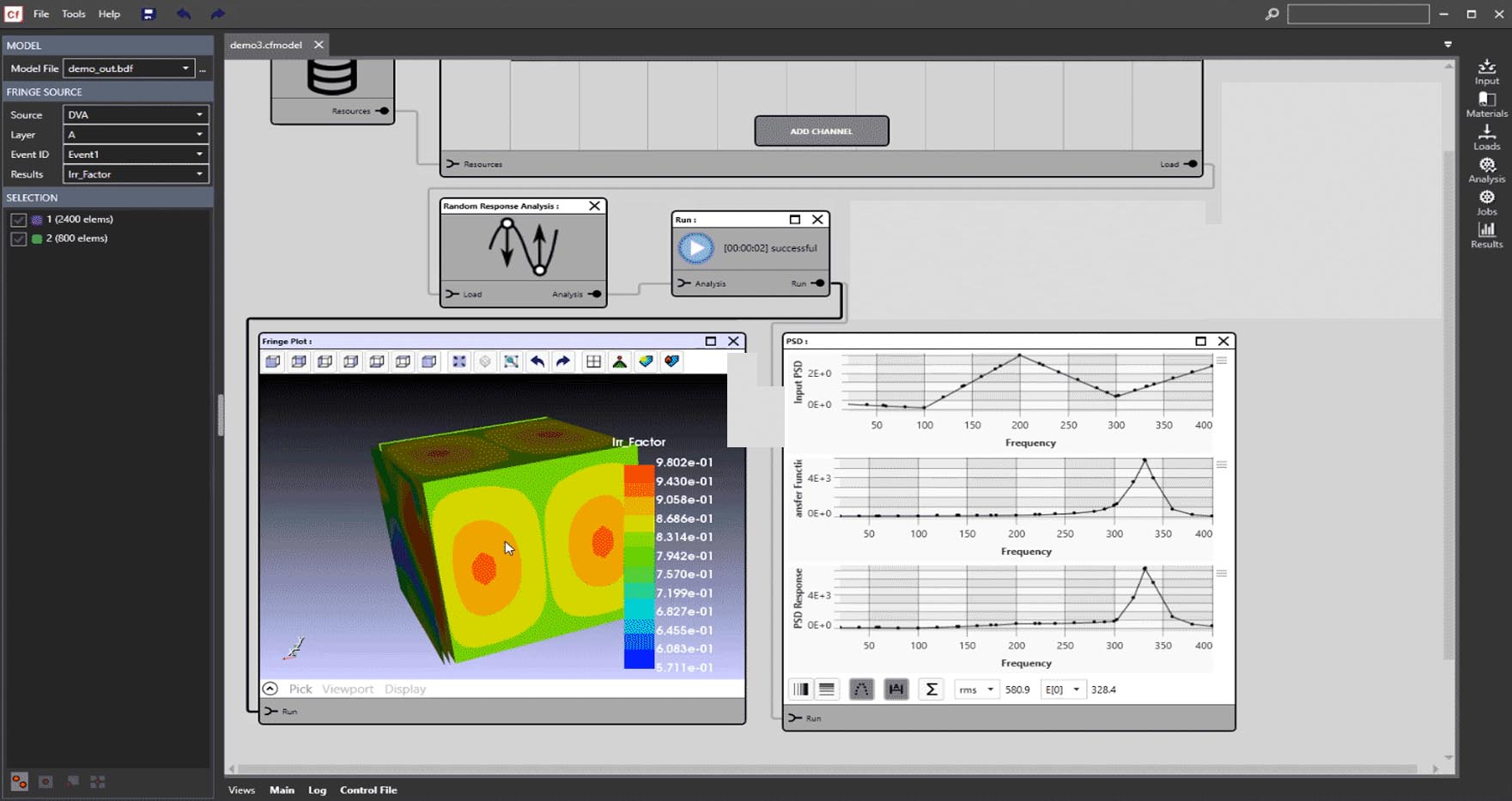
MSC CAEfatigue 2025.1 is a specialized post-processing software developed by MSC Software Corporation, a subsidiary of Hexagon AB, designed for predicting the fatigue life of engineering components. This tool integrates seamlessly with leading Finite Element Analysis (FEA) solvers, enabling durability engineers and CAE analysts in industries such as automotive, aerospace, and industrial machinery to translate simulation results into reliable life predictions. It is crucial for design verification and ensuring product longevity through virtual durability testing.
Overview of MSC CAEfatigue and Its Role in Mechanical Durability Simulation
MSC CAEfatigue functions as a critical post-processor, extending the capabilities of FEA simulations by focusing on fatigue durability assessment. It takes detailed stress, strain, and load data generated by FEA solvers and applies sophisticated fatigue analysis techniques to predict component lifespan under operational conditions. This advanced simulation capability is vital for the automotive, aerospace, off-highway vehicle, and industrial machinery sectors, where ensuring product durability and reliability is paramount. By providing detailed fatigue life predictions, MSC CAEfatigue helps engineers validate designs virtually, significantly reducing the need for extensive physical prototyping and testing, thereby accelerating development cycles and minimizing potential product failures.
Fatigue Analysis Methodologies Supported by MSC CAEfatigue
Stress-Life (S-N) High-Cycle Fatigue Analysis
The software employs the stress-life (S-N) approach for predicting fatigue life under conditions where stresses remain largely elastic, common in high-cycle fatigue scenarios. This method utilizes material-specific S-N curves, which plot stress amplitude against the number of cycles to failure, to estimate component durability under cyclic loading.
Strain-Energy (ε-N) Low-Cycle Fatigue and Cyclic Plasticity Modeling
For low-cycle fatigue applications, where stresses may exceed the material’s yield strength leading to plastic deformation, MSC CAEfatigue utilizes the strain-life (ε-N) methodology. This approach uses strain-based fatigue curves and incorporates models for cyclic plasticity to accurately capture material behavior and predict failure in regions experiencing significant deformation.
Multi-Axial and Non-Proportional Fatigue Approaches
MSC CAEfatigue supports advanced methods for analyzing fatigue under complex multi-axial and non-proportional loading conditions. Techniques such as critical plane methods and stress invariant approaches are implemented to accurately assess fatigue damage when stress states vary in direction and magnitude throughout a loading cycle.
Weld Fatigue Analysis Techniques
The software includes specialized methodologies for evaluating the fatigue life of welded joints. This encompasses detailed analysis for different types of welds, such as spot welds and seam welds, enabling engineers to predict the durability of critical connections in fabricated structures.
Integration with Leading Finite Element Analysis Solvers and Workflow Enhancements
MSC CAEfatigue is designed for seamless integration with a wide array of industry-standard Finite Element Analysis (FEA) solvers. This compatibility ensures that engineers can leverage their existing simulation workflows and data. The latest 2025.1 release specifically introduces enhancements to solver integration and overall performance, making it an efficient tool for complex durability assessments.
- Supported solvers include MSC Nastran, Abaqus, Ansys, and LS-DYNA, with improved compatibility in the 2025.1 version.
- Performance optimizations are included for handling large FEA models and multiple load cases, accelerating analysis time.
- Usability enhancements and GUI improvements facilitate the setup and execution of complex fatigue analysis workflows.
Real-World Applications and Industrial Use Cases of MSC CAEfatigue
In practical engineering scenarios, MSC CAEfatigue plays a critical role in validating product durability and reliability across demanding industries. Its capabilities enable engineers to simulate real-world operating conditions and predict potential fatigue failures before physical prototypes are manufactured.
- Fatigue life validation for automotive components such as chassis, suspension parts, and body structures under various road conditions.
- Aerospace applications involve assessing the fatigue resistance of aircraft structures and components subjected to flight cycles and various stresses.
- Virtual durability testing significantly reduces the need for expensive and time-consuming physical prototypes and testing rigs.
- The software’s insights help in identifying critical fatigue areas, improving design reliability, and mitigating risks of in-service failures.
Recent Innovations and Updates in MSC CAEfatigue 2025.1
The 2025.1 release of MSC CAEfatigue introduces several key advancements aimed at enhancing user productivity and analysis accuracy. These updates focus on improving integration, boosting performance, and expanding the software’s analytical capabilities.
- Enhanced solver integration provides more robust data exchange with the latest versions of popular FEA packages.
- Expanded material models allow for more precise characterization of material fatigue behavior under diverse conditions.
- Improvements in analysis speed and GUI streamlining contribute to a more efficient user experience for complex durability analysis setups.
- Staying current with these updates is important for leveraging the latest advancements in fatigue prediction and maintaining compatibility with evolving FEA simulation tools.
Frequently Asked Questions
How does MSC CAEfatigue integrate with FEA solvers like Abaqus and Ansys?
MSC CAEfatigue acts as a post-processor that takes stress, strain, or force results exported from FEA solvers such as Abaqus and Ansys. It translates these results into fatigue life predictions by applying advanced fatigue analysis methods tailored for various loading and material conditions. This integration enables a seamless workflow for durability assessment following structural simulations.
What types of fatigue analysis can MSC CAEfatigue perform?
MSC CAEfatigue supports multiple fatigue analysis types including high-cycle fatigue using stress-life (S-N) approaches, low-cycle fatigue via strain-life (ε-N) methods with cyclic plasticity modeling, multi-axial fatigue through critical plane and stress invariant methods, as well as specialized weld fatigue analysis for spot and seam welds.
What are the benefits of using MSC CAEfatigue for durability engineering?
MSC CAEfatigue enables virtual testing of component fatigue life, reducing dependence on expensive physical prototypes and test rigs. By accurately predicting cycles to failure and damage under real-world load histories, it helps ensure products meet their design life and reliability targets, ultimately reducing failure risks and improving product performance.






Reviews
There are no reviews yet.