
Download Synopsys QuantumATK 2025.06 – Advanced Atomistic Simulation Software for Materials and Device Research
Synopsys QuantumATK 2025.06 is a comprehensive atomistic simulation software platform designed for advanced research in materials science, nanotechnology, and semiconductor design. Developed by Synopsys, a leader in electronic design automation, QuantumATK integrates multiple quantum mechanical and semi-empirical simulation methods to bridge the gap between quantum-level phenomena and device-scale behavior. This powerful tool serves professionals in academic, national laboratory, and industry research settings, particularly those focused on semiconductors, catalysis, and nanoscale device engineering.
Comprehensive Quantum and Atomistic Simulation for Materials Innovation
Synopsys QuantumATK 2025.06 provides a versatile environment for atomistic simulations, enabling researchers to explore the fundamental properties of materials at the atomic level. The software is built upon a solid foundation of state-of-the-art simulation techniques, allowing for detailed analysis of electronic structure, molecular dynamics, and material behavior. Its capabilities are essential for industries engaged in developing novel materials and optimizing existing ones, including semiconductors, catalysis, and nanotechnology, by offering insights into material properties and reaction pathways.
Integrated Simulation Engines and Quantum Transport Modeling
At the core of QuantumATK are its integrated simulation engines, which offer a broad spectrum of computational chemistry and materials science capabilities. These include advanced Density Functional Theory (DFT) implementations with a variety of functionals for accurate electronic structure calculations, and Non-Equilibrium Green’s Function (NEGF) techniques crucial for simulating quantum transport phenomena in nanoscale devices. The platform also supports classical force fields, facilitating large-scale molecular dynamics simulations to study material behavior over longer timescales and larger systems.
Specialized Modules and Advanced Physics Models
QuantumATK 2025.06 extends its utility with specialized modules tailored for complex research areas. These modules enable sophisticated analysis of magnetic materials, investigation of optical properties through calculations like dielectric function and optical conductivity, and simulation of thermal transport phenomena such as thermal conductivity. Furthermore, it incorporates advanced physics models for simulating strongly correlated systems, superconductivity theories, and electrochemical processes, providing researchers with tools to tackle multifaceted challenges in materials design and analysis.
High-Performance Computing and AI-Driven Enhancements in QuantumATK 2025.06
This latest version of QuantumATK significantly advances computational efficiency and research capabilities through high-performance computing (HPC) and AI-driven enhancements. It features exascale-ready algorithms optimized for modern supercomputing architectures, including NVIDIA Grace Hopper. The software introduces advanced quantum machine learning force fields for faster, yet accurate, simulations of materials behavior, and provides interfaces to quantum computing platforms for tackling inherently quantum problems. These innovations accelerate the pace of discovery in computational materials science.
Efficient Workflows and Collaborative Analysis with Python and NanoLab GUI
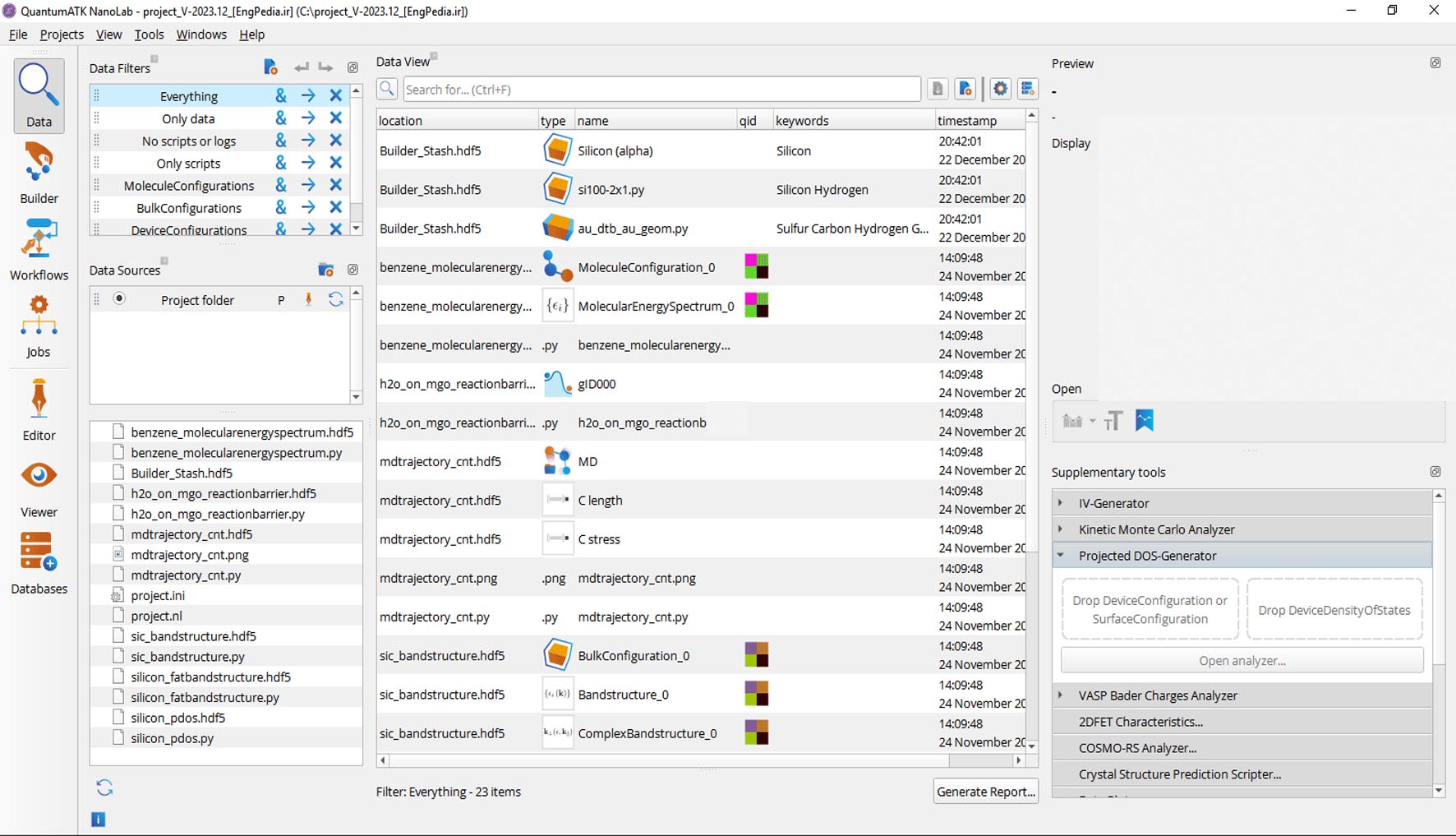
QuantumATK 2025.06 streamlines research workflows through robust scripting automation and an intuitive graphical user interface (GUI). The software’s extensive Python API allows for the automation of complex simulation setups, data analysis, and post-processing tasks, enhancing reproducibility and efficiency. The integrated NanoLab GUI provides a user-friendly environment for creating simulation models, visualizing results, and managing simulation projects. Enhanced database integration and real-time collaboration tools further support team-based research efforts.
Applications in Semiconductor Research, Nanodevice Design, and Materials Discovery
The practical applications of Synopsys QuantumATK 2025.06 span critical areas of scientific and technological advancement. In semiconductor research, it is employed for studying interface phenomena, defect states, and electronic properties of novel semiconductor materials. For nanodevice design, QuantumATK facilitates the simulation of nanoscale transistors, interconnects, and spintronic devices. Furthermore, its capabilities are crucial for materials discovery, enabling research into new catalysts for chemical reactions, advanced battery materials for energy storage, and two-dimensional materials with unique electronic and mechanical properties.
Frequently Asked Questions
How does Synopsys QuantumATK integrate quantum computing in its simulations?
QuantumATK 2025.06 includes interfaces to leading quantum computers like IBM and Google, allowing users to perform select quantum chemistry calculations on actual quantum hardware. This integration enhances simulation accuracy for complex quantum systems beyond classical computing limitations, opening new avenues for exploring materials with exotic quantum properties.
What types of materials and device simulations can I perform with QuantumATK?
QuantumATK supports simulations of electronic structure, quantum transport, thermal conductivity, magnetism, optical properties, and electrochemistry. It is widely used for semiconductors, nanodevices, catalysts, batteries, and novel 2D materials, offering a comprehensive suite for diverse research needs.
What high-performance computing resources are recommended for running QuantumATK 2025.06 efficiently?
For best performance, QuantumATK utilizes Linux servers with powerful CPUs such as AMD EPYC or Intel Xeon, ample RAM (128 GB minimum for basic use), and high-end GPUs like NVIDIA A100 or H100. The software is designed to leverage exascale computing resources through its optimized algorithms for large-scale computations on modern supercomputers.






Reviews
There are no reviews yet.