

Download JMatPro 7.0 – Advanced Computational Materials Engineering Software
JMatPro 7.0 is a specialized computational materials engineering software developed by Sente Software Ltd. It is designed for materials scientists, metallurgists, and engineers to predict the properties and behavior of alloys. The software is utilized across industries such as aerospace, automotive, metallurgy, and foundries, as well as in research and academic settings, to accelerate material development and reduce experimental testing.
Overview of JMatPro 7.0 and Industrial Applications
JMatPro 7.0 provides a robust platform for simulating alloy properties and processing behavior. Its core functionality is built upon CALPHAD (Calculation of Phase Diagrams) methodology and kinetic models, enabling detailed analysis of multicomponent alloys. Professionals in materials science and metallurgy rely on this computational materials engineering software for design, optimization, and troubleshooting in applications like solidification, heat treatment, and predicting in-service material performance.
Key industrial applications include:
- Aerospace: Designing advanced alloys for high-temperature performance and lightweight structures.
- Automotive: Optimizing heat treatment processes for components to achieve desired mechanical properties.
- Metallurgy and Foundries: Simulating solidification behavior and predicting microstructural evolution for casting processes.
- Heat Treatment: Analyzing phase transformations under various thermal cycles.
- Research & Academia: Investigating novel alloy systems and validating theoretical models.
Comprehensive Phase Diagram and Transformation Predictions
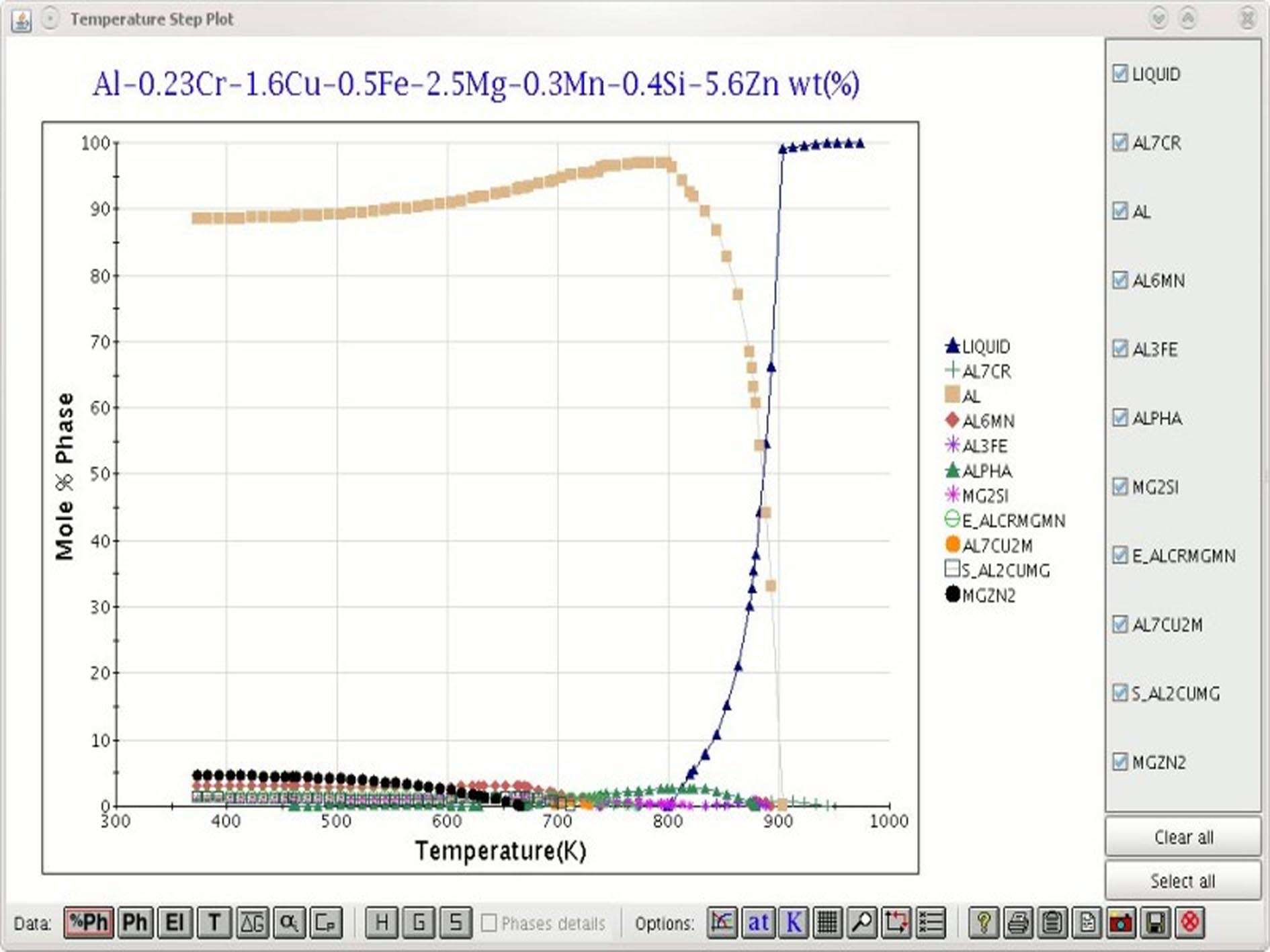
A fundamental capability of JMatPro 7.0 is its precise calculation of multicomponent phase diagrams. This includes equilibrium phase diagrams, as well as kinetic diagrams such as Time-Temperature-Transformation (TTT) and Continuous-Cooling-Transformation (CCT) diagrams. These predictions are essential for alloy designers and process engineers to understand phase stability, identify optimal processing windows, and control microstructural development for specific material properties.
The software enables users to:
- Identify stable phases at different temperatures and compositions.
- Determine the impact of alloying additions on phase equilibria.
- Simulate the effects of cooling rates on phase transformations during processes like welding or heat treatment.
- Predict the solvus temperatures for precipitation strengthening of alloys.
Thermophysical and Mechanical Property Simulations
JMatPro 7.0 excels in predicting a wide array of thermophysical and mechanical properties for alloys as a function of temperature. This capability is critical for evaluating material performance under various operating conditions.
The software can model:
- Thermophysical properties: Density, specific heat, thermal conductivity, thermal expansion coefficients, and melting ranges.
- Mechanical properties: Yield strength, tensile strength, ductility, hardness, elastic modulus, and creep resistance.
By providing these property predictions, JMatPro assists engineers in selecting appropriate materials for specific applications and simulating their behavior under thermal and mechanical loads, thereby enhancing product reliability.
Modeling Solidification, Precipitation, and Microstructural Evolution
Beyond phase equilibria, JMatPro 7.0 offers advanced kinetic models to simulate material evolution during processing and service. This includes predicting the complex processes involved in alloy solidification and the subsequent development of microstructure.
Specific simulation capabilities include:
- Solidification simulation: Predicting the sequence of phase formation during cooling from the melt, including the solidification range and latent heat.
- Microsegregation analysis: Modeling the non-equilibrium distribution of alloying elements within the solidifying microstructure.
- Secondary phase formation: Simulating the precipitation of intermetallic compounds and other secondary phases.
- Precipitation kinetics: Quantifying the kinetics of precipitation for age-hardening in alloys like aluminum and nickel superalloys.
- Inclusion formation: Predicting the likelihood and composition of non-metallic inclusions.
Accurate simulation of these phenomena is vital for controlling casting quality and achieving targeted mechanical properties in heat-treatable alloys.
Expanded Alloy Databases and Modern Materials Support
Reflecting current trends in materials science, JMatPro 7.0 features significantly expanded and updated alloy databases. This includes enhanced support for modern material classes that are critical for advanced manufacturing and high-performance applications.
Key database expansions in version 7.0 include:
- Additive Manufacturing (AM) alloys: Databases tailored for materials used in 3D printing processes like selective laser melting and electron beam melting.
- High-Entropy Alloys (HEAs): Comprehensive thermodynamic and kinetic data for multicomponent HEAs, a rapidly growing area of materials research.
- Updated traditional alloy systems: Refined databases for steels, aluminum alloys, and superalloys, incorporating the latest critically assessed data.
This support for novel and advanced materials makes JMatPro 7.0 an indispensable tool for researchers and designers working at the forefront of materials innovation.
Enhanced Usability with Modern Interface and Scripting Capabilities
JMatPro 7.0 introduces a modernized user interface (UI) and enhanced scripting capabilities designed to improve user experience and workflow efficiency. These advancements make the powerful simulation tools more accessible and integrable into broader engineering workflows.
Improvements include:
- A streamlined graphical user interface (GUI) for easier navigation and data input.
- An improved Python scripting API, enabling automation of repetitive tasks and complex calculation sequences.
- Enhanced output compatibility, facilitating seamless integration of JMatPro results with other Computer-Aided Engineering (CAE) tools, such as casting or finite element analysis (FEA) software.
These features empower users to leverage JMatPro 7.0 more effectively within their existing simulation environments, accelerating the design and analysis process.
Applications in Industry and Research: Case Studies
JMatPro 7.0 serves as a critical tool in various real-world scenarios for both industrial development and academic research, helping to optimize material selection, processing, and performance prediction.
-
Aerospace Alloy Design: Metallurgists utilize JMatPro to design next-generation nickel superalloys for turbine blades. By simulating phase stability and creep resistance at extreme temperatures, they can identify compositions that offer improved performance and longevity, reducing the need for extensive experimental trials.
-
Automotive Heat Treatment Optimization: Engineers in the automotive sector employ JMatPro to optimize heat treatment cycles for critical steel components, such as gears and shafts. The software’s TTT and CCT diagram calculations guide the selection of precise quenching and tempering parameters to achieve target hardness and toughness, ensuring component durability.
-
Academic Research on New Alloys: Researchers in universities use JMatPro, particularly its enhanced capabilities for high-entropy alloys and additive manufacturing materials, to explore the fundamental thermodynamic principles governing these complex systems. This simulation-driven approach accelerates the discovery and characterization of novel materials with unique properties.
Frequently Asked Questions
What types of alloy systems does JMatPro 7.0 support?
JMatPro 7.0 supports a wide range of alloy systems including steels (carbon, tool, stainless), aluminum, titanium, nickel superalloys, magnesium, zirconium, as well as modern additively manufactured alloys and high-entropy alloys. This extensive material database enables simulations for diverse applications.
How does JMatPro help with phase diagram analysis and alloy design?
By using thermodynamic CALPHAD models, JMatPro calculates complex multicomponent phase diagrams, time-temperature-transformation (TTT), and continuous-cooling-transformation (CCT) diagrams. These are crucial for understanding phase stability and guiding alloy and heat treatment design.
Can JMatPro be integrated with other simulation tools?
Yes, JMatPro 7.0 offers enhanced scripting capabilities through a Python API, allowing users to automate workflows and integrate outputs with other CAE software such as casting simulators or finite element analysis tools.






Reviews
There are no reviews yet.