

Download IES ConcreteSection 4.00 – Advanced Reinforced Concrete Section Analysis Tool
IES ConcreteSection 4.00 is a specialized structural engineering analysis software designed for the detailed nonlinear analysis of reinforced concrete cross-sections. Developed for professionals in civil, structural, and bridge engineering, this tool is critical for verifying the capacity and behavior of concrete elements under various load conditions. It focuses on generating essential design data, including axial load-moment interaction diagrams and moment-curvature relationships, supporting both standard and advanced seismic design workflows.
Overview of IES ConcreteSection in Structural and Seismic Engineering
In structural engineering, accurately assessing the capacity of reinforced concrete (RC) sections is paramount for ensuring safety and compliance with design standards. IES ConcreteSection provides specialized capabilities for this purpose, focusing on the nonlinear behavior of concrete and steel under combined axial loads and biaxial bending. This functionality is particularly crucial in seismic design, where understanding a section’s ductility and its ability to dissipate energy through plastic hinging is essential for withstanding earthquake forces. Typical use cases involve the detailed analysis of beams, columns, and walls in building and bridge structures.
Detailed Load-Moment Interaction and Moment-Curvature Analysis
IES ConcreteSection excels at generating comprehensive axial load-moment interaction diagrams, which define the capacity of a cross-section under combined axial forces and biaxial bending moments. The software utilizes nonlinear material models for concrete and reinforcement, allowing for a realistic simulation of stress and strain distributions. Furthermore, it computes moment-curvature relationships, providing critical insights into a section’s flexural stiffness, ductility, and ultimate moment capacity. This detailed analysis is vital for performance-based design and assessing the behavior of structures under extreme loading conditions.
Support for Complex Section Geometries and Reinforcement Layouts
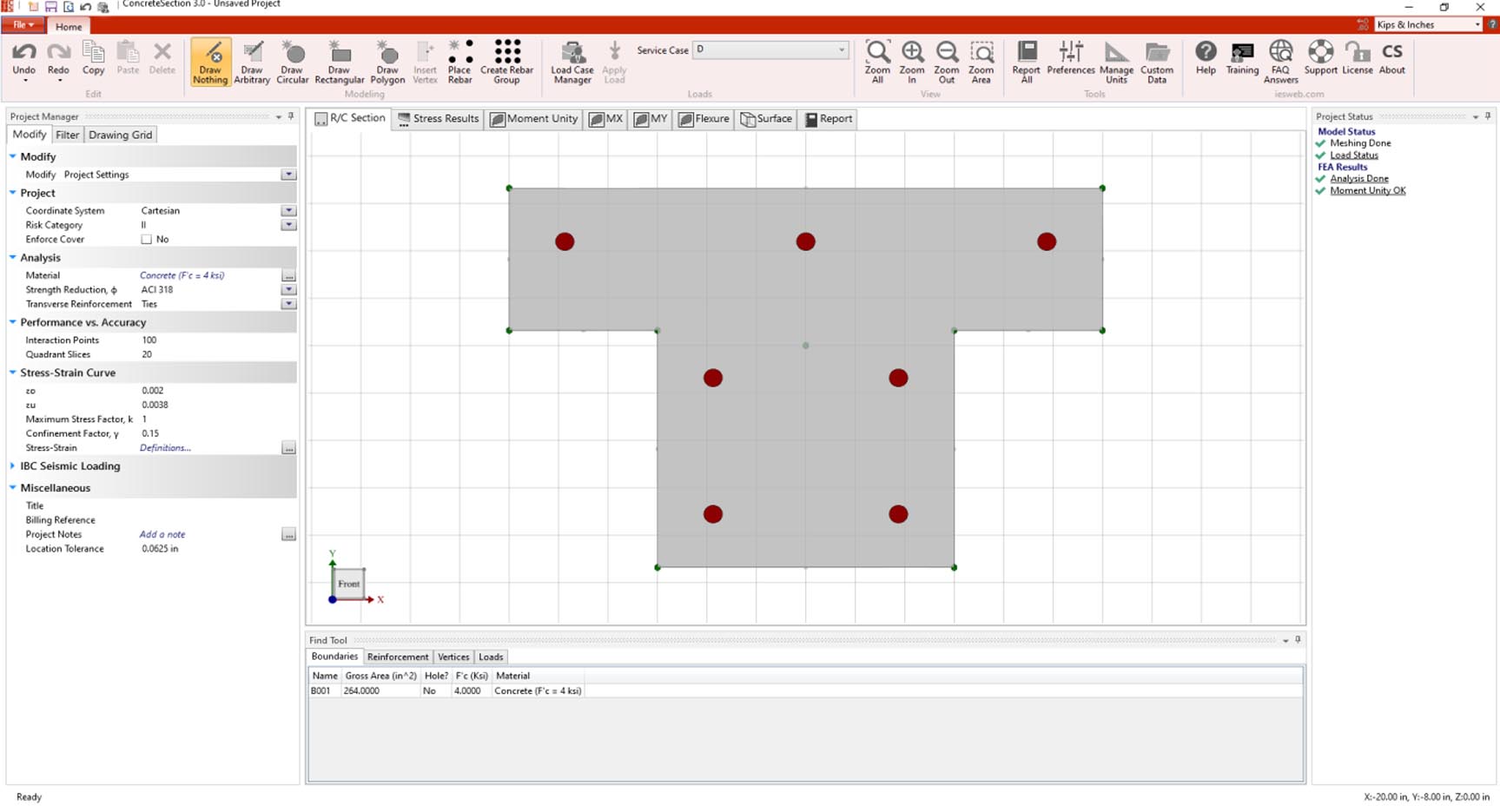
The software accommodates a wide range of section complexities, enabling engineers to model arbitrary cross-sectional shapes. This includes standard geometries like L-beams, T-beams, circular, and hollow sections, as well as custom shapes defined by the user. Support for multiple layers of reinforcement, varying steel grades, and the inclusion of voids or openings within the section allows for precise representation of real-world structural elements. This flexibility is essential for analyzing unique components found in bridges, complex building frames, and specialized structures.
Code Compliance and Seismic Design Enhancements in Version 4.00
Version 4.00 of IES ConcreteSection incorporates updated support for major international building codes, including ACI 318-19 for American standards, Eurocode 2 (often with country-specific National Annexes), and CSA A23.3 for Canadian designs. Significantly, this version enhances seismic design capabilities with advanced modeling for concrete confinement effects, leading to more accurate calculations of curvature ductility and the behavior of plastic hinges. These enhancements improve the reliability and safety of designs subjected to seismic events.
Intuitive User Interface and Visualization Tools
IES ConcreteSection features a modernized user interface designed to streamline the analysis process. It utilizes ribbon menus for logical command organization and provides real-time 3D surface visualization of interaction diagrams and moment-curvature responses. Enhanced sketching tools allow for intuitive definition of complex section geometries and reinforcement layouts. These graphical outputs and interactive visualization capabilities empower engineers to better understand section performance and make informed design decisions.
Material Modeling and Performance Improvements
The software employs advanced nonlinear material models for concrete, including the simulation of confinement effects which significantly enhance ductility and strength. It also incorporates models for reinforcing steel, supporting various grades and stress-strain behaviors. IES ConcreteSection can handle analyses involving high-strength concrete and steel. Performance improvements in version 4.00 focus on increased speed and accuracy, particularly beneficial for complex, large-scale analyses or when evaluating numerous design scenarios.
Real-World Applications and User Profiles
IES ConcreteSection is a valuable tool for structural engineers, bridge designers, geotechnical engineers, and advanced civil engineering students. Consultants and researchers also utilize its capabilities for specialized analyses. Typical projects benefiting from this software include the design and verification of bridge piers and abutments, seismic retrofitting of existing concrete structures, and performance-based design of buildings requiring detailed capacity checks. The software’s focus on code compliance and seismic performance makes it indispensable for these critical applications.
Frequently Asked Questions
How does IES ConcreteSection improve seismic design of reinforced concrete structures?
IES ConcreteSection employs robust confinement models and calculates curvature ductility and plastic hinge characteristics, which are critical for performance-based seismic design. These advanced features help engineers verify strength and ductility under seismic loads, ensuring structures can withstand earthquake forces more reliably.
What international design codes does IES ConcreteSection support?
The software supports major international codes including ACI 318-19, Eurocode 2 (with country-specific annexes), and CSA A23.3. This ensures compliance and adaptability for engineers working across different global regions and regulatory environments.
Can IES ConcreteSection analyze complex cross-section shapes and reinforcement layouts?
Yes, it allows modeling of arbitrary section geometries such as L-shaped, T-shaped, circular, hollow, and irregular sections with multiple reinforcement layers and voids, providing flexibility for realistic design scenarios encountered in actual projects.





Reviews
There are no reviews yet.