

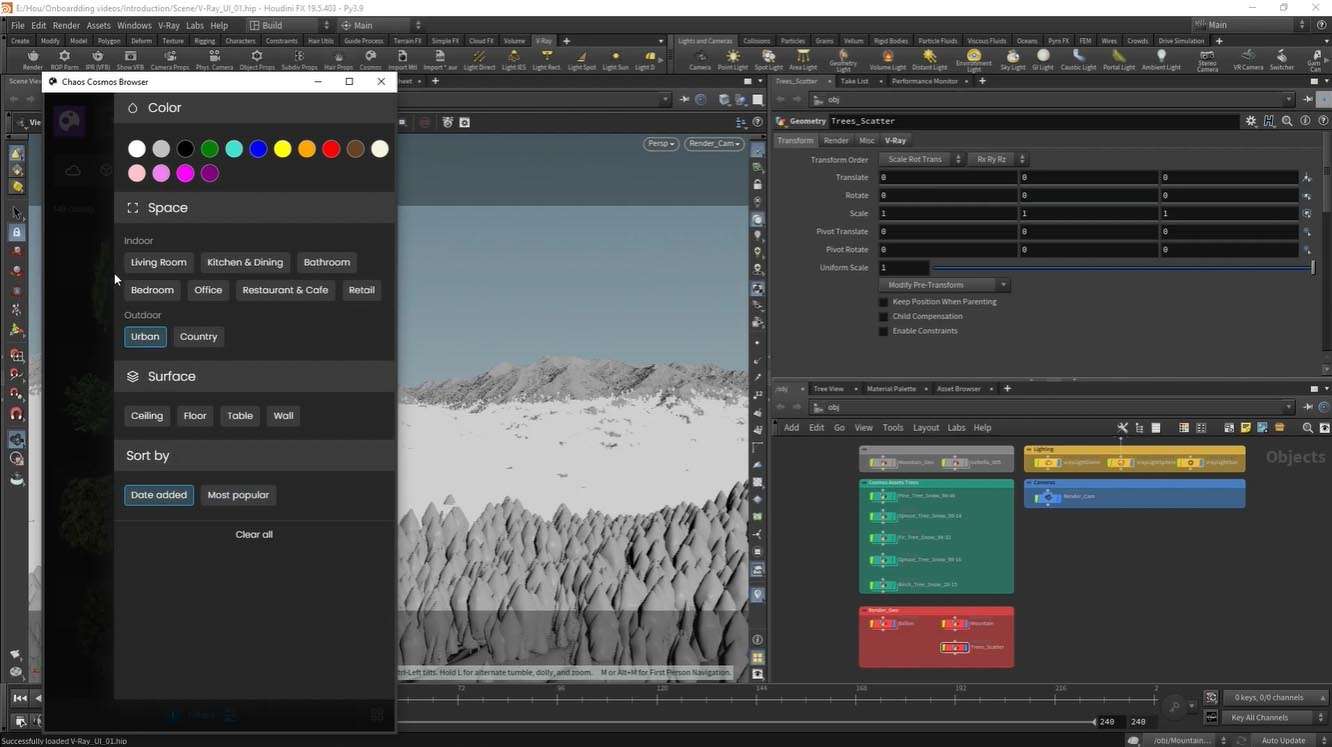
Download V-Ray 7.10 for Houdini 18.0-20.5 – Advanced Rendering Integration for Procedural Workflows
V-Ray 7.10 for Houdini represents a powerful integration of Chaos Group’s renowned rendering technology with SideFX Houdini’s industry-leading procedural 3D animation and VFX software. This plugin is specifically designed to offer professionals in visual effects, animation, architectural visualization, and film production a seamless pathway to high-quality, photorealistic rendering directly within Houdini’s sophisticated node-based environment. It leverages the strengths of both software packages to tackle complex scenes, advanced simulations, and intricate procedural modeling tasks efficiently.
Overview of V-Ray Integration with Houdini
The core strength of V-Ray for Houdini lies in its deep integration, enabling users to harness V-Ray’s advanced rendering capabilities directly within Houdini’s procedural workflow. This synergy allows artists to render procedurally generated geometry, complex simulations, and intricate scene assemblies with a high degree of artistic control. Industries such as visual effects, animation, and architectural visualization benefit from this combined power, facilitating the creation of detailed environments, realistic characters, and compelling motion graphics through efficient node-based workflows.
Rendering Capabilities Tailored for Houdini’s Procedural Environment
V-Ray is engineered to complement Houdini’s procedural nature, offering specialized tools that address the unique demands of rendering complex, dynamically generated scenes.
Procedural Rendering Workflow Support
V-Ray for Houdini directly interfaces with Houdini’s powerful node graph system. This allows for the efficient rendering of procedurally generated geometry and complex scene elements directly from Houdini’s native workflows, ensuring that the dynamism and editability of procedural assets are preserved throughout the rendering process.
Volume Grid and Simulation Rendering
The plugin provides optimized rendering for volumetric data commonly generated by Houdini simulations. It efficiently handles OpenVDB grids, enabling photorealistic representations of phenomena such as fire, smoke, explosions, and fluid simulations with precise control over diffusion, scattering, and absorption properties.
Hybrid CPU and GPU Rendering
V-Ray 7.10 for Houdini offers a flexible hybrid rendering approach, allowing users to leverage either CPU or GPU processing power, or a combination of both. This dual capability ensures efficient rendering across various hardware configurations, delivering consistent, high-quality results and accommodating different production needs and hardware availability.
Advanced Lighting and Scene Management Features
Beyond fundamental rendering, V-Ray integrates sophisticated lighting and scene management tools that integrate smoothly with Houdini’s advanced pipeline features.
Native Solaris/USD Hydra Delegate Integration
V-Ray for Houdini offers deep integration with the Solaris scene description and the Universal Scene Description (USD) framework. As a native Hydra Delegate, it allows for efficient scene assembly, lighting, and rendering within Houdini’s Solaris context, supporting the complex, layered scene management required in modern VFX pipelines.
Adaptive Dome Light and AOV System
The Adaptive Dome Light feature intelligently samples image-based lighting (IBL) sources for realistic, enhanced global illumination. Complementing this is V-Ray’s extensive Arbitrary Output Variables (AOV) system, which provides comprehensive render passes, including detailed light group outputs and cryptomatte support for streamlined compositing workflows.
Enhancements in V-7.10 Specific to Houdini
The V-Ray 7.10 release introduces several key features and improvements specifically beneficial to users of Houdini.
V-Ray Enmesh: Procedural Pattern Generation
A notable addition in V-Ray 7.10 is the V-Ray Enmesh tool. This feature allows for the procedural generation of intricate surface patterns by applying geometry to existing surfaces, ideal for creating complex textures, decorative elements, or detailed object surfaces with efficient rendering performance.
Improved GPU Rendering and Decal Tool
This version brings significant enhancements to V-Ray’s GPU rendering capabilities, including improved speed and stability for volume rendering. Additionally, the non-destructive decal tool has been refined, offering more intuitive projection of surface details and textures onto complex geometry without altering the underlying mesh.
Chaos Cloud for Collaborative Rendering
V-Ray 7.10 integrates seamlessly with Chaos Cloud, Chaos Group’s cloud rendering platform. This connectivity streamlines production by enabling users to distribute rendering tasks across a distributed network, facilitating faster turnaround times and enhanced collaboration on demanding projects.
Professional Applications and User Profiles
V-Ray 7.10 for Houdini serves a diverse range of visual computing professionals who rely on sophisticated rendering within a procedural framework.
- VFX Lighting Artists utilize V-Ray for its photorealistic lighting and material capabilities, integrating complex rendered elements into film and television shots.
- FX Technical Directors benefit from its ability to render intricate simulations like fire, smoke, and destruction, leveraging Houdini’s procedural strengths and V-Ray’s detailed output.
- Architectural Visualization Specialists employ V-Ray for creating highly realistic renderings of buildings and interiors, often using Houdini for procedural generation of complex architectural details or environments.
- Procedural Environment Artists leverage the combination of Houdini and V-Ray to build vast, detailed digital landscapes and assets, with V-Ray Enmesh offering new tools for surface detailing.
Compatibility and Supported Houdini Versions
V-Ray 7.10 for Houdini is designed to integrate within modern Houdini pipelines, supporting recent versions of the software. It is compatible with Houdini 18.0 through 20.5, running on Windows, macOS, and Linux operating systems, ensuring broad accessibility for professional studios and individual artists.
Frequently Asked Questions
What advantages does V-Ray 7.10 bring to the Houdini rendering workflow?
V-Ray 7.10 enhances Houdini’s rendering capabilities by supporting advanced procedural workflows, improved GPU rendering, native Solaris/USD integration, and new tools like V-Ray Enmesh for procedural pattern generation. These improvements allow faster, more photorealistic rendering of complex simulations and environments.
How does V-Ray for Houdini handle simulation volumes like fire or smoke?
V-Ray for Houdini includes an optimized Volume Grid feature that efficiently renders OpenVDB volumes created by Houdini simulations such as fire, smoke, and fluids, providing photorealistic results with support for hybrid CPU/GPU rendering.
Is V-Ray for Houdini compatible with Solaris and USD workflows?
Yes, V-Ray for Houdini offers native Solaris/USD Hydra Delegate integration, allowing seamless rendering and lighting within Houdini’s Solaris context, which supports USD-based scene description used in modern VFX pipelines.






Reviews
There are no reviews yet.