

DHI FEFLOW 2026 v11 – Advanced Finite Element Groundwater & Transport Modeling
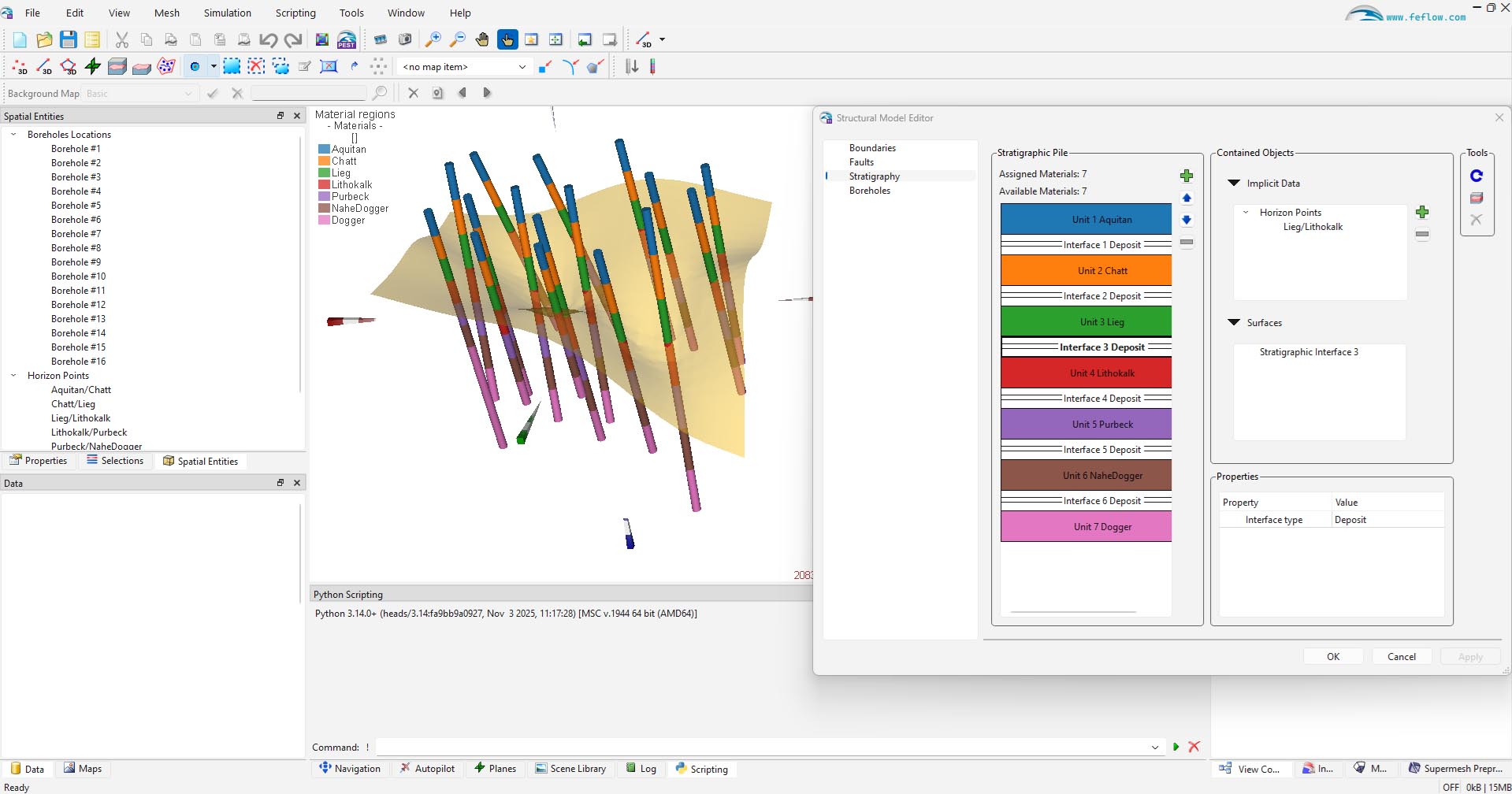
DHI FEFLOW 2026 v11 is a sophisticated finite element subsurface flow system designed for simulating groundwater, mass, and heat transport phenomena. Developed by DHI, a global leader in water environment solutions, this software is tailored for hydrogeologists, environmental engineers, and water resource managers. FEFLOW provides advanced capabilities for understanding complex subsurface processes, including saturated and unsaturated flow, density-dependent behavior, and reactive transport, making it an essential tool for professionals engaged in environmental monitoring, resource management, and energy exploration.
Overview of Advanced Groundwater Flow and Transport Simulation
Evolution and Finite Element Foundations
Since its initial development in 1979 by Hans-Jörg G. Diersch, FEFLOW has been a pioneering finite element subsurface flow system. It employs a robust finite element discretization approach to model a wide range of processes, including saturated and unsaturated groundwater flow, mass transfer, and heat transport. Over decades of continuous development, FEFLOW has evolved into a mature, peer-reviewed tool, with its theoretical underpinnings and numerical methods comprehensively documented.
DHI’s Role and Global Development Network
Acquired by DHI in 2007, FEFLOW has benefited from the company’s extensive expertise and global reach in water environment solutions. DHI, with its international team and widespread support network, continues to enhance FEFLOW, integrating cutting-edge research and user feedback. This collaborative development ensures the software remains at the forefront of hydrogeological modeling, providing reliable solutions for complex water-related challenges worldwide.
Multiphase Flow and Comprehensive Reactive Transport
FEFLOW 2026 v11 offers advanced solvers for multiphase flow and detailed reactive transport processes. The software can simulate density-dependent flow, crucial for understanding saltwater intrusion or thermal influences, as well as Richards equation for unsaturated conditions. It supports dual porosity/permeability models and integrates seamlessly with the Phreeqc geochemical code. This coupling allows for the simulation of multi-species reactions, including sequential electron-acceptor processes and mineral precipitation/dissolution, providing a powerful platform for contaminant fate and transport analysis in complex geological settings.
Geothermal Energy and Heat Transport Capabilities
The software is adept at modeling heat transport within subsurface environments, encompassing conduction, convection, and thermal dispersion. These capabilities are vital for designing and analyzing geothermal energy systems, such as Aquifer Thermal Energy Storage (ATES) and ground-source heat pump installations. FEFLOW enables engineers to simulate the thermal performance of underground reservoirs and assess the efficiency of heat extraction or injection operations, supporting sustainable energy solutions.
Interoperability with MIKE Suite and GIS Platforms
FEFLOW 2026 v11 boasts extensive interoperability features, facilitating integrated modeling workflows. It supports coupling with DHI’s MIKE SHE for comprehensive surface-subsurface hydrological simulations and MIKE 1D for river network interactions. The software efficiently imports and exports various geospatial data formats, including shapefiles and GeoTIFFs, allowing for seamless integration with Geographic Information Systems (GIS). Furthermore, the new Python API enables automation of routine tasks, advanced data processing, and custom workflows, enhancing user productivity.
High-Performance Simulation: GPU Acceleration & Cloud Deployment
Addressing the demand for faster computational performance, FEFLOW 2026 v11 incorporates CUDA-based GPU acceleration for its transport and reactive solvers. This technology can yield significant speedups, estimated at 3–5×, for computationally intensive simulations. Additionally, FEFLOW is cloud-ready, deployable on platforms like AWS and Azure, supporting distributed Monte Carlo simulations and large-scale uncertainty analyses. The new version also introduces discrete fracture network (DFN) modeling for explicit representation of fracture flow and behavior.
Applications in Water Resources, Remediation & Energy
Water Supply and Aquifer Management
FEFLOW is instrumental in sustainable water resource management. It aids in planning for managed aquifer recharge, assessing sustainable groundwater yields, and modeling the impacts of climate change on recharge rates and water availability. Coastal aquifer studies benefit from its ability to simulate saltwater intrusion dynamics.
Contaminant Fate, Transport and Remediation Strategies
Environmental engineers utilize FEFLOW for detailed analysis of contaminant fate and transport. This includes plume delineation, modeling the effectiveness of remediation techniques such as pump-and-treat and bioremediation, and simulating coupled reactive transport processes. The software helps in designing effective strategies to manage and mitigate subsurface contamination.
Mining, Civil Infrastructure and Geothermal Projects
In the mining and civil engineering sectors, FEFLOW is used for dewatering forecasts and managing groundwater control during excavation, such as tunnel dewatering. For the energy sector, it is essential for evaluating geothermal reservoirs and designing systems like ATES and ground-source heat pumps, supporting the transition to renewable energy sources.
Comparison with Alternative Groundwater Modeling Tools
Compared to grid-based finite difference models like MODFLOW, FEFLOW’s finite element methodology offers superior flexibility, particularly with its ability to handle complex geometries and unstructured meshes. This flexibility is crucial for accurately representing intricate geological formations and engineered systems. FEFLOW also significantly differentiates itself through its integrated multiphase flow solvers, advanced reactive transport capabilities via Phreeqc coupling, and explicit support for discrete fracture networks (DFN), which are often challenging for traditional modeling approaches.
Frequently Asked Questions
What new reactive transport features does FEFLOW 2026 v11 include?
FEFLOW 2026 v11 introduces fully coupled variable-density flow and Phreeqc geochemical reactions, enabling sequential electron-acceptor processes and mineral precipitation/dissolution within the flow solver. These enhancements streamline multi-species reactive transport workflows in a single simulation environment.
Can FEFLOW integrate with the MIKE SHE platform for surface-subsurface modeling?
Yes, FEFLOW 2026 v11 provides real-time, one-way or iterative coupling with MIKE SHE and MIKE 1D, enabling overland flow, river network exchange, and dynamic infiltration within a unified model framework. This integration supports fully coupled surface-subsurface hydrological studies.
Does FEFLOW support GPU acceleration and cloud deployment?
FEFLOW 2026 v11 offers CUDA-based GPU acceleration for transport and reactive solvers, achieving 3–5× speedups, and is cloud-ready on AWS or Azure for distributed Monte Carlo and large-scale uncertainty analyses.






Reviews
There are no reviews yet.