

Shipflow 8.0: Multi-Fidelity CFD for Ship Hydrodynamics & Hull Optimization
Shipflow 8.0 is an advanced hydrodynamic analysis software for ships and marine structures, developed by FLOWTECH and officially released in 2024 . Using Computational Fluid Dynamics (CFD), it enables simulation and analysis of water flow around ship hulls, hydrodynamic resistance evaluation, and hull form optimization.
Version 8.0 introduces Multi-Fidelity simulation capabilities, allowing engineers to combine potential flow, RANS, and boundary layer methods to achieve optimal accuracy-to-computational time ratios.
Shipflow is internationally validated and can predict ship power with less than 1.5% error compared to full-scale sea trial data . Hull optimization in Shipflow is based on RANS (Reynolds-Averaged Navier-Stokes) equations, utilizing adaptive 3D meshing techniques to ensure high accuracy in critical regions such as the bow, stern, and propeller area.
???? Primary Users
This professional computational fluid dynamics software is designed for:
-
Naval Architects & Marine Engineers optimizing hull forms, reducing hydrodynamic resistance, and predicting vessel performance during design stages .
-
Hydrodynamics Analysts simulating 3D water flow around hulls, analyzing free-surface waves, and calculating pressure and velocity distributions .
-
Renewable Marine Energy Researchers simulating wind-assisted propulsion systems (e.g., Flettner rotors, rigid sails) .
-
Propeller & Propulsion System Designers evaluating hull-propeller interaction, calculating thrust, and predicting cavitation .
-
Offshore & Marine Industry Professionals analyzing vessel performance under complex operating conditions such as variable waves and tidal currents
⚡ Key Features & Capabilities in Version 8.0
????️ New Applications
| New Feature | Description |
|---|---|
| Multi-Fidelity Wind-Assisted Propulsion | Performance prediction for vessels equipped with wind propulsion systems (Flettner rotors, rigid wing sails) |
| Ship Aerodynamics & Wind Propulsion RANS | Airflow analysis over decks and wind interaction with superstructures |
| Virtual Captive Test | Calculation of maneuverability derivatives for free-running simulations |
???? RANS Solver Improvements
-
New Flexible Hull Mesher (XGR8) : Improved mesh quality for complex geometries (e.g., twin-hull vessels) .
-
Major Overlapping Grid Update : Enhanced numerical stability and force accuracy for complex appendages (propellers, rudders, brackets) .
-
Multi-Propeller Power Allocation : Simulation capability for vessels with multiple propellers and power distribution .
???? MOTIONS Module
-
Ship Bending Moment Calculation : New capability for calculating vertical, horizontal, and torsional bending moments in calm water and waves .
-
Atmospheric Boundary Layer Models : Simulation of steady and unsteady winds using velocity profiles at various heights .
-
General PID Controller : Interface for simulating dynamic ship control systems using external libraries .
????️ XGRID & Meshing Improvements
-
New Hull Meshing Method (XGR8) : Automatically generates high-quality surface meshes for monohulls (including twin-hull vessels) .
-
C-Type Meshing for Ducts, Rudders & Brackets : Increased simulation accuracy for complex appendages using appropriate topology .
???? Integration & Utility Features
-
CAD Integration : Direct import of 3D geometries from industrial design software for rapid simulation .
-
Advanced Python Scripting : Ready-to-use examples for resistance analysis, propeller performance, self-propulsion, and wind force calculations .
-
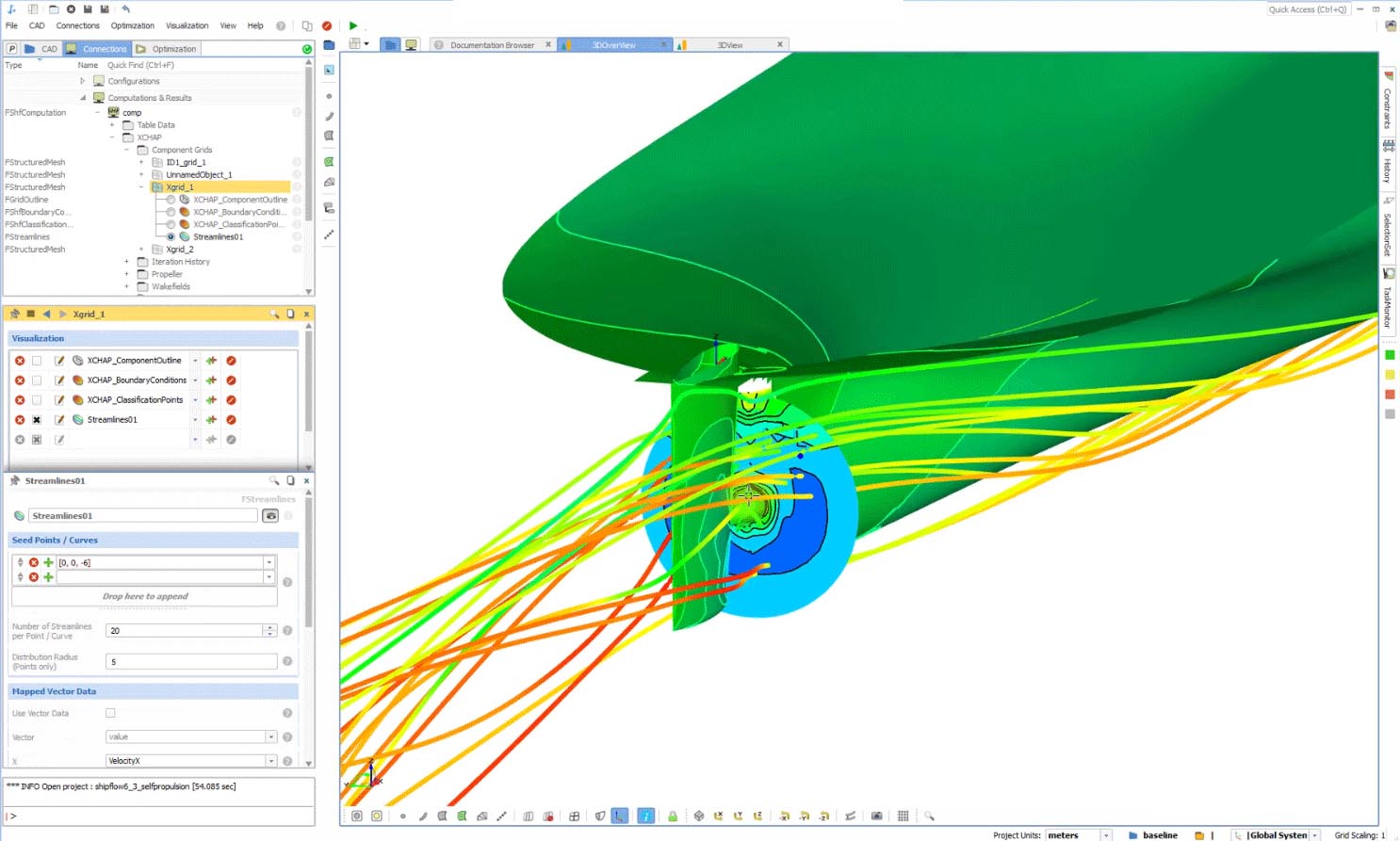
Advanced Reporting & Visualization : 3D visualization of pressure and velocity fields with analytical data output .
???? What’s New in Version 8.0 Compared to Previous Versions
Version 8.0 represents a major upgrade from previous versions. The table below highlights key differences :
| Feature | Shipflow 8.0 (New) | Shipflow 7.x (Legacy) |
|---|---|---|
| Wind-Assisted Propulsion | Full Multi-Fidelity simulation (Flettner rotors, rigid wing sails) | Limited or no support |
| Wind Modeling | Atmospheric boundary layer (steady/unsteady) + deck wind simulation | Primarily for added wave resistance only |
| Hull Meshing | New XGR8 mesher for complex topologies (twin-hull) | Older methods with lower efficiency |
| Overlapping Grids | Major update for complex appendage support | Limited to simpler geometries |
| Maneuvering Capabilities | Virtual Captive test + derivatives + PID controller | More limited capabilities |
???? System Requirements
Minimum Requirements
-
OS: Windows 10/11 (64-bit) or Linux (64-bit)
-
CPU: Intel Core i5 or equivalent (2.5+ GHz)
-
RAM: 8 GB (16 GB recommended)






Reviews
There are no reviews yet.