

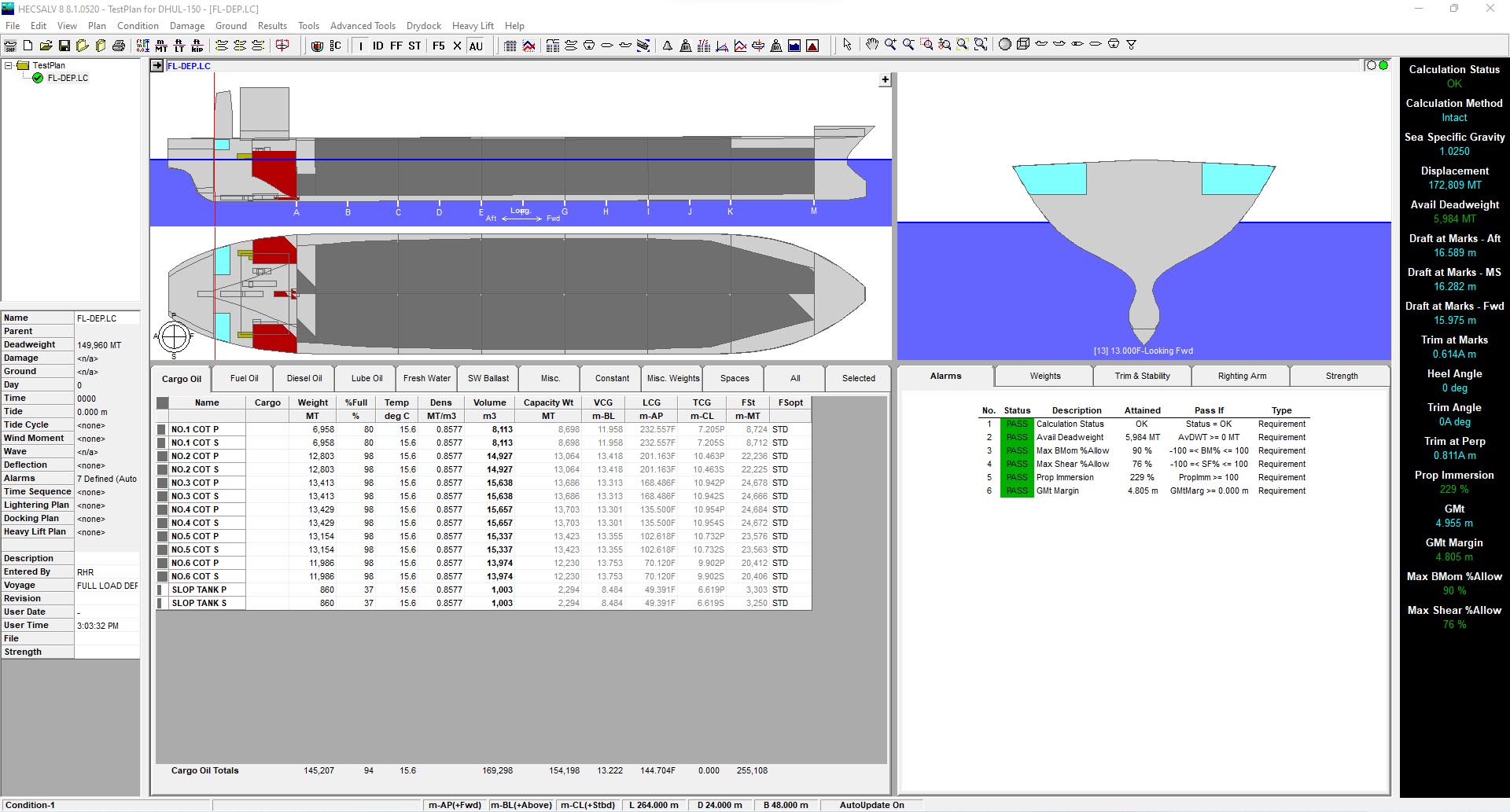
HECSALV 2025: Salvage & Emergency Response Software
HECSALV 2025 is the industry-leading salvage and emergency response software developed by Herbert-ABS Software Solutions LLC (a joint venture between Herbert Engineering Corp and American Bureau of Shipping) . Trusted by naval architects, salvage engineers, classification societies, and military organizations worldwide, HECSALV provides rapid, accurate evaluation of damaged ship conditions during maritime emergencies.
The software allows users to quickly collect and process available data, define the extreme bounds of the problem, and evaluate multiple scenarios for remedial action. As more information becomes available, the user can quickly and automatically update the entire analysis from beginning assumptions to later-stage pump allocations, producing a refined salvage plan
⚓ Primary Users
This professional salvage engineering software is designed for:
-
Salvage Engineers & Naval Architects evaluating damaged vessel stability, grounding scenarios, and lightering plans
-
Ship Owners & Operators conducting emergency response planning and oil outflow assessment
-
Classification Societies verifying damage stability and residual structural strength (Certified by CR Classification Society)
-
Military Organizations & Coast Guards performing rapid casualty response and towing analysis
-
Offshore & Energy Companies analyzing FPSO/FSO stability and mooring requirements
⚡ Key Features & Capabilities
???? Stability Analysis
| Capability | Description |
|---|---|
| Intact Stability | Unusual loads, direct evaluation of free surface effects at large heel angles |
| Free-Floating Damage | Evaluation of equilibrium and partial flooding conditions |
| Damage Stability | MARPOL/OPA-90 compliant modeling for certification |
| Tide Cycle Analysis | Time-sequence analysis spanning one or more tide cycles |
????️ Grounding & Structural Assessment
-
Multiple Grounding Types – Rigid and penetrable shelves, single and multiple pinnacles
-
Structural Damage Evaluation – Assessment of residual strength and risk of hull fracture
-
Corroded Structure Modeling – Analysis with Section Modulus Editor for damaged/corroded sections
-
Ground Reaction Analysis – Structural evaluation of grounding impacts
⛽ Oil Outflow & Lightering
-
Oil Outflow Assessment – Critical evaluation of oil loss for mobilization decisions, including density differences and tide effects
-
Lightering Plans – Transfers within vessel, to lightering barges, or discharge into sea
-
Intact/Damaged Tank Transfers – Full lightering capability
???? Towing & Rapid Analysis
-
Rapid Analysis Feature – Quick rational estimates of salvage issues without pre-defined ship model
-
Towing Analysis – Tow line tensions, towing speed, and safety factors
-
Tow Planning Module – Evaluate towing requirements
???? Supported Applications
| Application | Purpose |
|---|---|
| Ship Project Editor | Ship modeling tool to define vessel geometry |
| Section Modulus Editor | Detailed structural cross-section analysis with damage/corrosion simulation |
| Tow | Towing planning and evaluation |
| Rapid | Emergency response tool independent of pre-defined ship model |
| Ullage/Sounding Table Generator | Generate tables for breached void spaces |
???? Integration
-
100% compatible with CargoMax™ 2.x and LMP 2.x
-
SMP Interface – Connects to US Navy’s Ship Motions Program for dynamic load calculation
???? What’s New in HECSALV 2025
Based on the evolution from Version 8 (2013) to current 2025 release:
-
Enhanced core calculations with refined, more user-friendly interface
-
New 3D rendered graphics based on Hoops 3D technology
-
Simplified grounding definition wizard
-
Observed draft tools to quickly establish waterplane
-
Fully integrated ullage/sounding tools
-
Customizable alarms and criteria
-
Macro language for custom calculations
Offshore Component (HECSALV Offshore):
-
Advanced loading capabilities for tendons, chains, and risers
-
MODU Code stability evaluation
-
Environmental loading (wind, current, wave)
-
Multiple-axis stability
???? System Requirements
Minimum Requirements
-
OS: Windows 10/11 (64-bit)
-
Processor: 2.0 GHz dual-core
-
RAM: 8 GB (16 GB recommended for complex models)
-
Storage: 10 GB free space (SSD recommended)
-
Display: 1280 × 1024 resolution






Reviews
There are no reviews yet.