

Ensoft DynaN 2026.4.1 – Dynamic Analysis of Shallow and Deep Foundations Under Harmonic, Transient, and Random Loadings
DynaN is a computer program developed by Ensoft Inc. for the dynamic analysis of shallow and deep foundations under harmonic, transient, and random loadings . Such loadings can be produced by rotating or reciprocating machines, earthquakes, wind, blasts, sea waves, and other sources .
The program is based on the improved Novak’s method, where a non-reflective boundary is formed between the near field and the far field to account for the mass of soil in the boundary zone . This approach enables the program to compute the dynamic stiffness and damping constants of foundations, which can then be used in soil-structure interaction analyses .
Version 2026.4.1 is a significant release in the 2026 development cycle, introducing double-precision computation for improved numerical stability, an interactive footing response amplitude function, new data entry templates, and Microsoft Word/Excel report generation . This version represents the latest evolution of the DynaN platform since its original release, with version 3.0 preceding the current 2026 numbering scheme.
Primary Users
DynaN 2026.4.1 is designed for geotechnical engineers, structural engineers, and earthquake engineering specialists who need to perform dynamic analysis of foundations subjected to a wide range of loading conditions. It serves professionals who:
-
Design foundations for rotating or reciprocating machinery requiring precise vibration analysis
-
Evaluate foundation response to seismic events, wind, blast, and wave loading
-
Perform soil-structure interaction (SSI) studies for buildings, bridges, and industrial structures
-
Analyze both shallow foundations (footings, mats) and deep foundations (pile groups) in layered soil profiles
-
Generate foundation stiffness and damping matrices for integration into structural analysis programs such as SAP2000
Key Features & Capabilities
Theoretical Foundation and Analysis Methods
-
Improved Novak’s Method: A non-reflective boundary is formed between the near field and the far field to account for the mass of soil in the boundary zone
-
Coupled Six Degrees of Freedom: Foundations (or caps on piles) are assumed rigid, and all six DOF are considered as coupled
-
Time and Frequency Domain Analysis: Supports transient and random loading analysis in the time domain, and harmonic loading analysis in the frequency domain
-
Damping Reduction: Based on experimental results from full-scale tests; soil damping is reduced for practical engineering applications
Foundation Types Supported
| Foundation Type | Description |
|---|---|
| Half-Space | Footing supported on a homogeneous half-space |
| Stratum | Footing supported on a homogeneous layer |
| Multilayer | Footing embedded in layered medium |
| Pile Option | Deep foundation (single piles and pile groups) |
Dynamic Response and Loading Types
-
Harmonic Loading: Constant amplitude or frequency-dependent (quadratic) excitation
-
Transient Loading: Time-domain analysis for impulsive loads
-
Random Loading: Stochastic loading analysis
Soil-Structure Interaction Capabilities
-
Foundation Stiffness and Damping: Returns stiffness and damping constants for use in soil-structure interaction analysis
-
Substructure Method: Superstructure response can be calculated using finite element programs like SAP2000, while foundation stiffness and damping are generated by DynaN
-
Group Effect: Pile group interaction accounted for using interaction factors
-
Soil Layering: Supports layered soil profiles with different material properties
-
Weakened Zone: Models possible weakened zones around foundations
New Features in Version 2026.4.1
-
Double-Precision Computation: Improves numerical stability for complex applications and convergence of numerical iterations
-
Interactive Footing Response Amplitude: View response amplitudes at any user-specified reference point (with XYZ coordinates) instead of only at the center of gravity
-
Data Entry Templates: New “Copy Prev. Row” button in Soil Layer Data and Pile Sections input screens to save time on data entry
-
Pile Group Coordinate Templates: Automatic generation of rectangular and circular pile layouts with user-specified spacing
-
Simplified Pile Section Input: Single row of pile section properties for uniform cross-section piles
-
Microsoft Word Report Generation: Pre-formatted reports including model data, output tables, and graphs
-
Export Plots to Excel: Background data for graphics can be exported to Microsoft Excel for further analysis
-
Time History Upload: Upload transient or random load data from external text files or copy/paste from clipboard
-
3D View Improvements: Enhanced display for models with embedded pile caps
-
Single Sign-On (SSO): For enterprise-level remote subscription licenses
Output and Visualization
-
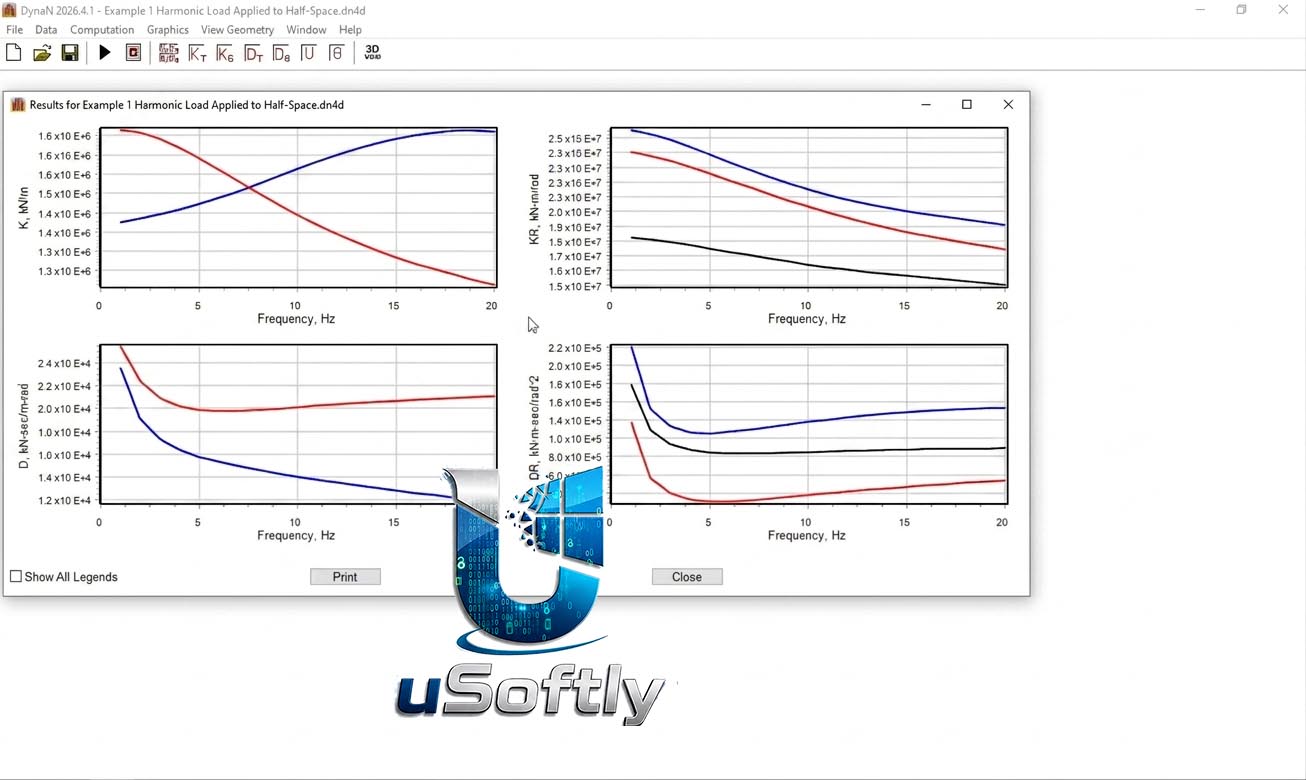
Translation Stiffness (Kxx, Kyy, Kww): Plots vs. loading frequencies
-
Rotation Stiffness (Kppx, Kppy, Kzt): Plots vs. loading frequencies
-
Translation Damping (Cxx, Cyy, Cww): Plots vs. loading frequencies
-
Rotation Damping (Cppx, Cppy, Czt): Plots vs. loading frequencies
-
Footing Response Amplitude: Harmonic, random, and transient response plots at center of gravity or user-specified reference point
-
3D Model Visualization: Top, side (XZ and YZ planes), and 3D views


Reviews
There are no reviews yet.