

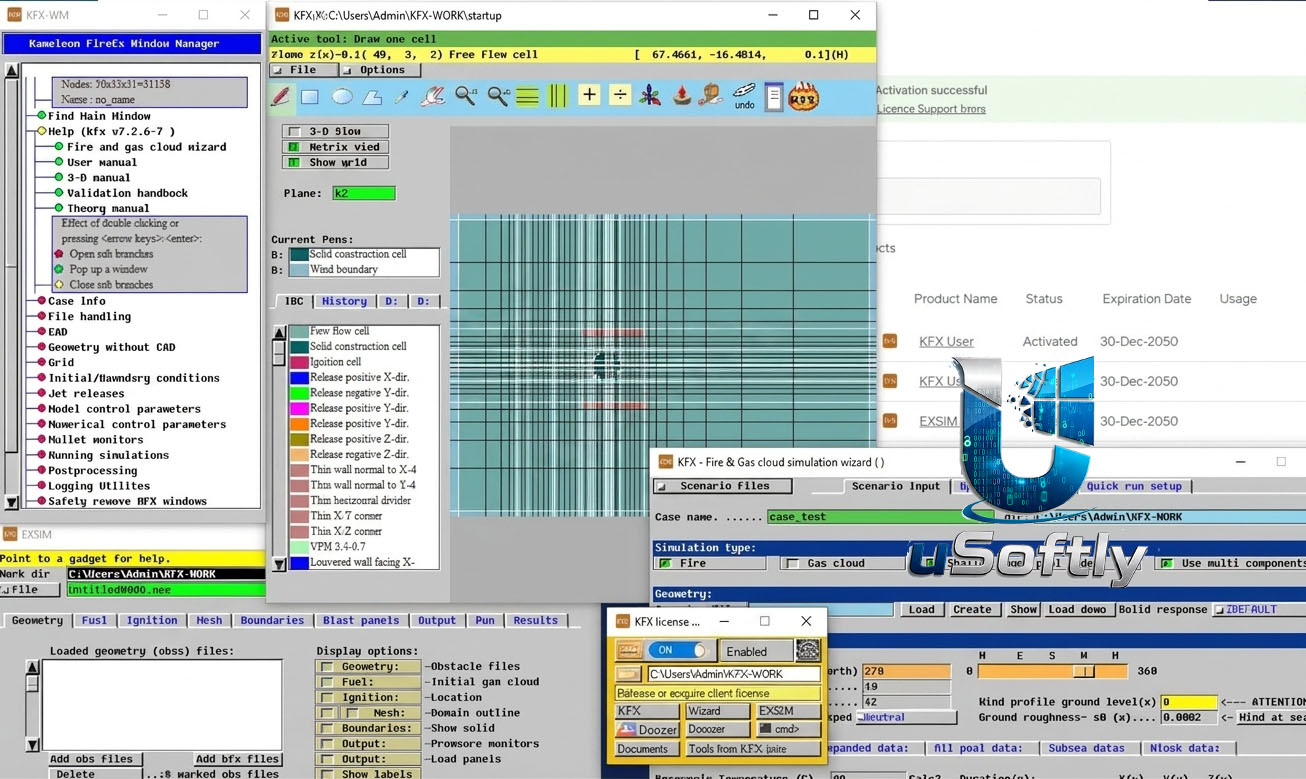
DNV KFX and EXSIM 2026 v7.2.6 – Advanced CFD Software Suite for Gas Dispersion, Fire, and Explosion Simulation in Industrial Environments
DNV KFX (Kameleon FireEx) and EXSIM are advanced 3D Computational Fluid Dynamics (CFD) tools developed by DNV (formerly DNV GL) for the simulation of gas dispersion, fires, and explosions in complex industrial geometries . They are widely used in the oil and gas, chemical, and energy sectors to support safety case development, risk assessments, and design optimization .
The software is trusted by leading oil and gas operators, engineering firms, and regulatory authorities worldwide . KFX and EXSIM are recognized as the industry standard for consequence modeling of major accidents, with a strong track record of validation against experimental data.
Primary Users
DNV KFX and EXSIM 2026 v7.2.6 are designed for safety engineers, risk analysts, process safety professionals, and CFD specialists in the oil and gas, chemical, pharmaceutical, and energy industries. It serves professionals who:
-
Perform consequence analysis for gas leaks, fires, and explosions to support safety case development and regulatory compliance
-
Design and optimize passive fire protection, blast mitigation measures, and gas detection systems
-
Conduct quantitative risk assessments (QRA) for offshore platforms, onshore plants, and LNG facilities
-
Evaluate the effectiveness of layout modifications and safety barriers in reducing risk
-
Support decision-making for plant design, emergency response planning, and incident investigation
Key Features & Capabilities
Gas Dispersion Modeling (KFX)
KFX provides accurate simulations of gas releases from leaks in complex geometries, accounting for the effects of wind, terrain, buildings, and obstructions . It models:
-
Steady-state and transient gas releases including jet, plume, and heavy gas dispersion
-
Gas accumulation in confined and semi-confined areas
-
Ventilation effects and natural/forced convection
-
Evaporation from liquid pools and aerosol formation
-
Rainout and vaporization of volatile liquids
Fire Modeling (KFX)
KFX models all aspects of fires with an industry-leading flame model:
-
Jet fires, pool fires, flash fires, and fireballs
-
Impact of wind and obstacles on flame geometry and heat flux
-
Passive fire protection (PFP) requirements and heat load on equipment
-
Radiation to personnel and surrounding structures
-
Fire-induced structural response and escalation
Explosion Modeling (EXSIM)
EXSIM specializes in gas explosion modeling with a focus on:
-
Vapor cloud explosions (VCE) in both open and congested areas
-
Deflagration to detonation transition (DDT)
-
Overpressure generation and propagation
-
Effect of congestion (pipelines, vessels) and confinement (walls, decks)
-
Blast wave propagation and load on structures
Integrated Workflow and Automation
The KFX and EXSIM package provides several key workflow advantages:
-
Automated Mesh Generation: Tailored for industrial geometries with buildings, equipment, and piping; supports adaptive mesh refinement for details like pipe racks
-
Automated Analysis: Prepare and run simulation cases without manual intervention after initial setup
-
Post-Processing: Comprehensive visualization tools for geometry, results, and comparisons; export to common formats and third-party viewers
Industry Validation and Support
KFX and EXSIM are validated against a large number of experimental data sets, including large-scale field tests. The software is supported by a team of experts and a dedicated user community.
What’s New in KFX & EXSIM 2026 v7.2.6
While specific release notes for version 7.2.6 are not available in the provided search results, the 2026 release cycle continues the development of the KFX and EXSIM platform. Previous major updates have included:
-
Parallel Solver Support for faster simulation and efficient utilization of multi-core processors
-
User-Defined Chemical Kinetics for modeling gas combustion in complex conditions
-
Enhanced Solver Stability and Accuracy through improved algorithms
-
Updated Pre-Processors for gas release and fire/explosion modeling
-
New Features for Radiation Modeling, including view factors for mixed effects





Reviews
There are no reviews yet.