

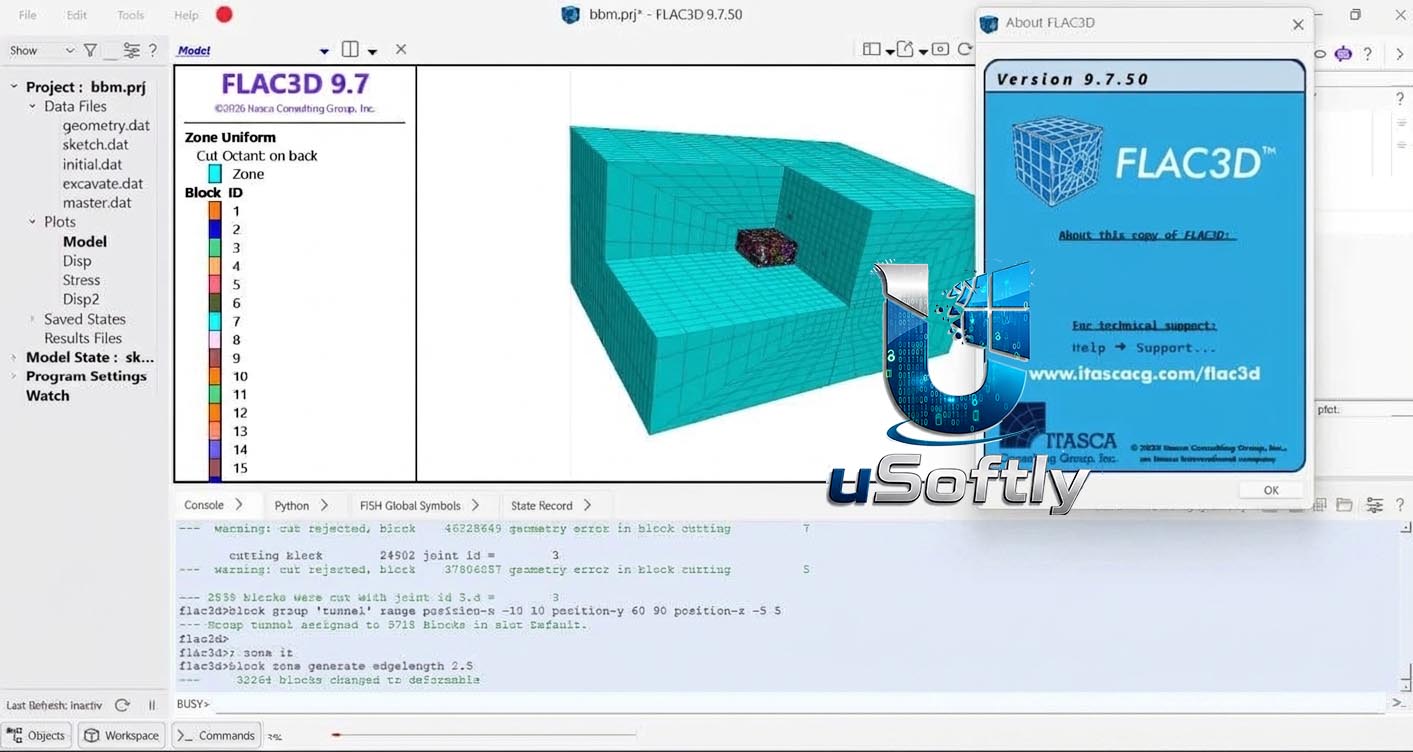
Download Itasca FLAC3D 9.7.50 – Advanced Geotechnical Analysis Software
Itasca FLAC3D is a powerful numerical modeling software developed by Itasca Consulting Group, Inc., designed for advanced geotechnical analysis. This application is crucial for professionals in civil engineering, mining, and geomechanics disciplines, enabling detailed simulations of soil and rock structures. The software facilitates the understanding and prediction of complex geomechanical behavior under various conditions.
Understanding Itasca FLAC3D
Itasca FLAC3D is a sophisticated numerical software that utilizes a finite difference method to analyze the behavior of soil, rock, and other materials in three dimensions. It excels in modeling both linear and nonlinear responses, making it suitable for a wide range of geomechanical challenges.
Overview of FLAC3D’s Capabilities
FLAC3D offers a comprehensive suite of capabilities for advanced geomechanical simulations. Its core strength lies in its ability to handle complex material behaviors and geometric configurations, providing engineers with robust tools for analysis and design.
- Continuous Lagrangian analysis for simulating large deformations and complex failure mechanisms in geomechanical contexts.
- Advanced capabilities for modeling nonlinear material behavior, including plasticity, creep, and fabric anisotropy in soil and rock masses.
- Robust simulation of both static and dynamic loading conditions, essential for seismic analysis and impact assessments.
- Extensive mesh generation tools combined with a powerful built-in C++-based programming language (FISH) for automating complex tasks and custom analyses.
- Visualization of results through contour plots, vector fields, and historical data tracking, aiding in the interpretation of simulation outcomes.
Main Applications in Civil Engineering
The practical applications of Itasca FLAC3D are extensive within civil engineering. Its advanced simulation features allow for detailed assessments of structural integrity and performance in demanding environments.
- Analysis of underground excavation stability, including tunnels, caverns, and deep mines, considering stress redistribution and potential failures.
- Design and assessment of foundations for large structures, analyzing settlement, bearing capacity, and soil-structure interaction under various loads.
- Slope stability analysis and remediation design for natural terrain and engineered slopes, identifying potential failure modes and evaluating reinforcement effectiveness.
- Infrastructure strengthening projects, such as evaluating the performance of earth dams, levees, and retaining walls under operational and extreme conditions.
- Modeling the behavior of underground storage facilities and contaminant transport through porous media.
Modeling Techniques and Approaches
FLAC3D provides users with flexible methods to define geometric parameters and simulate nonlinear material responses. These techniques are fundamental to achieving accurate and reliable geomechanical simulations.
Geometric Parameters and Nonlinear Behavior
Accurately defining the geometry of a project site and its subsurface conditions is fundamental to successful modeling. FLAC3D allows for the precise input of complex 3D geometries, which directly influences the simulation of stress distribution and deformation.
The software’s capacity to model nonlinear behavior is a key differentiator. This includes simulating how materials like soil and rock deform irreversibly under stress, experience strain softening, or exhibit time-dependent creep. By accurately capturing these nonlinear effects, FLAC3D enables more realistic predictions of structure performance and failure mechanisms than simpler linear models.
Integration with Other Engineering Tools
While FLAC3D is a powerful standalone application for geomechanical analysis, its utility is often enhanced through integration with other specialized engineering software. This interoperability allows for more comprehensive project workflows.
- Data exchange with CAD and BIM software for importing terrain models and exporting analysis results for visualization in broader project contexts.
- Coupling with groundwater flow models to simulate coupled hydro-mechanical behaviors in saturated or partially saturated soils.
- Potential integration with seismic analysis software to incorporate dynamic loading conditions from earthquake records into geotechnical models.
- Exporting results for structural analysis software to assess the impact of soil-structure interaction on adjacent civil engineering structures.
Real-World Case Studies
Itasca FLAC3D has been instrumental in solving complex challenges across various engineering projects. Its advanced analytical capabilities provide reliable insights into the behavior of soil and rock mechanics.
- A significant underground excavation project benefited from FLAC3D analysis to pre-emptively identify potential instability zones and optimize support systems, preventing costly delays and ensuring worker safety.
- In the development of a major transportation infrastructure, the software was used to model the long-term geomechanical behavior of a tunnel subjected to static and dynamic loads, verifying its structural integrity over its design life.
- Geotechnical engineers utilized FLAC3D to assess the stability of natural slopes that were susceptible to landslides, informing recommendations for stabilization measures such as retaining walls and soil nailing.
- The software played a role in the design of foundations for a large industrial facility, accurately predicting settlement behavior under heavy loads by considering the nonlinear stress-strain response of the underlying soil strata.
Getting Started with FLAC3D
Commencing with Itasca FLAC3D involves understanding its core functionalities and workflow. While the software offers a graphical user interface, proficiency in its advanced features often involves scripting.
Users typically begin by defining the project geometry, selecting appropriate material models to represent the soil or rock, and applying boundary conditions and loads. The simulation is then executed, and results are analyzed using FLAC3D’s built-in post-processing tools. For complex or repetitive tasks, utilizing the built-in C++-based programming language (FISH) is recommended to automate procedures and optimize the modeling process.
Conclusion
Itasca FLAC3D 9.10 stands as a vital tool for geotechnical engineers, offering unparalleled capabilities in simulating the complex geomechanical behavior of soil and rock. Its strengths in nonlinear analysis, 3D modeling, and versatile application across mining, civil engineering, and geomechanics make it indispensable for critical infrastructure projects. By providing detailed insights into structural stability and performance, Itasca FLAC3D download ensures safer, more efficient, and reliable engineering designs.
Frequently Asked Questions
What types of analysis can I perform with Itasca FLAC3D?
FLAC3D is designed for geotechnical analysis and can perform both static and dynamic simulations of soil and rock behavior under various loading conditions. This includes stress-strain analysis, deformation, and failure mechanism prediction.
Is coding required to effectively use Itasca FLAC3D?
Yes, while FLAC3D offers a graphical user interface, advanced modeling often requires coding to implement complex scenarios and maximize the software’s capabilities. The built-in scripting language facilitates automation and customization.
In which industries is Itasca FLAC3D primarily used?
FLAC3D is mainly used in civil engineering, mining, and geomechanics, with applications across various projects involving soil and rock analysis. Its versatility supports diverse applications from tunneling to slope stability.






Reviews
There are no reviews yet.