

Ensoft Inc 2026 – Industry-Leading Geotechnical Engineering Software for Deep Foundations and Soil-Structure Interaction
Ensoft, Inc. is a Texas-based software company founded in 1985 that specializes in the development of geotechnical engineering software. The company’s flagship product, LPILE, is recognized as the industry standard for laterally loaded pile analysis using the p-y method.
The 2026 release cycle brings significant updates across multiple programs, including new features, expanded material models, and modernized user interfaces. Each program is sold individually, and all require an active maintenance contract for access to updates and technical support.
Primary Users
Ensoft, Inc. software is designed for geotechnical engineers, structural engineers, and foundation design specialists who analyze deep foundations and soil-structure interaction. It serves professionals who:
-
Design and analyze piles and drilled shafts under lateral, axial, and combined loading
-
Perform pile group analysis for complex foundation systems
-
Evaluate retaining walls and slope stability using advanced numerical methods
-
Conduct dynamic foundation analysis for machine foundations and seismic loading
-
Perform 2D finite element analysis for soil-structure interaction problems
Confirmed 2026 Software Releases
LPILE v2026 — Laterally Loaded Pile Analysis
LPILE v2026 coincides with the program’s 40th anniversary and includes significant technical and presentation improvements while maintaining its familiar interface.
Key Features:
-
Expanded p-y Curve Library: Includes models for liquefied sand (Franke & Rollins) and massive rock (Liang et al.)
-
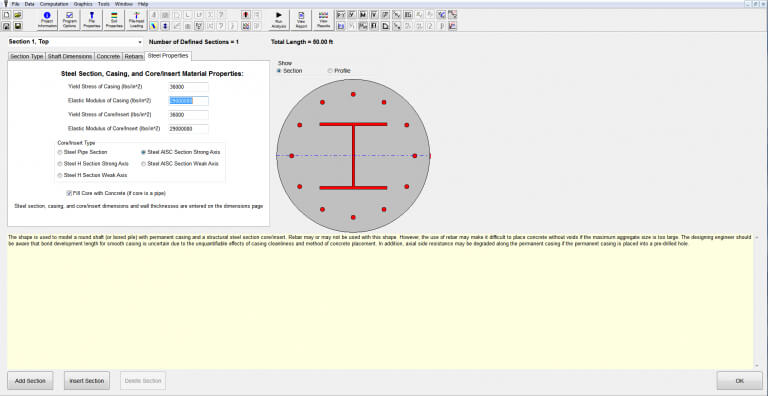
AISC Section Support: Include any AISC section for nonlinear or elastic pile models
-
Confinement Effect Modeling: Automatic confinement effect for rectangular and circular shafts (Mander, Priestley, Park 1998)
-
Interaction Diagrams: Automatic full interaction diagram generation for all sections
-
Push-Over Analysis: Automatic push-over analyses for a range of pile-head displacements
-
Pile Buckling Analysis: Automatic buckling analysis with various pile-head fixity conditions
-
LRFD Implementation: Up to 100 load combinations with resistance factors for flexure and shear
-
Stiffness Matrix Computation: Pile-head stiffness matrix values for soil-structure interaction studies
-
Export to Excel: Direct plot export with pre-formatted tabs
-
Version Numbering: 2026.13.04
APILE v2026 — Axially Loaded Driven Pile Analysis
APILE v2026 computes the axial capacity (skin friction and end bearing) of driven piles as a function of depth.
Key Features:
-
Standard Methods: API RP-2A, USACE, FHWA, Revised Lambda Method
-
Offshore CPT-Based Methods: NGI, ICP, UWA, Unified CPT-Based (UCPT), Alm & Hamre (A&H)
-
LRFD Implementation: Independent reduction factors for skin friction and end bearing per AASHTO
-
Load-Settlement Curves: Short-term prediction using internal t-z and Q-w curves
-
Tensile (Uplift) Loading: Computations with user-specified reduction factors
-
Neutral Plane Analysis: Downdrag analysis per FHWA recommendations
-
CPT Data Import: Read cone penetration test files and convert to equivalent SPT-N values
-
GRLWEAP Export: Generate input files for dynamic pile driving analysis
-
User Manual: Dated April 2026, confirming active release
DynaN v2026 — Dynamic Foundation Analysis
DynaN v2026 performs dynamic analysis of shallow and deep foundations under harmonic, transient, and random loadings.
Key Features:
-
Improved Novak’s Method: Non-reflective boundary between near field and far field
-
Coupled Six Degrees of Freedom: All six DOF considered as coupled
-
Time and Frequency Domain Analysis: Transient, random, and harmonic loading
-
Foundation Types: Half-space, stratum, multilayer, and pile options
-
Double-Precision Computation: Improved numerical stability for complex applications
-
Interactive Footing Response Amplitude: View response amplitudes at any user-specified reference point
-
Data Entry Templates: “Copy Prev. Row” button for efficient data entry
-
Pile Group Coordinate Templates: Automatic generation of rectangular and circular pile layouts
-
Microsoft Word Report Generation: Pre-formatted reports with model data, tables, and graphs
-
Export Plots to Excel: Background data for graphics can be exported to Excel
-
Time History Upload: Upload transient or random load data from external text files
-
Single Sign-On (SSO): For enterprise-level remote subscription licenses
-
Version Numbering: 2026.4.1 (release date September 8, 2026)
EnFEM 2026 — 2D Finite Element Analysis
EnFEM 2026 is a general-purpose 2D finite element analysis program for simulating the mechanical behavior of solid materials under various loads.
Key Features:
-
Analysis Types: Plane-strain, plane-stress, and axisymmetric analyses
-
Element Library: First- or second-order quadrilateral and triangular elements
-
Material Models: Linear elastic, Tresca, von Mises, Mohr-Coulomb, Drucker-Prager, Duncan-Chang, Modified Cam-Clay
-
Strength Reduction Method (SRM): Built-in finite element slope stability analysis
-
Geostatic Stress: Multi-stage analysis for sequentially applied loads
-
Contact Analysis: Penalty methods for conforming or non-conforming meshes
-
PYWall Import: Models built in PYWall can be imported directly
-
Version Numbering: 2026.4.2
EnSlope v2025 — Slope Stability Analysis
EnSlope (Version 2025, released July 9, 2026) is a slope-stability program based on the STABL series.
Key Features:
-
Limit Equilibrium Methods: Bishop, Janbu, Spencer, and others
-
Quick and Easy to Use: Designed for fast slope stability assessments
-
STABL Heritage: Based on the well-established STABL series
Other Ensoft Programs
The following programs are part of Ensoft’s portfolio, though specific 2026 version confirmations were not explicitly detailed in the search results:
| Program | Application |
|---|---|
| GROUP | Analysis of pile groups under combined axial, lateral, and torsional loading (version 2022.12.10 confirmed) |
| PYWall | Analysis of flexible retaining walls (version 2025.8.7 confirmed) |
| DynaPile | Dynamic stiffness of single piles and pile groups (version 2026.4.1 confirmed) |
| SETOFF | Settlement analysis of foundations |





Reviews
There are no reviews yet.