

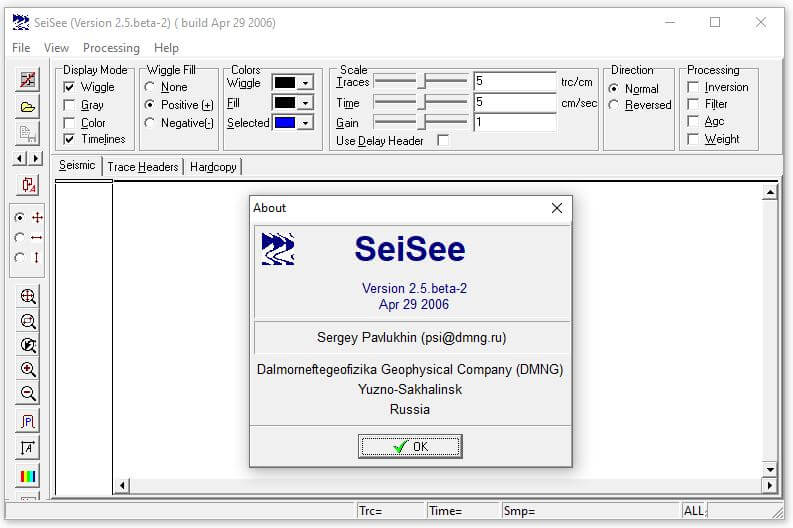
Download Seisee 2.5 – Visualize Seismic Data Effectively
Seisee 2.5 is a specialized software application designed for seismic data visualization within the field of geophysics. It enables professionals in earth sciences to effectively interpret and analyze geological subsurface data, particularly from formats like SEG-Y and CST. This tool is essential for tasks ranging from oil exploration to environmental assessments, providing an intuitive interface for managing complex seismic datasets.
Introduction to Seisee 2.5 and Its Applications
Overview of Seismic Data Visualization
Visualizing seismic data is critical in geophysics for understanding subsurface structures, identifying potential resource reservoirs, and assessing geological hazards. Seisee 2.5 facilitates this process by offering advanced tools to render and interpret the complex wave patterns recorded by seismic surveys. Its applications span across numerous real-world scenarios, from mapping hydrocarbon deposits in the oil and gas industry to studying tectonic plate movements and evaluating the environmental impact of geological formations.
Key Features of Seisee 2.5
Supported Formats and Data Manipulation
Seisee 2.5 is engineered to handle common geophysical data formats, providing users with the tools necessary for deep data analysis. The software allows for detailed interaction with seismic traces and their associated metadata.
- Supports both SEG-Y and CST file formats for comprehensive seismic data loading.
- Accommodates various sample formats, including integer and IBM float, ensuring compatibility with diverse datasets.
- Enables users to extract and manipulate individual seismic traces based on their index or header information.
- Provides functionality to write processed or selected data segments back to disk in SEG-Y format.
Understanding SEG-Y and CST Formats
Technical Specifications and Applications
The SEG-Y (Society of Exploration Geophysicists – Y) format is a widely adopted standard for storing seismic data, essential for geophysical exploration and research. It encodes header information alongside the recorded seismic traces, making it a robust format for data exchange and analysis.
- The SEG-Y format includes a 3200-byte ASCII text header and a binary reel header, followed by trace data.
- CST files, while less universally known than SEG-Y, serve similar purposes in seismic data storage and are supported by Seisee 2.5 for extended compatibility.
- Understanding these formats is crucial for geophysicists to ensure data integrity and effective utilization within specialized software like Seisee 2.5.
User Interface and Functionality
Navigating Seisee’s Features
Seisee 2.5 features an intuitive graphical user interface designed to simplify the complex task of seismic data analysis. Users can efficiently explore datasets and extract specific information without extensive scripting.
- The interface allows for easy navigation through stacked seismic traces using simple controls.
- Users can select and display specific header values associated with each trace, providing context for seismic interpretation.
- Interactive tools facilitate the examination of trace characteristics and the identification of geological features.
Real-World Use Cases
Applications in Geophysics
Seisee 2.5 provides practical solutions for professionals across various sectors that rely on seismic data interpretation. Its specialized features make it a valuable tool for both analytical and exploratory tasks.
- Oil and Gas Exploration: Used to visualize subsurface seismic surveys to identify potential oil and gas reservoirs, analyze geological structures, and plan drilling operations.
- Environmental Assessments: Applied to study underground geological formations, assess soil stability, or monitor seismic activity for environmental impact studies.
- Academic Research: Supports researchers in seismology and earth sciences for analyzing seismic wave propagation, studying tectonic plate boundaries, and conducting geophysical surveys for educational purposes.
Comparison with Other Geophysical Software
Seisee vs. Competitors
When evaluating seismic data visualization tools, Seisee 2.5 distinguishes itself through its focused approach on specific formats and user-friendly manipulation capabilities.
- Compared to more general visualization platforms, Seisee 2.5 offers specialized support for SEG-Y and CST formats, reducing the need for format conversion.
- Its interface is designed for straightforward navigation and manipulation of seismic traces and header values, potentially offering a simpler learning curve for users focused on these specific tasks.
- While other software might offer broader geophysical analysis suites, Seisee 2.5 provides a dedicated solution for efficient seismic data visualization and basic data extraction.
Frequently Asked Questions
What file formats does Seisee 2.5 support for seismic data visualization?
Seisee 2.5 supports visualization of seismic data in SEG-Y and CST formats, accommodating various data types like integer and IBM float samples. This broad compatibility ensures that users can work with a wide range of seismic datasets commonly used in the industry.
Can Seisee 2.5 write SEG-Y files, and if so, how?
Yes, Seisee 2.5 allows users to write entire SEG-Y files or portions of it to disk, providing flexibility in data management based on trace index or header values. This feature is crucial for users who need to export processed data or specific segments for further analysis or integration into other workflows.
In what industries is Seisee 2.5 primarily used?
Seisee 2.5 is primarily used in geophysics and sectors related to earth sciences, such as oil and gas exploration and environmental studies, where seismic data interpretation is crucial. These industries rely heavily on the accurate visualization and analysis of subsurface data that Seisee 2.5 provides.






Reviews
There are no reviews yet.