

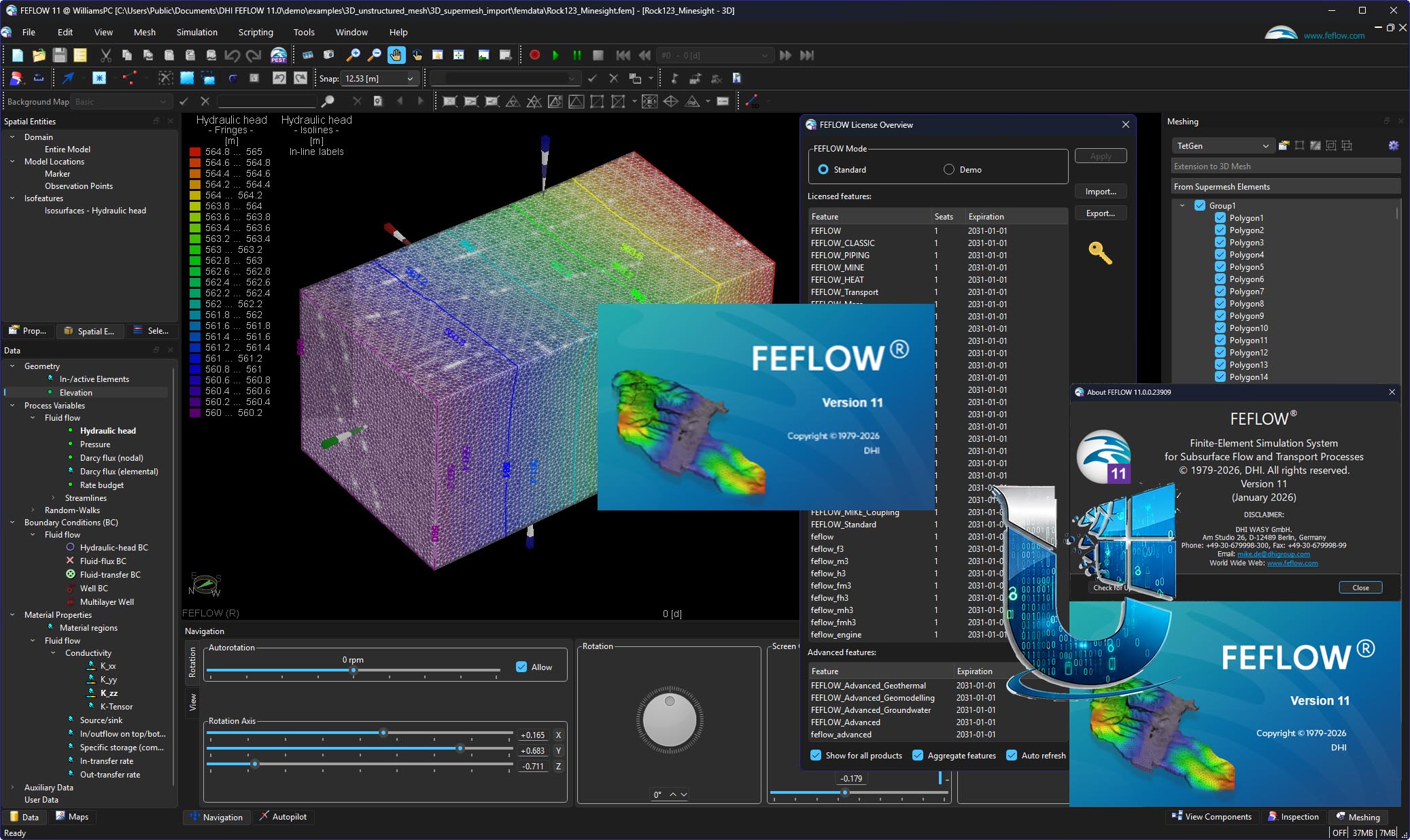
Download FEFLOW 2026 – Innovative Groundwater Modeling Software
FEFLOW 2026 is a leading finite element subsurface modeling program developed by DHI A/S, designed for simulating groundwater flow, heat transport, and mass transfer. Originally created in 1979 and refined over decades, FEFLOW is now a comprehensive solution for hydrogeology, environmental engineering, and geothermal energy professionals seeking advanced capabilities in subsurface modeling.
Overview of FEFLOW
History and Development
The origins of FEFLOW trace back to 1979, with its initial development by Hans-Jörg G. Diersch. The software’s advanced capabilities in subsurface modeling were further cultivated by WASY GmbH. In 2007, DHI A/S acquired FEFLOW, integrating it into their portfolio and continuing its development. This progression has ensured FEFLOW remains at the forefront of groundwater modeling technology, consistently evolving to meet the complex challenges faced by environmental engineers and hydrogeologists.
Key Functionalities of FEFLOW 2026
Advanced Flow and Heat Transport Modeling
FEFLOW 2026 leverages the power of the finite element method to accurately simulate groundwater flow and heat transport phenomena. The software supports a wide range of flow equations, allowing for the precise modeling of various hydrogeological conditions. Its advanced capabilities extend to detailed heat transfer simulations, crucial for understanding thermal regimes in subsurface environments, particularly in applications like geothermal energy extraction.
State-of-the-Art Reactive Transport Capabilities
Addressing the complexities of contaminant fate and transport, FEFLOW 2026 offers sophisticated reactive transport solvers. These features enable users to simulate the movement and transformation of chemical species in groundwater, considering various geochemical reactions. The software also facilitates coupling with external geochemical models, such as Phreeqc, to provide more comprehensive and accurate analyses of environmental pollution scenarios and remediation strategies.
Industry Applications for FEFLOW
Water Resource Management
In water resource management, FEFLOW is instrumental in assessing and managing aquifer systems. Its robust simulation capabilities support the analysis of groundwater replenishment strategies, the prediction of impacts from abstraction, and the evaluation of climate change effects on water availability. Professionals utilize FEFLOW to develop sustainable management plans for vital water resources.
Geothermal Energy Systems
FEFLOW is extensively used for modeling geothermal energy systems, providing essential tools for designing and optimizing energy extraction and injection processes. The software allows for the simulation of thermal dispersion and complex underground heat flows, supporting the development of efficient geothermal solutions. This makes it a valuable asset for companies and researchers in the renewable energy sector focused on geothermal applications.
Improved Integration and Data Features
GIS Data Integration
FEFLOW integrates seamlessly with Geographic Information System (GIS) tools, enhancing the analysis and visualization of subsurface data. This interoperability allows professionals to import, process, and utilize spatial data more effectively, building comprehensive models that align with real-world geographic information. The GIS integration streamlines workflows and improves the accuracy of model inputs and outputs.
New in Version 2026 v11
The latest iteration, FEFLOW 2026 v11, introduces significant enhancements, including improved tools for managing discrete fracture networks and modeling thermal dispersion. It also features new capabilities for geothermal modeling, advanced data integration, and enhanced coupling with other DHI software, such as MIKE. The addition of GPU acceleration significantly boosts simulation speeds, and new cloud capabilities offer greater flexibility in managing complex projects and data.
Comparison with Other Groundwater Modeling Software
Compared to other groundwater modeling software, FEFLOW distinguishes itself through its highly flexible finite element approach, which excels in handling complex geometries and heterogeneous subsurface conditions. While many programs offer basic flow simulation, FEFLOW’s advanced capabilities in multiphase flow, reactive transport, and integrated heat transfer modeling provide a more comprehensive toolkit. Its strong emphasis on advanced solvers and robust data integration, including GIS and direct coupling with other environmental modeling tools, positions it as a powerful solution for intricate hydrogeological challenges.
Conclusion
FEFLOW 2026 continues to be an indispensable tool for professionals in hydrogeology, environmental engineering, and related fields. Its comprehensive suite of advanced simulation capabilities, from multiphase flow and reactive transport to sophisticated heat transfer modeling, empowers users to tackle complex subsurface challenges. With continuous development and new features in version 2026, FEFLOW remains a premier choice for accurate and reliable groundwater modeling.
Frequently Asked Questions
What is FEFLOW used for?
FEFLOW is utilized for simulating groundwater flow, mass transport, and heat transfer within various subsurface conditions, aiding professionals in hydrogeology and environmental engineering to make critical decisions affecting water resource management, contaminant remediation, and infrastructure planning.
How does FEFLOW handle multiphase flow modeling?
FEFLOW employs a robust finite element method to model multiphase flow, enabling users to simulate complex scenarios such as saltwater intrusion, oil and gas migration, and other density-dependent flows with significant accuracy.
What are the latest features in FEFLOW 2026?
The latest version, FEFLOW 2026, introduces features such as GPU acceleration for faster simulations, improved reactive transport solvers, and enhanced coupling with surface water and GIS tools. It also includes specialized tools for discrete fracture networks and geothermal modeling, increasing its efficiency and usability.






Reviews
There are no reviews yet.