

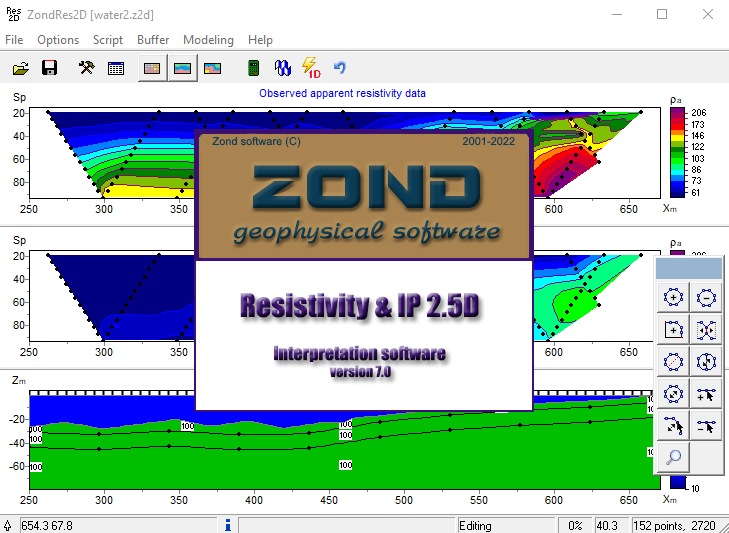
Download ZondST2D – Advanced Geological Engineering Software for Seismic Data Interpretation
ZondST2D is an advanced geophysics software developed for 2D seismic interpretation, crucial for professionals in geological engineering. This application is designed to interpret seismic data, employing mathematical modeling to address complex challenges inherent in seismology and subsurface analysis. Its specialized modules cater to a range of geophysical tasks, offering powerful tools for geophysicists and geological engineers working with seismic tomography data.
Introduction to ZondST2D
Overview of Seismic Tomography in Geophysics
Seismic tomography is a critical technique in geophysics and geological engineering, used to create detailed models of the Earth’s subsurface by analyzing seismic wave travel times and amplitudes. This process involves complex mathematical inversions to map variations in seismic velocity and attenuation. ZondST2D leverages these principles, providing a specialized environment for users to perform sophisticated 2D seismic interpretation, contributing to a deeper understanding of geological structures and properties for various engineering projects.
Key Functional Modules of ZondST2D
MASW / ReMi Module
The MASW (Multichannel Analysis of Surface Waves) and ReMi (Refraction Microtremor) modules within ZondST2D are dedicated to processing and interpreting surface wave data. These functionalities are essential for determining shear wave velocity profiles from ambient noise or controlled source seismic data, offering a robust approach to near-surface geophysics for engineering applications.
Key functionalities include:
- Processing of ambient noise and active seismic recordings.
- Dispersion curve extraction and analysis.
- Generation of shear wave velocity (Vs) models.
Reflection and Refraction Waves Modeling
This module provides capabilities for conventional seismic modeling using reflection and refraction wave phenomena. It aids in understanding wave propagation through different geological layers, facilitating the interpretation of seismic reflection and refraction survey data, which are fundamental in oil and gas exploration, as well as geotechnical investigations.
Users can perform:
- Modeling of seismic wave paths and travel times.
- Simulation of seismic responses for layered earth models.
- Assistance in forward modeling for inversion processes.
Attenuation Tomography Features
ZondST2D includes features for attenuation tomography, which analyzes the decay of seismic wave energy as they travel through the subsurface. This capability provides insights into the physical properties of the rock and fluid content, such as porosity and the presence of fluids, complementing velocity information for a more comprehensive subsurface characterization.
This module supports:
- Calculation of seismic attenuation coefficients (e.g., Qp, Qs).
- Tomographic inversion for 2D attenuation models.
- Integration of attenuation data into overall geological models.
Velocity Anisotropy Analysis
Analyzing velocity anisotropy is crucial for understanding the directional dependence of seismic wave velocities in rock formations, often caused by fabric or layering. ZondST2D offers tools to quantify and analyze these directional variations, providing geological engineers with essential data for assessing reservoir properties or rock mechanics integrity.
Features for anisotropy analysis include:
- Methods for identifying and quantifying seismic anisotropy.
- Incorporation of anisotropy effects into seismic modeling and inversion.
- Assessment of velocity variations with azimuth and incidence angles.
Main Features and Capabilities
ZondST2D is engineered with a robust set of features designed for efficient and accurate seismic data interpretation. Its core strengths lie in its advanced mathematical modeling capabilities, which are fundamental to seismic tomography. The software employs sophisticated inversion algorithms to process seismic data and generate detailed subsurface models. It also offers options for incorporating topographic effects, ensuring that geological models accurately reflect the complex surface conditions encountered in real-world surveys.
- Advanced mathematical modeling for seismic wave propagation.
- Sophisticated inversion algorithms for reliable data interpretation.
- Topography integration for realistic geological modeling.
- Tools specifically designed for 2D seismic interpretation tasks.
- Comprehensive processing of seismic datasets for geophysics applications.
Applications in Geological Engineering
Professionals in geological engineering utilize ZondST2D across a spectrum of projects requiring detailed subsurface analysis. Its application spans from near-surface investigations for civil engineering and environmental studies to more complex tasks in resource exploration. The software’s ability to generate detailed 2D seismic models assists engineers in making informed decisions regarding site characterization, hazard assessment, and the planning of infrastructure projects.
Typical use cases include:
- Characterizing shallow subsurface conditions for construction projects.
- Mapping geological structures for hydrocarbon exploration.
- Assessing geological hazards such as faults and zones of weakness.
- Environmental site assessments and groundwater investigations.
- Geotechnical investigations requiring detailed shear wave velocity profiles.
Integration and Compatibility
ZondST2D emphasizes practical integration within professional workflows by supporting various data formats and offering robust output options. The software can import and export data in common formats, facilitating seamless collaboration and data exchange. Its compatibility extends to bitmap and vector graphics, enabling detailed visualization of results, and it offers CAD integration, allowing seismic interpretation models to be readily incorporated into engineering design plans.
- Support for standard seismic data file formats.
- Export capabilities for bitmap (e.g., JPG, PNG, BMP) and vector graphics (e.g., WMF, EMF).
- Integration with CAD software through DXF or similar formats.
- Compatibility with spreadsheet applications for data tabulation.
Conclusion
ZondST2D stands as a powerful and specialized tool for geophysicists and geological engineers focused on 2D seismic interpretation. Its modular design, combined with advanced mathematical modeling and robust visualization capabilities, makes it an invaluable asset for understanding complex subsurface structures. By facilitating detailed seismic tomography and providing comprehensive output compatibility, ZondST2D supports accurate data analysis and enhances decision-making in critical engineering and scientific projects.
Frequently Asked Questions
What is ZondST2D used for?
ZondST2D is a software application designed for interpreting seismic tomography data, specifically for geological and engineering tasks that require detailed seismic analysis. It helps in processing various wave types essential for understanding subsurface conditions, enabling the creation of detailed 2D models.
What are the main modules in ZondST2D?
The main modules in ZondST2D include MASW/ReMi for surface wave data processing, modeling for refractive and reflection waves, and tools for attenuation tomography and velocity anisotropy analysis, providing a comprehensive set of functionalities for geophysical analysis.
How does ZondST2D handle data visualization?
ZondST2D offers advanced visualization capabilities, including three-dimensional illustrations of the velocity section and various output formats to integrate with programs like AutoCAD or Excel for enhanced data presentation and sharing.






Reviews
There are no reviews yet.