

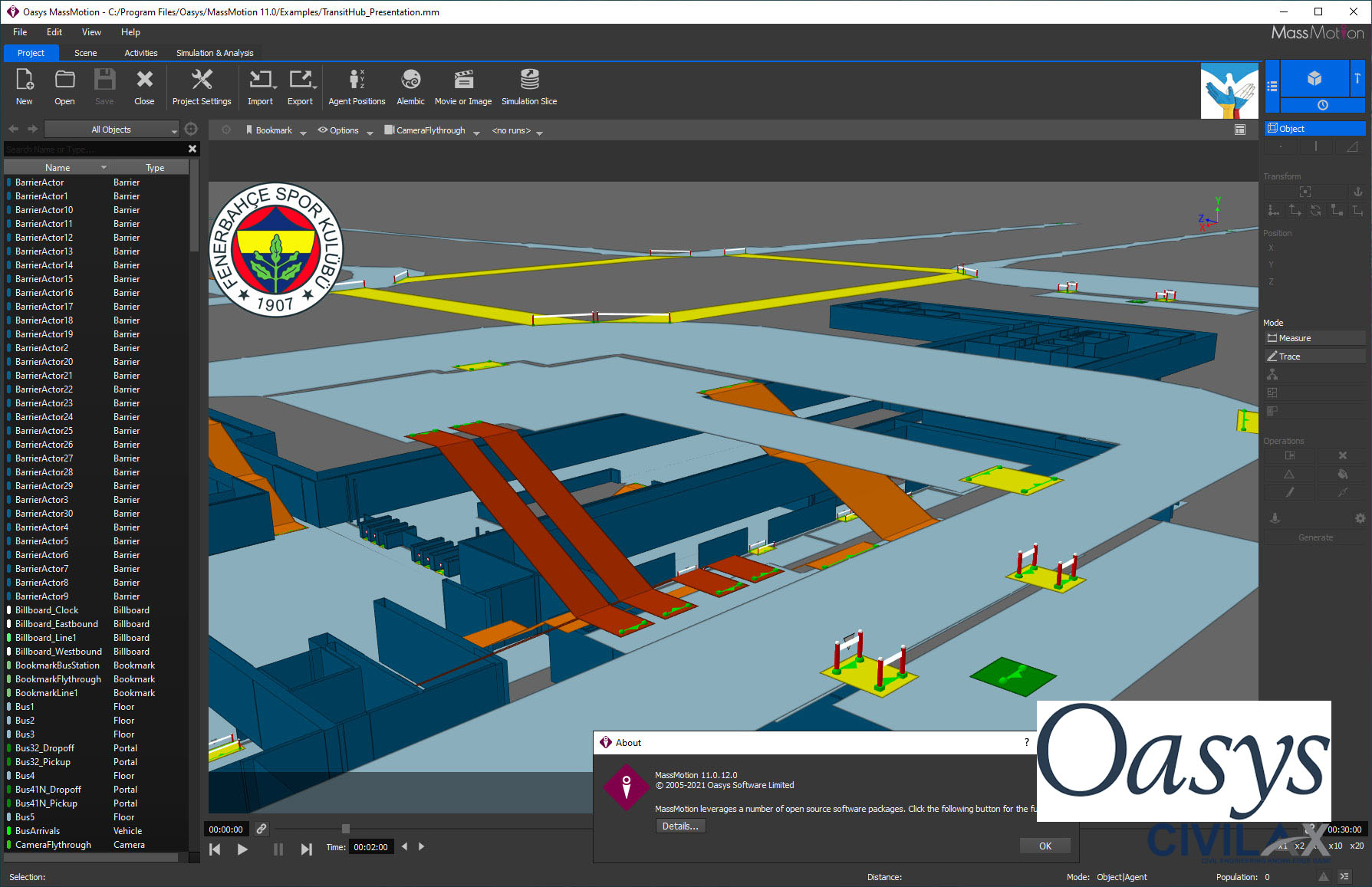
Download Oasys MassMotion – Advanced Crowd Simulation Software
Oasys MassMotion is a leading crowd simulation software developed by Oasys Group, engineered to model and analyze the movement and impact of people within complex environments. It addresses limitations in earlier crowd simulation technologies by offering seamless integration with Building Information Modeling (BIM) workflows. This software is indispensable for professionals across architecture, transport planning, event management, retail, and public safety sectors, providing critical insights into crowd dynamics and spatial performance.
Overview of Oasys MassMotion
Oasys MassMotion provides a sophisticated platform for understanding how crowds behave and interact within various physical spaces. Its core purpose is to enable designers, safety officers, and planners to anticipate potential issues related to pedestrian flow, density, and movement, thereby informing design decisions and operational strategies. The software is crucial for ensuring the functionality and safety of buildings and public areas when subjected to high occupancy or dynamic crowd conditions.
Key Applications in Architecture and Safety Planning
The application of Oasys MassMotion extends across multiple disciplines, offering distinct benefits for each. In architecture, it is used to optimize building layouts for efficient occupant movement and emergency egress. For event management, it helps in planning secure and functional venues, assessing capacity, and managing attendee flow. In transport planning, MassMotion aids in designing efficient station layouts and analyzing passenger movement. Public safety professionals leverage it for evacuation planning and risk assessment in densely populated areas.
Crowd Simulation Capabilities and Features
Oasys MassMotion offers a comprehensive suite of tools designed for detailed crowd analysis and visualization.
Modeling and Visualization Tools
- Agent-Based Modeling: Creates detailed individual agent behaviors to simulate realistic crowd dynamics based on customizable parameters.
- Environment Design: Allows users to import or create detailed 3D models of environments, including buildings, rooms, and outdoor spaces.
- Data Visualization: Provides advanced graphical representations of simulation results, including heat maps, flow lines, and density plots, to easily identify bottlenecks and critical areas.
- Egress Analysis: Specifically models and quantifies evacuation times, aiding in the verification of safety compliance and the identification of potential hazards during emergencies.
Integration with BIM Workflows
Oasys MassMotion emphasizes streamlined project workflows through its robust Building Information Modeling (BIM) integration. This capability allows users to directly import architectural models from common BIM software, ensuring that simulation environments accurately reflect the designed space. This integration facilitates better communication among project teams and stakeholders, enabling informed design adjustments based on simulated crowd performance rather than relying solely on static plans.
Reducing Risk and Enhancing Operational Efficiency
Utilizing Oasys MassMotion simulation models allows for the proactive identification and mitigation of risks associated with crowd management. By simulating various scenarios, professionals can preemptively address potential safety hazards, optimize egress routes, and prevent overcrowding. This not only enhances public safety but also leads to improved operational efficiency, reduced design costs by avoiding late-stage modifications, and ensures compliance with regulatory standards. The software’s automation features further contribute to efficiency by reducing the time required for complex simulation setups and analyses.
Case Studies and Real-World Applications
Oasys MassMotion has been implemented in a wide range of high-profile projects, demonstrating its versatility and effectiveness. Examples include large-scale transportation hubs like airports and train stations, where analysis of passenger flow is critical for operational efficiency and safety. It has also been utilized in the planning and safety assessment of major event venues such as stadiums and concert halls, ensuring the secure movement of large numbers of attendees. Furthermore, its application in retail environments helps optimize store layouts for customer experience and sales, while public safety assessments for critical infrastructure benefit from its detailed crowd dynamics analysis.
Conclusion: Why Choose Oasys MassMotion?
Oasys MassMotion stands out as an advanced crowd simulation software due to its powerful modeling capabilities, intuitive visualization tools, and deep integration with BIM workflows. It empowers professionals in architecture, safety, and planning to enhance design outcomes, elevate safety standards, and improve operational efficiency through accurate crowd dynamics analysis. Its emphasis on automation and customization makes it a flexible and powerful solution for complex pedestrian flow challenges.
Frequently Asked Questions
What is Oasys MassMotion used for?
Oasys MassMotion is used for crowd simulation to analyze how crowds move and interact within physical spaces. It is essential for architects, urban planners, and safety professionals to assess egress times, identify bottlenecks, and improve design efficiency and safety measures in various environments.
How does Oasys MassMotion integrate with BIM?
Oasys MassMotion seamlessly integrates with Building Information Modeling (BIM) workflows, allowing users to incorporate crowd simulation directly into their design processes by importing existing architectural models. This integration enhances project communication and enables data-driven design refinements.
What are the benefits of using crowd simulation software like MassMotion?
Utilizing crowd simulation software such as MassMotion helps identify potential design flaws, enhances safety measures, and facilitates better decision-making during the design phase. This leads to reduced costs, mitigated risks associated with crowd management, and improved overall project outcomes.





Reviews
There are no reviews yet.