

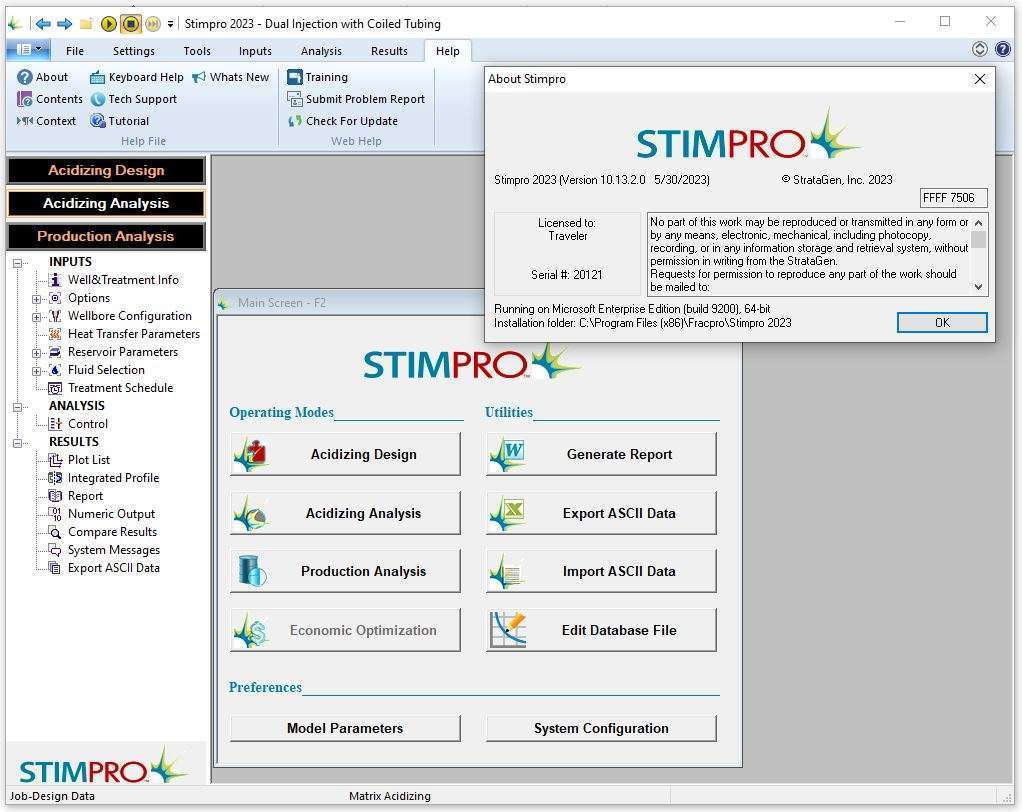
Download Stimpro 2024 – Advanced Matrix Acid Treatment Software
Stimpro 2024, developed by StrataGen, is a specialized matrix acid treatment design software tailored for the oil and gas industry. This advanced application is crucial for engineers focused on optimizing matrix acidizing processes, a vital technique for enhancing well productivity. By leveraging real treatment data for analysis, Stimpro provides a detailed understanding of well responses, making it an indispensable tool for professionals in oil and gas exploration and production.
Introduction to Stimpro and Its Applications
Stimpro 2024 serves as a comprehensive matrix acid simulator, empowering oil and gas engineers to design, analyze, and optimize matrix acid treatments. This process involves injecting acid into the pore spaces of reservoir rock to dissolve mineral constrictions, thereby improving permeability and flow rates. The software’s focus on real treatment data ensures that analyses and designs are grounded in practical performance, differentiating it from purely theoretical models. Its application is central to maximizing the efficiency and lifespan of oil and gas wells.
Key Features and Enhancements in Stimpro 2024
Stimpro 2024 builds upon its predecessor’s foundation with significant enhancements designed to refine the accuracy and scope of matrix acid treatment simulations. These updates are critical for engineers seeking to maximize well productivity and efficiency through precise acidizing designs.
- Perforations Discharge Coefficient: The introduction or refinement of the perforations discharge coefficient allows for more accurate modeling of fluid flow through perforations, a key factor in treatment effectiveness.
- ICD Addition: Inclusion of Inch-type Interval Control Devices (ICDs) in wellbore configurations enables engineers to simulate and account for their performance in controlling fluid distribution during acid treatments.
- Fluid Design Shift Updates: Enhancements in the fluid design module offer improved criteria and options for selecting and simulating acid fluid systems, including acid retardation factors for tailored performance.
- Damage Profile Analysis: Advanced capabilities for defining and analyzing various damage profiles within the reservoir and wellbore contribute to more targeted and effective acid treatment strategies.
Real-World Applications of Stimpro
The practical utility of Stimpro is evident across numerous scenarios within the oil and gas sector. By utilizing actual treatment data, engineers can validate simulation outcomes against historical performance, leading to continuous improvement in well intervention strategies. For instance, when faced with declining production due to formation damage, Stimpro can simulate various acid treatments to identify the most effective approach. Companies use it to predict the impact of treatments on productivity, minimizing risks associated with costly interventions and maximizing return on investment.
Comparison with Previous Versions
Stimpro 2024 introduces several advancements that distinguish it from earlier iterations, including Stimpro 2022. While maintaining core functionalities, the latest version focuses on improved usability and simulation accuracy based on real-world data feedback. Users migrating from older versions will find enhanced wellbore configuration options and more sophisticated damage modeling. The compatibility considerations ensure a smoother transition for ongoing projects, while the updated fluid design criteria reflect the latest industry practices and research in acidizing treatments.
Technical Insights into Matrix Acid Treatments
Matrix acidizing is a stimulation technique used in the oil and gas industry to increase the permeability of a formation by dissolving damaging materials in the near-wellbore region. This process involves injecting acid, such as hydrochloric acid (HCl) or a mixture of acids, at pressures below the fracture gradient to ensure treatment remains within the rock’s pore matrix. Key considerations include the choice of acid type, retarders to control reaction rates, mutual solvents to prevent precipitation, and diverting agents to ensure uniform treatment coverage. Stimpro’s ability to incorporate real treatment data helps calibrate these parameters for improved simulation accuracy and predictive power.
Community and Support for Stimpro Users
StrataGen provides resources to support Stimpro users in optimizing their use of the matrix acid treatment software. This includes access to technical documentation and potentially user forums where engineers can share insights, troubleshoot issues, and discuss best practices for applying Stimpro in their projects. Engaging with the Stimpro community can lead to a deeper understanding of advanced features and effective utilization of the matrix acid simulator for complex well challenges.
Frequently Asked Questions
What are the main improvements in Stimpro 2024 compared to earlier versions?
Stimpro 2024 introduces significant enhancements, including updated features for wellbore configuration and damage profile analysis, as well as refined criteria for fluid design. Notably, this new version effectively leverages real treatment data, leading to improved accuracy in its matrix acid treatment simulations compared to previous versions like Stimpro 2022.
How does Stimpro handle real treatment data analysis?
Stimpro excels by utilizing actual field treatment data to enhance the simulation of well responses. This practical approach allows engineers to gain a more accurate understanding of how wells react to matrix acid treatments and to refine their procedures based on real-world performance, ensuring more effective stimulation designs.
What industries benefit most from using Stimpro?
The primary industry that benefits from Stimpro is the oil and gas sector. It is particularly valuable for professionals involved in matrix acidizing processes, as it helps them optimize well productivity and operational efficiency through sophisticated design and simulation capabilities.


1 review for Stimpro 2024 v10.13.23
felipe –
I need Stimpro v2024 whit license generator, because i need install some computers for use educational