

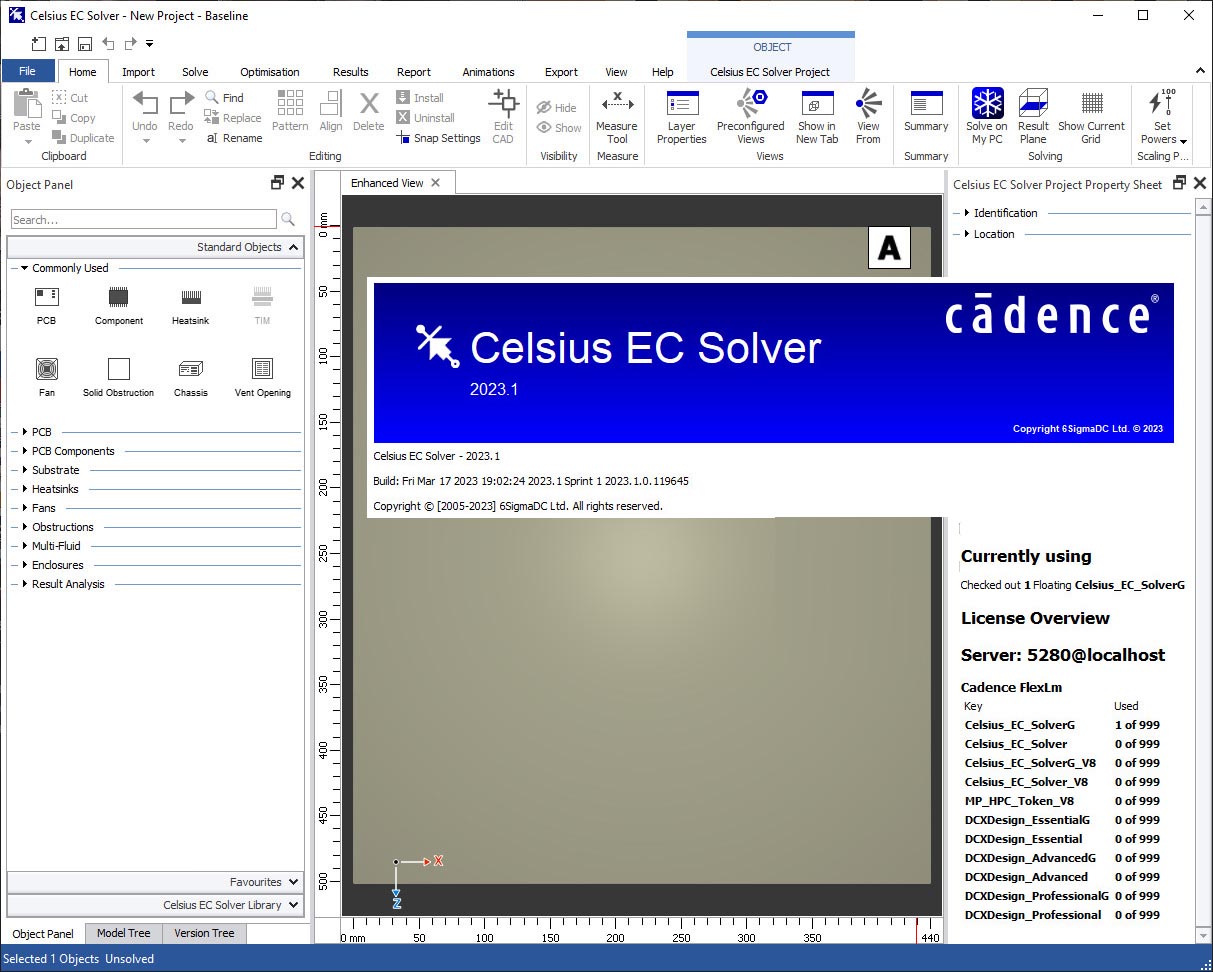
Download Cadence 6SigmaET Celsius EC Solver 2023.1 – Advanced Thermal Analysis Tool
Cadence 6SigmaET Celsius EC Solver 2023.1 is a specialized thermal analysis simulation software developed by Cadence Design Systems, Inc. This tool is designed for electronic and semiconductor industries, catering to professionals in PCB design and electronic system development. It leverages advanced computational techniques to address critical heat management challenges in modern electronic products, integrating with existing electronic design automation (EDA) workflows.
Understanding Celsius EC Solver and Its Applications
The Cadence Celsius EC Solver is a sophisticated application engineered for comprehensive thermal analysis within electronic systems. Its primary function is to simulate and predict thermal behavior, enabling engineers to identify and mitigate potential heat-related issues that can impact performance and reliability. The software is particularly vital for the electronics, semiconductor, and PCB design sectors, where effective thermal management is paramount for product success.
Key applications include:
- Analyzing heat dissipation in complex integrated circuits.
- Managing thermal load in densely populated printed circuit boards.
- Ensuring the operational stability of electronic components under various load conditions.
- Optimizing cooling solutions for electronic devices.
Thermal Analysis Capabilities for Electronics
Celsius EC Solver employs advanced simulation methodologies to deliver accurate thermal insights. It integrates both Finite Element Analysis (FEA) and Computational Fluid Dynamics (CFD) techniques, providing a robust platform for understanding heat generation and transfer mechanisms in electronic designs. This dual-approach allows for a thorough examination of thermal phenomena, from component-level heat generation to system-level airflow and cooling.
The FEA component facilitates detailed analysis of heat conduction within solid materials. Concurrently, the CFD capabilities model heat transfer through fluid mediums, such as air, essential for understanding cooling fan performance and convective heat loss. This comprehensive approach supports the accurate prediction of temperature distributions, crucial for preventing thermal runaway and ensuring optimal device performance.
Integration with Cadence Design Tools
A significant advantage of the Cadence Celsius EC Solver is its seamless integration with other Cadence design tools, notably Allegro and OrCAD. This interoperability allows designers to directly import geometry and netlist data from their PCB layouts. By leveraging existing CAD data, engineers can initiate thermal simulations without the need for extensive re-modeling, significantly streamlining the design workflow.
This integration supports a unified design process, where thermal analysis becomes an integral part of the overall electronic design automation flow. Such synergy enhances design accuracy and reduces the iteration cycles typically associated with thermal management challenges in complex PCB designs.
Key Features and User Benefits
The Cadence Celsius EC Solver offers a suite of features designed to enhance the thermal design process and improve design outcomes. These capabilities provide engineers with critical data for making informed design decisions and optimizing product performance.
- Real-time Thermal Simulations: Enables quick evaluation of design changes and their thermal impact.
- Resistance Calculations: Helps in understanding and quantifying thermal resistances across different layers and interfaces.
- Enhanced Design Accuracy: Provides precise temperature predictions, reducing the risk of thermal failures.
- Multi-physics Simulation: Combines electrical and thermal analysis for a holistic view of system behavior.
- Automated Meshing: Streamlines the setup process for complex geometries, generating high-quality meshes for FEA and CFD.
These features translate into tangible benefits for users, including reduced prototyping costs, faster time-to-market, and improved product reliability through effective thermal management.
Case Studies in Thermal Management
The practical application of Cadence Celsius EC Solver is evident across various industries, where it has been instrumental in overcoming complex thermal challenges. For instance, in the development of high-performance computing systems, the software has been used to simulate the thermal behavior of multi-core processors and densely packed server components. This analysis has led to optimized heatsink designs and fan placements, ensuring sustained performance under heavy computational loads.
Another use case involves the thermal analysis of power electronics modules. Engineers utilize Celsius EC Solver to predict temperature spikes in power transistors and capacitors, enabling the implementation of effective heat dissipation strategies such as improved thermal interface materials and optimized PCB layouts. This proactive approach prevents component degradation and enhances the longevity of power delivery systems.
Comparative Analysis with Other Thermal Simulation Software
Compared to general-purpose FEA or CFD tools, Cadence Celsius EC Solver offers specialized capabilities tailored for electronic design automation environments. Its strength lies in its tight integration with Cadence’s EDA suite, allowing for direct data transfer from schematic and layout tools. This contrasts with some standalone simulation packages that require significant effort to import and prepare electronic design data.
While other thermal analysis software might offer broader physics simulation capabilities, Celsius EC Solver excels in providing accurate and efficient thermal modeling specifically for PCBs and integrated circuits. Its unique combination of FEA and CFD, coupled with its EDA workflow integration, positions it as a specialized solution for electronics thermal management challenges.
Future Developments in Thermal Analysis Technologies
The field of thermal analysis is continuously evolving, driven by the increasing power density and miniaturization of electronic components. Future developments in thermal simulation software are expected to focus on enhanced multi-physics coupling, artificial intelligence-driven optimization, and more accurate modeling of advanced cooling techniques like liquid cooling and thermoelectric devices. Cadence is likely to continue refining Celsius EC Solver to incorporate these advancements.
Potential roadmap directions may include improved simulation speeds for real-time design feedback, more sophisticated modeling of transient thermal effects, and expanded capabilities for characterizing new materials with complex thermal properties. The ongoing pursuit of greater simulation accuracy and computational efficiency will remain central to the development of thermal analysis tools in the electronics sector.
Frequently Asked Questions
What is Cadence Celsius EC Solver used for?
Cadence Celsius EC Solver is a thermal analysis tool that utilizes finite element analysis (FEA) and computational fluid dynamics (CFD) to simulate and manage heat within electronic components, ensuring efficient thermal design in PCs and microcircuits.
How does Celsius integrate with other Cadence software?
Celsius integrates seamlessly with other Cadence tools such as Allegro and OrCAD, allowing designers to leverage existing CAD data to analyze thermal performance without needing to reload geometry each time.
What are the main technologies behind Celsius EC Solver?
The main technologies in Celsius EC Solver are finite element analysis (FEA) and computational fluid dynamics (CFD), which together provide highly accurate thermal simulations for complex electronic designs.






Reviews
There are no reviews yet.