

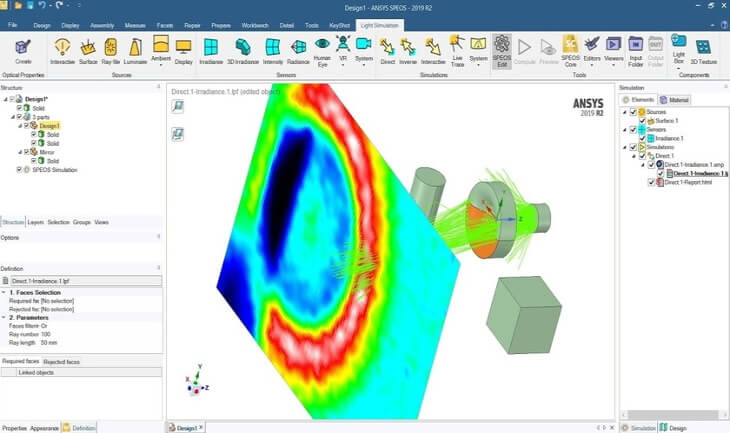
Download ANSYS SPEOS 2020 R2 for Siemens NX Series – Advanced Optical Performance Software
ANSYS SPEOS 2020 R2 for Siemens NX Series is an advanced optical simulation software developed by Ansys, Inc. It is designed to address the complex challenges of optical system design and performance analysis within industries such as automotive, aerospace, and consumer products. As part of Ansys’s comprehensive suite of engineering simulation tools, SPEOS focuses on understanding light interactions with materials to ensure optimal product functionality and efficiency.
Introduction to ANSYS SPEOS
Overview of Software and History
ANSYS SPEOS is a specialized engineering software application focused on the design, simulation, and analysis of optical systems. Developed by Ansys, Inc., a global leader in engineering simulation, SPEOS is crucial for assessing the optical performance and design characteristics of products. The software facilitates operational modeling and employs a comprehensive library to support fast and accurate optical simulations, making it an integral part of the Ansys product portfolio.
Key Capabilities and Applications
Efficient Lighting System Modeling
SPEOS provides robust tools for simulating lighting systems, enabling engineers to visualize and analyze light distribution, intensity, and color. This capability is essential in industries where lighting plays a critical role, such as automotive headlamps, interior cabin lighting, and aerospace display technologies. The software accurately models complex light interactions, helping users achieve desired lighting effects and compliance with industry standards.
Optical Design Optimization
The software offers advanced capabilities for optical design optimization, allowing users to refine optical performance parameters effectively. Through iterative design and simulation, SPEOS helps engineers improve factors such as brightness, uniformity, and energy efficiency. This feature supports the development of high-performance optical components and systems, reducing the need for physical prototypes and accelerating the product development cycle.
Simulation Features and Technical Capabilities
Photon-Mechanical Interaction Analysis
ANSYS SPEOS is engineered to analyze the complex interactions between photons and material geometries. This includes simulating how light behaves when it encounters different surfaces and materials, taking into account properties like reflection, refraction, absorption, and scattering. Understanding these photon-mechanical interactions is vital for predicting the real-world performance of optical components and assemblies.
Using High-Performance Computing (HPC)
To handle the computational demands of complex optical simulations, ANSYS SPEOS leverages High-Performance Computing (HPC). HPC allows for significantly faster simulation times by distributing processing tasks across multiple cores or machines. This acceleration is critical for performing detailed optical performance analysis and design optimization, enabling engineers to iterate more rapidly and obtain timely results for critical design decisions.
Integration with Siemens NX
Compatibility and Workflow Enhancements
ANSYS SPEOS offers seamless integration with the Siemens NX design environment. This compatibility enhances the overall engineering workflow by allowing users to perform optical simulation and analysis directly within their familiar CAD platform. The integration streamlines the process from initial design to final validation, reducing data transfer issues and improving collaboration between design and simulation teams.
Real-world Application Examples
Case Studies in Industry
ANSYS SPEOS is applied in numerous real-world engineering projects across various sectors. In the automotive industry, it is used for designing and validating headlamps, taillights, and interior lighting to meet aesthetic and regulatory requirements. For aerospace applications, SPEOS aids in simulating cockpit displays and external lighting systems. Consumer product design also benefits from its capabilities in areas like camera optics and display technologies.
Comparison with Other Optical Design Tools
Strengths of ANSYS SPEOS
Compared to other optical design tools, ANSYS SPEOS distinguishes itself through its robust simulation engine and direct integration with the Siemens NX ecosystem. Its strength lies in accurately predicting optical performance and facilitating efficient lighting system modeling. The combination of advanced photon-mechanical analysis, HPC utilization, and comprehensive design optimization tools makes it a powerful solution for demanding engineering challenges.
Frequently Asked Questions
What industries use ANSYS SPEOS?
ANSYS SPEOS is widely utilized in industries such as automotive, aerospace, and consumer product design, where optical performance and lighting simulation are critical. Its capabilities are particularly valuable for applications requiring precise control and analysis of light behavior.
How does ANSYS SPEOS improve optical design processes?
SPEOS enhances optical design by providing advanced modeling tools that simulate light interactions effectively, enabling faster optimization and reducing overall design costs. It allows engineers to visualize and refine designs early in the development cycle, ensuring optimal performance and reducing the need for expensive physical testing.
What is the significance of using High-Performance Computing with SPEOS?
High-Performance Computing enables ANSYS SPEOS to perform simulations with greater speed and efficiency, allowing for timely analysis and results that enhance decision-making in product design. This computational power is essential for handling complex optical scenarios and large datasets, leading to more informed design choices.






Reviews
There are no reviews yet.