

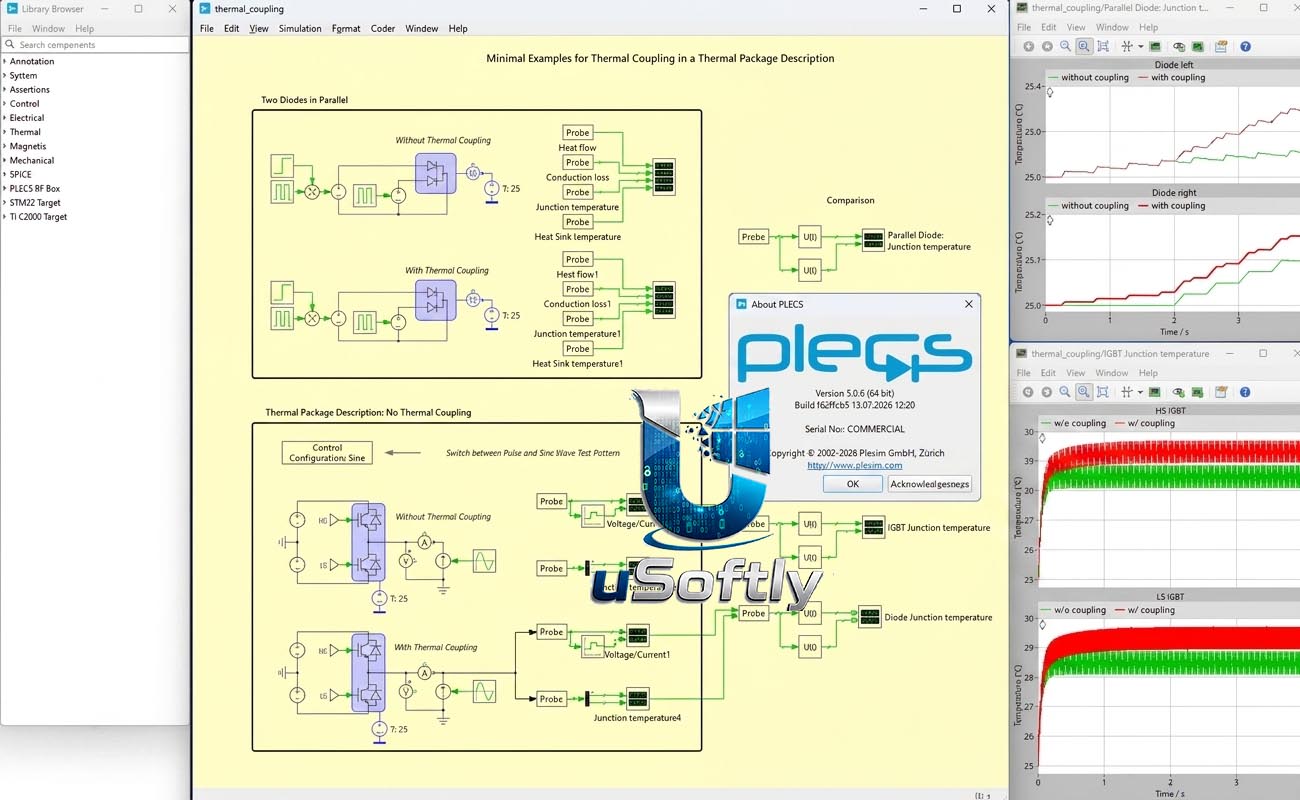
Download Plexim PLECS – Advanced Simulation Tool for Power Electronics
Plexim PLECS is a specialized simulation software developed by Plexim GmbH for the analysis and design of electrical circuits, with a particular focus on power electronics. This powerful tool is designed for system-level simulations, supporting multidisciplinary modeling and enabling engineers and academics to efficiently model complex electrical systems, control loops, and thermal behaviors. Its unique approach to simulation accelerates the design process for power electronic engineers and researchers working with demanding applications.
Overview of PLECS and Its Applications
Plexim PLECS stands out as a premier simulation platform within the electrical engineering domain, especially for professionals focused on power electronics. It is engineered to handle intricate system-level simulations, offering a robust environment for developing and testing designs before physical implementation. The software is broadly utilized in both academic research and industrial product development, supporting the creation of advanced electrical systems.
Key Features and Capabilities
PLECS offers a comprehensive suite of features designed for efficient and accurate simulation of electrical circuits, focusing on the unique demands of power electronics. Its core capabilities facilitate detailed analysis across multiple physical domains.
- Piecewise Linear Simulation: At its heart, PLECS utilizes a piecewise linear approach to circuit simulation. This method significantly speeds up simulations by handling circuit topologies that change at discrete events, such as the switching of semiconductors.
- Multi-Domain Modeling: The software extends beyond purely electrical simulations, allowing users to incorporate other physical domains like thermal and mechanical aspects. This holistic approach is crucial for accurately modeling comprehensive power electronic systems.
- Advanced Switch Modeling: PLECS employs a novel method for modeling switches. Instead of relying on traditional, computationally intensive nonlinear models, it uses ideal switches that toggle between closed and open states. This technique maintains simulation accuracy while dramatically improving speed.
- Control System Design: Integrated tools for designing and simulating control loops allow engineers to develop sophisticated control strategies for power electronic converters and drives.
Modeling Electrical Systems Efficiently
PLECS provides engineers with the tools necessary to efficiently model various electrical systems, from individual components to complex integrated designs. Its specialized features are tailored for the challenges of power electronics.
The software excels in modeling power converters, enabling the simulation and optimization of diverse topologies such as DC-DC converters, inverters, and rectifiers. This capability is essential for designing efficient power conversion systems used in a wide array of applications. Furthermore, PLECS facilitates the accurate modeling of electrical drives, crucial for applications in robotics, electric vehicles, and industrial automation. The effective modeling extends to control systems, allowing engineers to implement and test complex control algorithms that govern the behavior of power electronic circuits and drives with high fidelity.
Integration with Other Tools
Plexim GmbH offers PLECS in distinct editions to cater to different user workflows and preferences, ensuring compatibility and flexibility within existing engineering environments.
- PLECS Blockset: This edition seamlessly integrates with the industry-standard MATLAB/Simulink environment. It allows users to build and simulate models directly within Simulink, leveraging its extensive toolboxes and familiar interface while benefiting from PLECS’s specialized simulation engine for power electronics.
- PLECS Standalone: For users who do not require MATLAB/Simulink or prefer a dedicated simulation environment, PLECS Standalone provides a focused and efficient platform. This version offers direct access to PLECS’s core simulation capabilities, making it a powerful, self-contained solution for circuit simulation.
Real-World Applications and Case Studies
The effectiveness of Plexim PLECS is demonstrated through its successful implementation in challenging real-world engineering and research projects. Its capabilities are rigorously tested and validated in practical scenarios.
Academic researchers frequently utilize PLECS for exploring novel power electronic topologies and control strategies, often publishing findings that showcase the software’s accuracy in replicating experimental results. In industrial settings, engineers employ PLECS for the design and validation of components and systems such as electric vehicle powertrains, renewable energy grid-tie inverters, and high-frequency power supplies, where precise simulation is critical for performance and reliability. The ability of PLECS to handle complex multi-domain interactions makes it invaluable for optimizing designs that involve intricate interactions between electrical, thermal, and control aspects.
Numerous Industry Applications
The versatility of Plexim PLECS makes it an indispensable tool across a broad spectrum of industries that rely on advanced power electronics for their core operations.
- Automotive: Used for designing electric vehicle (EV) powertrains, battery management systems, and charging infrastructure.
- Renewable Energy: Critical for simulating grid-tied inverters for solar and wind power generation, as well as energy storage systems.
- Industrial Automation: Employed in the development of motor drives, industrial power supplies, and advanced control systems for manufacturing processes.
- Aerospace and Defense: Utilized for designing lightweight and high-efficiency power systems for aircraft and defense applications.
- Consumer Electronics: Applied in the design of compact and efficient power solutions for various electronic devices.
- Research and Development: Serves as a fundamental tool in universities and corporate R&D departments for exploring next-generation power electronic technologies.
Conclusion and Getting Started with PLECS
Plexim PLECS provides unparalleled efficiency and accuracy for simulating power electronic systems. Its unique piecewise linear simulation engine, multi-domain modeling capabilities, and flexible integration options make it an essential tool for engineers and researchers aiming to innovate in the field of electrical engineering. By offering both a standalone version and seamless integration with MATLAB/Simulink, PLECS caters to diverse user needs, accelerating product development cycles and enhancing design quality.
Frequently Asked Questions
What is Plexim PLECS used for?
Plexim PLECS is used for system-level simulations of electrical circuits, particularly in the power electronics field, enabling the modeling of circuits, control loops, and thermal behavior in a unified environment. This allows engineers to design, analyze, and optimize complex power electronic systems efficiently.
How does PLECS handle switch modeling differently from conventional simulation software?
Unlike traditional simulation tools that model switches using nonlinear elements, PLECS employs ideal switches that toggle between closed and open circuits, significantly enhancing simulation speed and accuracy. This piecewise linear approach avoids the computational overhead associated with solving complex nonlinear differential equations at each switching event.
Can PLECS integrate with other simulation tools?
Yes, PLECS provides integration with MATLAB/Simulink through the PLECS Blockset, allowing users to leverage familiar environments while benefiting from PLECS’s specialized simulation capabilities. This integration streamlines workflows for engineers who already utilize Simulink for other aspects of their system design and analysis.






Reviews
There are no reviews yet.