

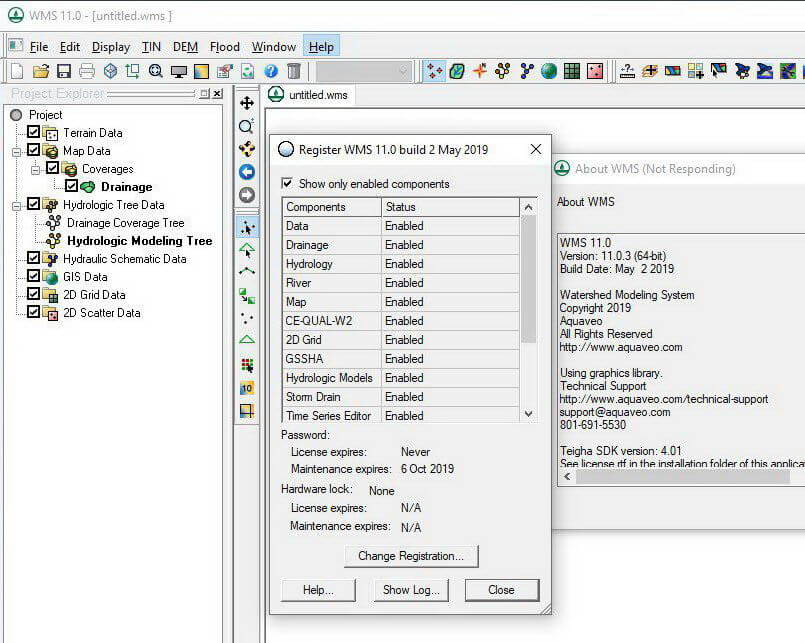
Download Aquaveo Watershed Modeling System – Comprehensive Hydrological Solutions
The Aquaveo Watershed Modeling System (WMS) is specialized hydrological modeling software developed by Aquaveo LLC. Originating from early development at Brigham Young University, this advanced application is designed for professionals in water resources management, environmental engineering, and civil engineering. It provides a suite of tools for comprehensive watershed simulations, focusing on both water quantity and quality aspects, making it an essential resource for complex environmental assessments.
Overview of Aquaveo Watershed Modeling System
The Aquaveo Watershed Modeling System (WMS) has a robust history rooted in academic research before becoming a professional engineering tool. Its development has focused on providing sophisticated hydrological analysis capabilities within an integrated software environment.
History and Development
Initially conceived in the early 1990s at the Engineering Computer Graphics Laboratory at Brigham Young University, the WMS software was developed to address the complexities of watershed simulations. This foundational work laid the groundwork for its comprehensive features. Subsequently, Aquaveo LLC took over development, refining and expanding the software into the professional hydrological modeling solution it is today, supporting a wide array of industry-standard models and analytical techniques.
Key Capabilities for Hydrological Analysis
Aquaveo WMS offers a powerful platform for users to conduct detailed hydrological studies, supporting a range of established models and methods critical for water resource assessment and management.
Supporting Models and Techniques
The system is engineered to work seamlessly with several industry-recognized hydrological models. This allows users to perform diverse simulations and gain deep insights into watershed behavior. Key supported models include:
- HEC-1 and HEC-HMS for rainfall-runoff analysis.
- TR-20 for flood hydrograph computations.
- MODRAT for hydraulic modeling and water quality analysis.
- Capabilities for both 2D and 3D hydrologic modeling.
Tools for Effective Watershed Management
WMS integrates essential tools for data processing and visualization, making it a comprehensive solution for effective watershed management in various environmental contexts.
GIS Integration and Data Processing
Leveraging its strength in GIS integration, Aquaveo Watershed Modeling System facilitates robust data handling and analysis required for hydrological projects. The software allows for:
- Importing and processing of geographic information system (GIS) data.
- Interfacing with computer-aided design (CAD) files and various GIS formats.
- Automating complex hydrological calculations, including watershed delineation.
- Visualizing terrain models and simulating water flow paths.
Real-World Applications
The Aquaveo Watershed Modeling System has been applied in numerous significant projects, showcasing its versatility and effectiveness in addressing practical environmental and engineering challenges.
Case Studies and Use in Environmental Projects
Professionals utilize WMS for critical tasks in water resource management and environmental engineering. Historical applications highlight its significance:
- Preparation for environmental assessments, such as those conducted for the 2002 Winter Olympics.
- Studies within prominent river basins, like the Sava River basin, for detailed hydrological analysis and planning.
- Flood modeling and infrastructure analysis for urban and regional planning.
- Water quality assessments and long-term water resource management strategies.
User Support and Community Engagement
Aquaveo provides comprehensive resources to support users of the Watershed Modeling System, fostering an environment for continuous learning and problem-solving within the professional community.
Resources and Community Forums
Users can access a wealth of information through dedicated resources developed by Aquaveo. These include:
- Detailed user guides and documentation for in-depth understanding of features.
- Online tutorials and technical articles to assist with various modeling tasks.
- An active online community and forums where professionals can exchange knowledge and discuss solutions.
Advanced Features and Future Directions
The Aquaveo Watershed Modeling System continuously evolves, incorporating advanced functionalities and enhancements to meet the demanding requirements of modern hydrological and environmental engineering.
While specific details on upcoming features for versions beyond are typically announced by Aquaveo, the software’s trajectory focuses on refining its core strengths. This includes enhancing its GIS integration capabilities, expanding support for emerging hydrological models and data sources, and improving the automation of complex simulation workflows. The ongoing development aims to further streamline environmental assessments and water resource planning for engineering professionals.
Frequently Asked Questions
What types of hydrological models can be used with Aquaveo WMS?
Aquaveo WMS supports a variety of hydrological models including HEC-1, HEC-HMS, TR-20, and MODRAT, enabling users to conduct complex simulations and analyses for both water quantity and quality within watershed environments.
How does Aquaveo WMS integrate with GIS data?
Aquaveo WMS allows users to import GIS data and process it alongside hydrological models, enhancing analysis through effective visualization and data manipulation. This integration supports precise watershed delineation and terrain analysis.
What are some practical applications of Aquaveo WMS in real projects?
Aquaveo WMS has been used in various projects, including flood modeling and infrastructure analysis, demonstrating its utility in real-world hydrological challenges. It is frequently employed for environmental assessments and comprehensive water resource management strategies.






Reviews
There are no reviews yet.