

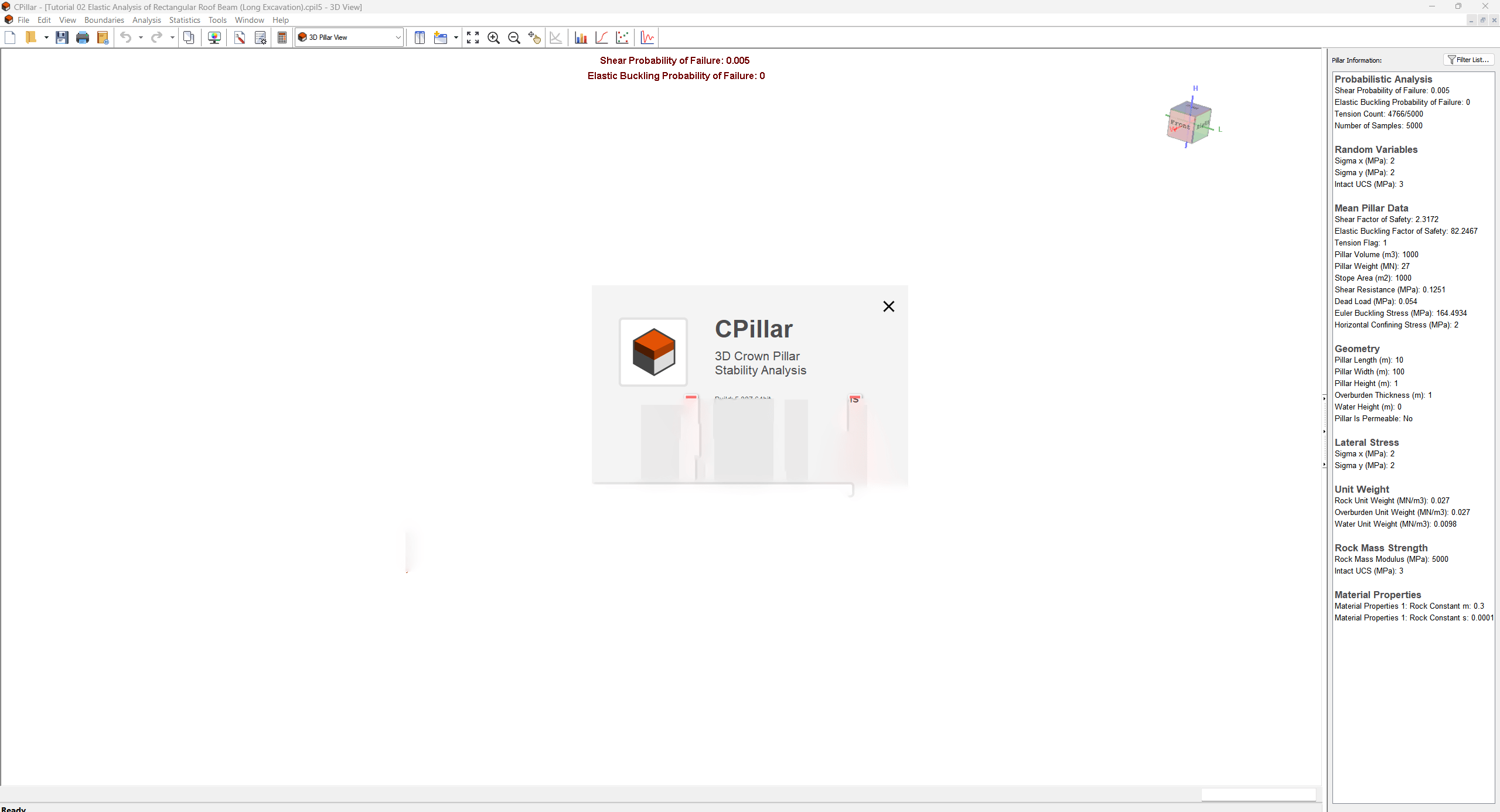
Download Rocscience C-Pillar 2026 – Crown Pillar Stability Analysis Software
Rocscience C-Pillar 2026 is a specialized geotechnical engineering software developed by Rocscience Inc., designed for the critical analysis of crown pillar stability in mining operations. This application serves mining engineers, geotechnical engineers, and civil engineering professionals involved in the design and safety assessment of underground and surface excavations, particularly those concerning rock masses. It offers a robust suite of analytical tools to ensure structural integrity and operational safety within the demanding environments of mining engineering.
Understanding Crown Pillar Stability in Mining Engineering
Crown pillars are critical rock masses situated between adjacent underground mine openings or between surface features and underlying excavations. Their stability is paramount to prevent collapses that could lead to significant safety hazards, operational disruptions, and economic losses. Effective crown pillar analysis in mining engineering requires sophisticated tools that can accurately model complex geological conditions and failure mechanisms to ensure reliable design and safety validation for both underground rock stability and surface subsidence considerations.
Advanced Analytical Methods for Pillar Stability Assessment
Rocscience C-Pillar employs established limit equilibrium methods to analyze the stability of crown pillars. These methods provide engineers with the ability to assess failure potential under various assumptions regarding rock mass behavior and loading conditions.
Rigid Plate Analysis
The rigid plate analysis method models the crown pillar as an infinitely large, rigid plate. This approach assumes no deformation within the pillar itself, focusing on the general stability based on stress distribution and shear strength. It is often used as a preliminary assessment or for scenarios where deformation is not the primary failure driver.
Elastic Plate Analysis
This method considers the crown pillar to behave elastically, meaning it deforms under load but returns to its original shape once the load is removed. The elastic plate analysis accounts for bending stresses and deflections, providing a more refined assessment of pillar behavior and stability compared to the rigid plate method, and is particularly relevant for understanding stress concentrations.
Voussoir (No Tension) Plate Analysis
The Voussoir plate analysis simulates a crown pillar composed of discrete blocks (voussoirs) separated by joints or bedding planes. This method explicitly models the behavior of rock masses that can sustain compressive stresses but cannot support tensile stresses (no tension assumption). It is highly effective for analyzing stratified rock formations and steeply dipping ore bodies where block interlock and failure mechanisms are complex, offering a realistic simulation of real rock behavior.
Probabilistic and Sensitivity Analysis Capabilities
Beyond deterministic safety factors, Rocscience C-Pillar offers advanced probabilistic analysis features. These capabilities allow engineers to model the inherent variability of geological parameters such as rock strength, joint properties, and stress conditions using statistical distributions. By simulating a range of possible outcomes, the software calculates the probability of failure, providing a more comprehensive understanding of the risk associated with crown pillar design. Sensitivity analyses further aid in identifying which input parameters have the most significant impact on stability, guiding data collection and design refinement.
Empirical Design Methods for Crown Pillars
Complementing analytical methods, Rocscience C-Pillar incorporates empirical design relationships that have been developed from decades of field observations and case histories in mining. These methods provide design guidance based on established correlations between geological factors, excavation geometry, and observed stability. The software includes specific empirical approaches tailored for the unique challenges presented by steeply dipping ore bodies and laminated roof beds, enabling engineers to leverage practical experience for robust design validation.
Integration in Geotechnical and Mining Engineering Workflows
Rocscience C-Pillar is designed to integrate seamlessly into broader geotechnical and mining engineering workflows. As part of the Rocscience suite of software, it can work in conjunction with other specialized tools such as RocData for material property characterization and RocSlope for slope stability analysis. This integration allows for a comprehensive and cohesive approach to mine design, enabling engineers to transfer data and analyses between different modules, streamlining project execution and enhancing the accuracy of overall stability assessments.
Real-World Applications and Case Studies
The application of Rocscience C-Pillar is critical in numerous real-world mining projects. For instance, in underground metalliferous mines, it is used to determine safe excavation spans and pillar dimensions to prevent pillar collapse and hanging wall failures in ore bodies. For surface mining operations, it helps assess the stability of the final pit slope where it might interact with underlying underground workings, preventing surface subsidence. These applications, often supported by generic case references found in industry practice, underscore the software’s role in validating designs and ensuring the safety and economic viability of complex mining endeavors.
Frequently Asked Questions
What types of crown pillar stability analysis does Rocscience C-Pillar support?
Rocscience C-Pillar supports three main limit equilibrium methods: rigid plate, elastic plate, and Voussoir (no tension) plate analysis, allowing engineers to assess stability under different assumptions about rock behavior.
How does the probabilistic analysis feature enhance stability assessments?
Probabilistic analysis in Rocscience C-Pillar models variability in key parameters with statistical distributions, providing a probability of failure that helps engineers understand risk levels beyond deterministic factors of safety.
Can Rocscience C-Pillar be used for both surface and underground crown pillars?
Yes, Rocscience C-Pillar is designed to analyze both surface and underground crown pillars as well as laminated roof beds, making it versatile for various mining and geotechnical engineering applications.






Reviews
There are no reviews yet.