

Download CYMGRD 8.0 – Advanced Grounding System Design and Analysis Software
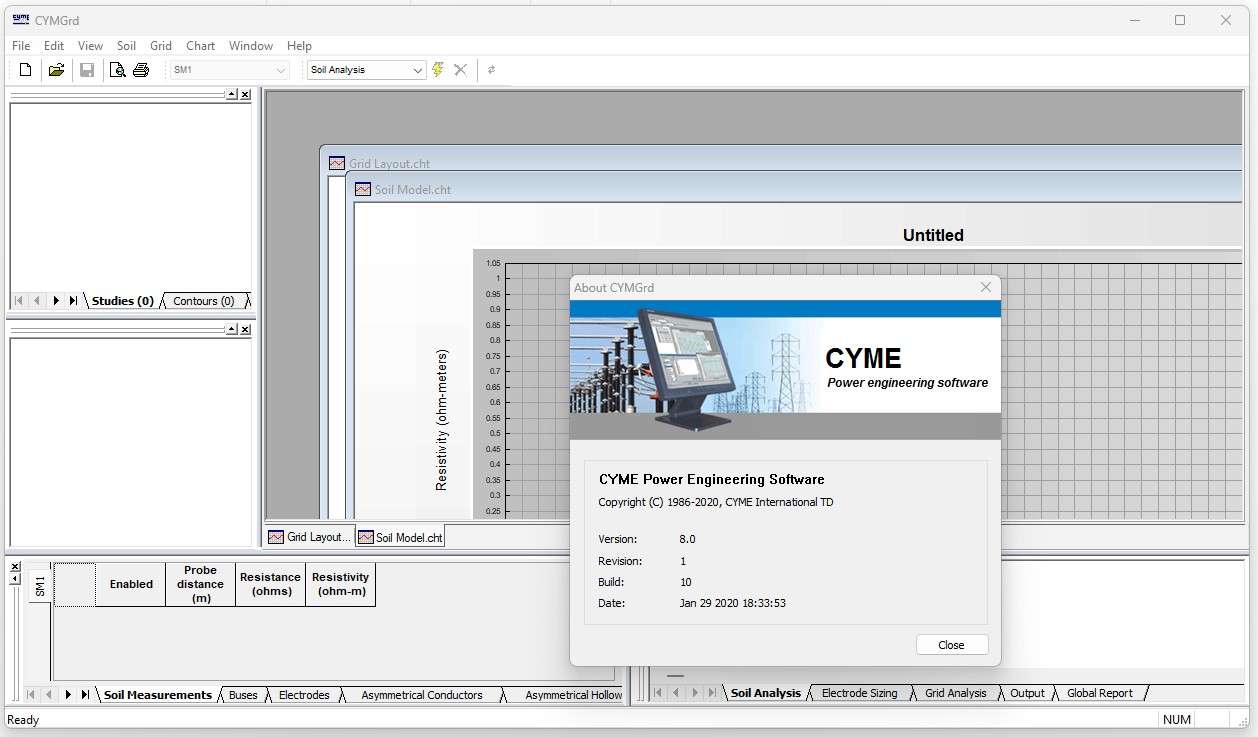
CYMGRD 8.0 is a specialized software application developed by CYME International T&D Inc. for the comprehensive design and analysis of electrical grounding systems. This software is crucial for electrical power engineering professionals, particularly in substation design, power generation facilities, and industrial electrical safety engineering. It is engineered to ensure electrical safety and system reliability by adhering to critical industry standards, primarily focusing on IEEE guidelines for grounding.
Overview of CYMGRD and Its Application in Electrical Safety
CYMGRD 8.0 provides engineers with a robust platform to design and analyze grounding systems, ensuring they meet stringent safety and performance requirements. The software assists in calculating critical safety parameters such as step and touch voltages, essential for protecting personnel and equipment from electrical hazards in high-voltage environments. Its application spans various domains within electrical power engineering, ensuring that grounding configurations are both effective and compliant with modern safety regulations.
Modeling Soil Resistivity for Reliable Grounding Systems
Accurate grounding system design begins with a thorough understanding of soil conditions. CYMGRD 8.0 supports sophisticated soil resistivity modeling, allowing engineers to represent the earth’s electrical properties using both single and double-layer models. This detailed soil modeling is fundamental for predicting how fault currents will dissipate into the ground and for calculating contact voltages that pose a hazard to individuals. The software facilitates graphical plotting of resistivity data, enabling engineers to visualize variations and their impact on overall grounding performance according to standard methodologies.
Network Analysis for Grounding Layouts of Any Configuration
CYMGRD 8.0 features a powerful network analysis module capable of handling grounding layouts of any geometric complexity. It accurately calculates the propagation of fault currents through conductor networks. The software supports the design of 2D and 3D substation grounding layouts, offering flexibility for various infrastructure designs. Furthermore, it can incorporate the influence of underground utilities, such as pipes and adjacent grounding systems, which play a significant role in complex fault current distribution scenarios and soil potential calculations.
Visualization and Interpretation of Grounding System Performance
Effective visualization is key to understanding and optimizing grounding system performance. CYMGRD 8.0 generates detailed 2D and 3D color-coded graphical outputs that clearly illustrate the distribution of various potentials and currents throughout the grounding network. This includes precise representation of touch and step voltage contours, providing engineers with clear visual feedback to identify potential safety risks and inform design modifications. These visual aids are instrumental in making informed decisions to enhance the safety and reliability of electrical installations.
Precision Grounding Calculations Using Finite Element Analysis
At its core, CYMGRD 8.0 utilizes the finite element method (FEM) to perform highly precise calculations for grounding systems. This advanced numerical technique enables detailed analysis of current distribution within ground network conductors and grounding rods. The software can accurately determine station ground resistance and the overall ground potential rise (GPR) experienced during fault conditions. FEM’s capability to handle complex geometries and material properties ensures that the analysis of grounding conductors and their interaction with the soil is thorough and reliable.
Compliance with IEEE Standards for Safe Electrical Installations
Adherence to industry standards is paramount for ensuring electrical safety and regulatory compliance. CYMGRD 8.0 is engineered to support key IEEE grounding standards, including IEEE 80-2000 (“Guide for Safety in AC Substation Grounding”), IEEE 81-1983 (“IEEE Guide for Measuring Earth Resistivity, Ground Electrode Resistance, and Earth Stratification”), and IEEE 837-2002 (“IEEE Standard for Qualifying Permanent Electrical Safety Grounding/Bonding Equipment for Use in Maintaining Service Approximately Nominal Voltage”). By embedding these standards into its calculation engine, the software ensures that designed grounding systems meet authoritative safety benchmarks.
Use Cases: Designing Grounding Systems for Substations and Industrial Facilities
CYMGRD 8.0 is extensively applied in the design and analysis of grounding systems for critical infrastructure. This includes ensuring the safety and reliability of electrical substations, where managing high fault currents and ground potential rise is essential. In power plants, it aids in designing robust grounding networks that protect sensitive equipment and personnel. For industrial facilities, the software helps optimize grounding layouts to mitigate electrical hazards in complex manufacturing environments, leading to technically sound and economically efficient grounding solutions.
Frequently Asked Questions
How does CYMGRD ensure compliance with IEEE grounding standards?
CYMGRD 8.0 incorporates IEEE 80-2000, IEEE 81-1983, and IEEE 837-2002 standards directly into its analysis algorithms. This ensures that calculations for contact and step voltages, as well as ground electrode resistance, accurately reflect the requirements set forth by these authoritative safety guidelines, thereby guaranteeing designs meet crucial safety criteria.
Can CYMGRD model complex substation grounding layouts including underground utilities?
Yes, CYMGRD 8.0 offers robust capabilities for modeling complex grounding networks in both 2D and 3D environments. It can accurately simulate the presence and impact of underground utilities, such as metallic pipes and conduits, as well as adjacent grounding networks. This comprehensive modeling allows for a realistic analysis of how these elements affect fault current distribution and soil potentials.
What are the benefits of using finite element analysis in CYMGRD for grounding system design?
The finite element analysis (FEM) employed by CYMGRD 8.0 provides exceptional precision in calculating current distribution and potential fields within intricate grounding networks. This advanced computational method enables engineers to thoroughly analyze conductor resistances, ground rod performance, and overall system impedance, allowing for more effective optimization of grounding system designs for enhanced safety and performance.







Reviews
There are no reviews yet.