
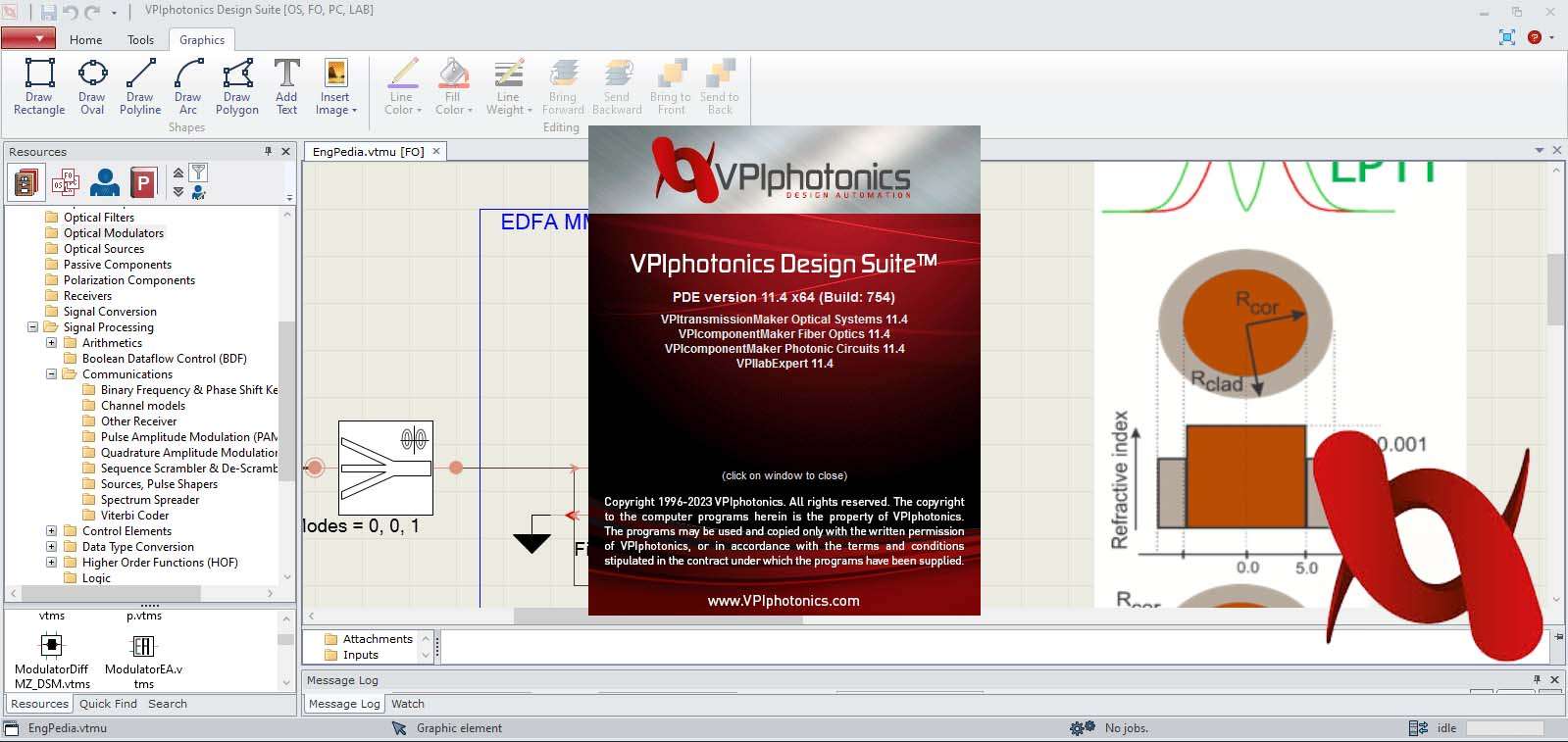
Description
Download VPI Photonics Suite 11.7 – Advanced Photonic Design and Simulation Software
VPI Photonics Suite 11.7, developed by VPIphotonics, is a comprehensive software package for photonic design and simulation. It serves as a critical tool for professionals in optical communication, integrated photonics, and optoelectronics, enabling the detailed modeling, analysis, and optimization of photonic components and systems. Target users include engineers and researchers in telecommunication engineering and academic institutions focused on photonics, who require precise simulation capabilities for advanced optical systems.
Overview of VPI Photonics Suite and Its Role in Photonic Engineering
VPI Photonics Suite provides a structured, modular approach to designing complex photonic systems. Its application spans multiple domains, including optical transmission systems, fiber optics, and the intricate design of photonic integrated circuits. The software’s methodology supports a hierarchical design flow, allowing engineers to build and analyze sophisticated optical devices and networks with high fidelity. This makes it an indispensable tool for both industrial research and development and academic pursuits in advanced photonics.
Core Simulation Components and Photonic System Modeling Capabilities
The suite is comprised of specialized modules designed for distinct aspects of photonic engineering:
- VPItransmissionMaker™ Optical Systems: Facilitates the simulation of optical transmission systems, enabling designers to model and optimize network performance.
- VPIlabExpert™: Replicates lab instrumentation for real-time testing and analysis of photonic components and systems.
- VPIcomponentMaker™ Fiber Optics: Dedicated to the design and simulation of fiber optic components, including fiber amplifiers, with support for complex optical phenomena.
- VPIphotonics Circuits: Focuses on the simulation of photonic integrated circuits (PICs), offering detailed analysis of their optical and electrical characteristics.
These modules integrate advanced numerical algorithms to accurately represent physical behaviors, including critical polarization effects, which are modeled using both Jones and Muller formalisms to ensure comprehensive system analysis.
Integration of Electrical and Optical Simulation for Accurate Device Analysis
A key strength of VPI Photonics Suite is its capability to seamlessly integrate electrical and optical signal simulations. This dual-mode analysis is crucial for accurately modeling optoelectronic devices and complex photonic integrated circuits, where the interaction between electrical control signals and optical outputs is fundamental. The software includes tools for parameter sweeps and optimization routines, enabling engineers to efficiently explore design spaces and refine device performance parameters to achieve desired characteristics.
Industry Applications and Use Cases in Optical Communications and Photonics Research
VPI Photonics Suite is utilized across a range of critical applications within the photonics industry and research community. Its capabilities are instrumental in:
- Designing and optimizing high-speed optical transmission systems for telecommunications.
- Developing and refining the performance of fiber optic amplifiers, such as Erbium-Doped Fiber Amplifiers (EDFAs).
- Creating and characterizing novel photonic integrated circuits for various applications, from signal processing to sensing.
- Simulating complex optical communication networks to predict behavior and identify potential bottlenecks.
- Conducting fundamental research into new photonic devices and optical phenomena.
These applications highlight the software’s role in pushing the boundaries of optical technology and enabling next-generation communication systems.
Extensive Module Libraries and Customization for Advanced Photonic Projects
The software features extensive libraries of pre-defined optical and electrical components, significantly accelerating the design process. Beyond these libraries, VPI Photonics Suite supports the creation of user-defined modules and the development of custom libraries. This modularity, combined with hierarchical design capabilities, allows for the construction of highly customized simulation environments tailored to specific, advanced photonic projects and unique research requirements, ensuring flexibility for specialized engineering tasks.
Comparison and Positioning Among Photonic Design Software Tools
While many software tools exist for electronic and optical simulation, VPI Photonics Suite distinguishes itself through its specialized focus on optical communication systems and integrated photonics. Its strength lies in the tight integration of optical and electrical domain simulations, coupled with advanced modeling techniques like precise polarization analysis. This makes it particularly well-suited for applications demanding high accuracy in scenarios involving fiber optics, complex transmission lines, and optoelectronic device interactions. Its modular architecture further enables tailored workflows for specific photonic design challenges.
Frequently Asked Questions
What are the primary applications of VPI Photonics Suite in optical engineering?
VPI Photonics Suite is primarily used for designing and simulating photonic integrated circuits, optical transmission systems, fiber optic amplifiers, and complex optical communication networks. It supports both electrical and optical signal simulations to enable precise analysis of optoelectronic devices.
How does VPI Photonics Suite handle simulation of polarization effects in photonic devices?
The software simulates polarization effects using advanced Jones and Muller formalism, allowing detailed and accurate modeling of optical signals in photonic systems, which is critical for precise device characterization.
Can VPI Photonics Suite support custom module development for specialized photonics projects?
Yes, it supports defining user modules and libraries, enabling advanced users to customize the simulation environment and extend the functionality to meet specific photonics design requirements.



Reviews
There are no reviews yet.