

Download ANSYS Forming 2025 R2 – Advanced Sheet Metal Forming Simulation Software
ANSYS Forming 2025 R2 is a specialized simulation software developed by Ansys, Inc. designed for the precise analysis of sheet metal forming and stamping processes. This advanced tool assists engineers in the automotive, aerospace, and heavy manufacturing sectors by accurately predicting and analyzing complex forming phenomena. By simulating virtual tool and process designs, it plays a critical role in reducing the need for physical prototyping and accelerating product development cycles.
High-Precision Simulation for Sheet Metal Forming and Stamping
ANSYS Forming provides engineers with a robust platform for virtual process design and optimization in sheet metal applications. It is particularly crucial for industries like automotive and aerospace manufacturing where complex, precisely formed metal components are standard. The software’s core function is to enable the prediction of forming behavior, thereby minimizing costly physical tryouts and accelerating the time-to-market for new designs.
Robust Modeling of Material Behavior and Process Parameters
Advanced Material Libraries and Yield Criteria
Realistic simulation of sheet metal forming demands accurate material models. ANSYS Forming 2025 R2 supports a wide array of validated material hardening laws and anisotropic material models, such as Hill’48 and Barlat’89. These are critical for capturing the directional properties of materials like advanced high-strength steels and aluminum alloys, ensuring high-fidelity predictions of material flow and deformation.
Friction and Lubrication Models
The interaction between the sheet metal and the tooling surfaces is a key factor in forming success. The software incorporates sophisticated friction models that simulate these tool-sheet interactions under various lubrication conditions. This detailed approach helps engineers accurately predict material behavior and prevent issues such as galling or tearing during the stamping process.
Comprehensive Simulation Workflow and Solver Technology
Geometry Preparation and Multi-Stage Process Setup
A seamless workflow begins with accurate geometry. ANSYS Forming offers tools for die surface preparation, robust CAD import capabilities, and the setup of multi-phase forming processes. Engineers can define complex sequences including drawing, trimming, flanging, and hemming operations to simulate the entire manufacturing sequence.
Implicit and Explicit Solver Performance
ANSYS Forming 2025 R2 leverages both implicit and explicit solvers, providing flexibility for diverse forming scenarios. These solvers are adept at handling extreme deformations and complex contact conditions inherent in stamping. Significant improvements in solver performance in the 2025 R2 release enhance the speed and efficiency of analyzing large deformation, contact, and the critical phenomenon of springback.
Predicting and Compensating Forming Defects
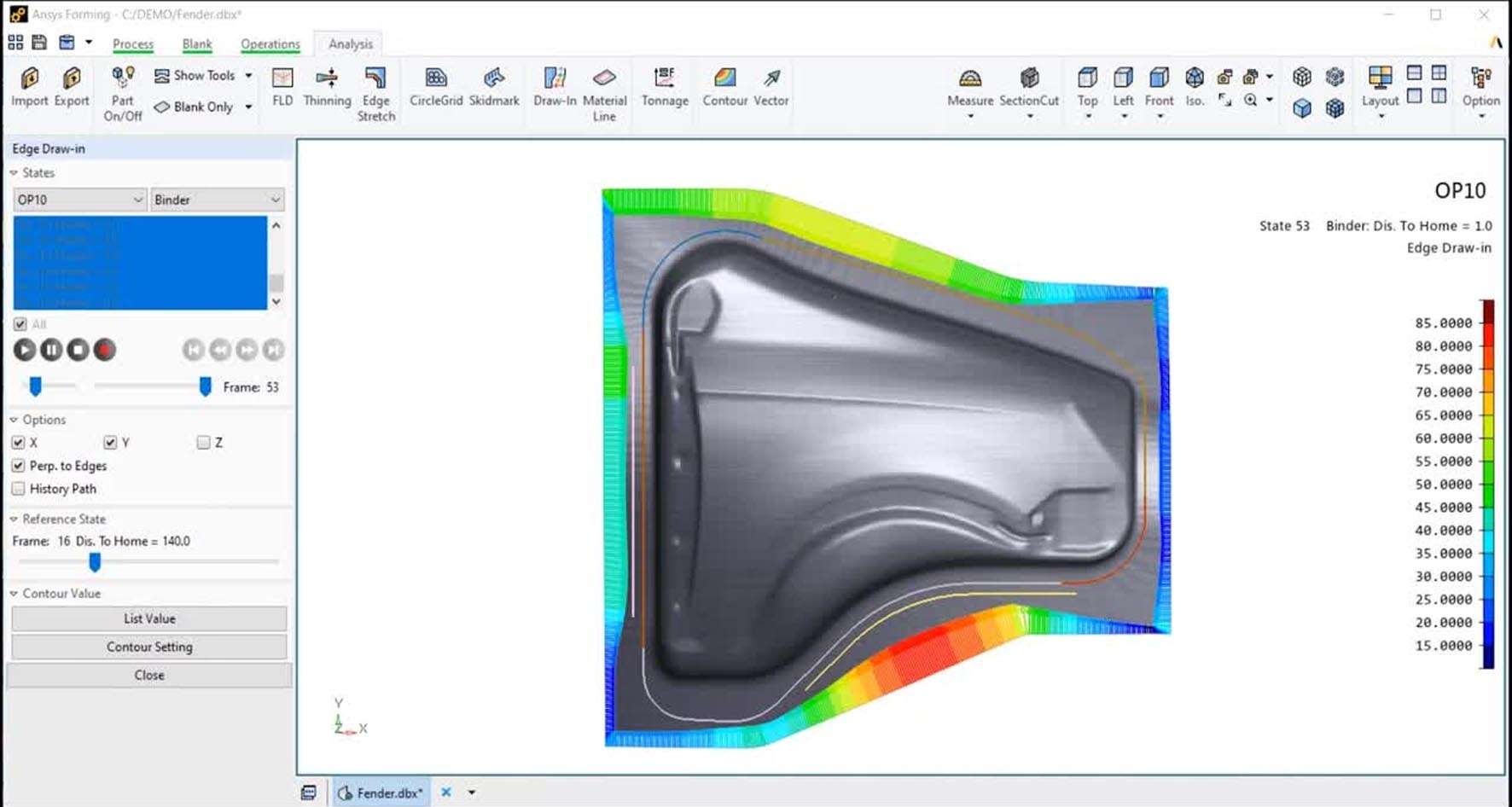
Identifying and rectifying potential defects before physical tooling is a primary benefit of ANSYS Forming. The software utilizes Forming Limit Diagrams (FLDs) for early prediction of wrinkling and tearing. Detailed analysis of thickness variations and shape deviations provides clear insights into part quality. Crucially, the software offers automated springback and shape deviation correction tools, allowing engineers to directly adjust tooling geometry to achieve target part accuracy.
Integration with CAD and Process Optimization Tools
Streamlining the design-to-manufacturing pipeline is essential. ANSYS Forming offers integrated CAD capabilities that facilitate dynamic geometry updates, ensuring that simulation models stay synchronized with design changes. Furthermore, the software supports process window exploration, enabling sensitivity analysis and robustness studies by evaluating the impact of varying key process parameters.
Industrial Applications and Case Examples
ANSYS Forming plays a pivotal role in modern manufacturing, particularly in automotive lightweighting initiatives where high-strength steels and aluminum alloys are increasingly employed. Its application in stamping process simulation allows engineers to efficiently design and validate tooling, significantly reducing the iterative trial-and-error common in traditional methods. This accelerates development timelines and lowers costs, making it an indispensable tool for high-volume metal fabrication.
Frequently Asked Questions
How does ANSYS Forming 2025 R2 improve the accuracy of sheet metal forming simulations?
ANSYS Forming 2025 R2 uses advanced material models including anisotropic hardening laws and multiple friction models that replicate real-world forming conditions. Its high-fidelity implicit and explicit solvers capture large deformations and complex contact mechanics, leading to precise predictions of defects such as wrinkling, thinning, and springback.
Can ANSYS Forming 2025 R2 simulate forming processes for advanced high-strength steels and aluminum alloys?
Yes, the 2025 R2 release broadens support for third-generation advanced high-strength steels (AHSS) and aluminum alloys, integrating their complex material behaviors into forming simulations to help users optimize tooling and processes for these challenging materials.
What are the benefits of using ANSYS Forming for springback compensation in metal forming?
ANSYS Forming enables automated springback compensation by iteratively modifying tooling surfaces based on predicted shape deviations after forming. This reduces costly physical trial-and-error, improves first-time-right tooling accuracy, and shortens manufacturing lead times.






Reviews
There are no reviews yet.