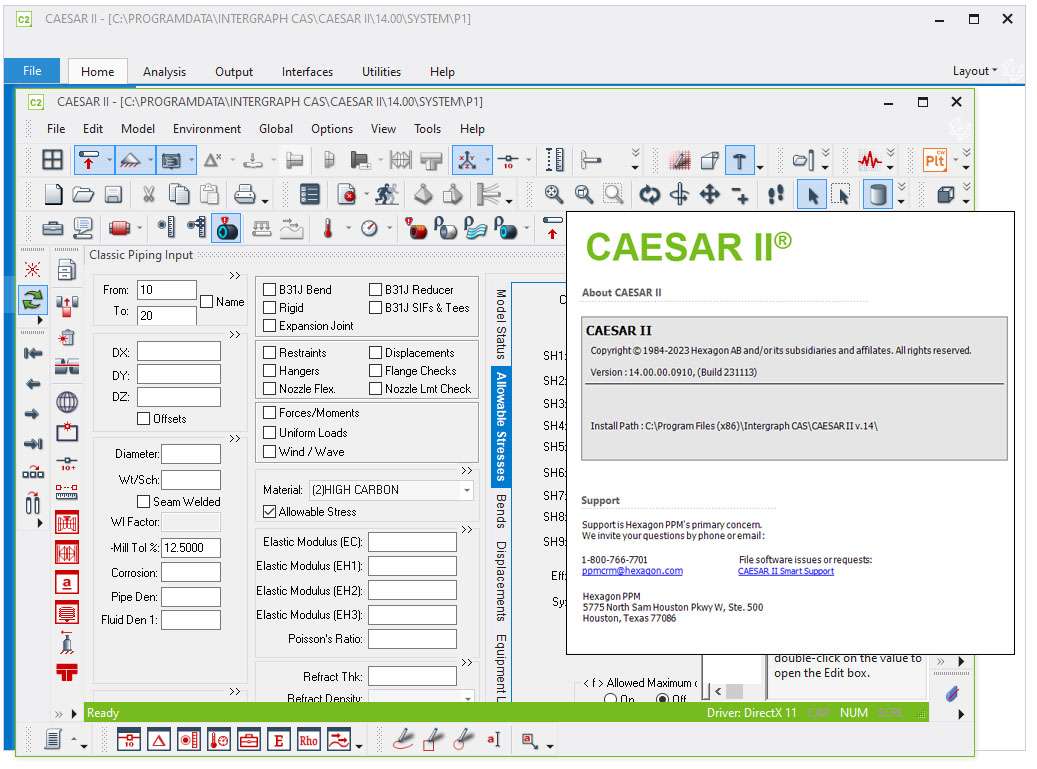
Download Hexagon CAESAR II v15.1 2025 – Advanced Piping Stress Analysis Software
Hexagon CAESAR II v15.1 2025 is a premier piping stress analysis software designed for engineers working in demanding industries such as oil and gas, chemical processing, and construction. Developed by Hexagon, this sophisticated application provides essential tools for analyzing and ensuring the integrity of piping systems under various operational conditions. The software enables users to accurately assess the impact of thermal expansion, seismic events, wind, and other loads, thereby promoting safety, compliance, and operational efficiency in complex engineering projects.
Introduction to CAESAR II Software and Its Applications
Overview of Stress Analysis in Piping Systems
CAESAR II stands as a pivotal tool for executing thorough stress analysis within piping systems. This process is critical for identifying potential failures and ensuring that installed piping can safely withstand all anticipated operational and environmental stresses. The software, a product of Hexagon’s expertise acquired through Intergraph, has evolved to become a benchmark in the field, offering both depth and breadth in its analytical capabilities for piping engineers.
Modeling Capabilities and Supported Materials
CAESAR II features advanced modeling capabilities that allow engineers to construct detailed and accurate representations of piping systems. Users can define complex geometries, select from an extensive database of materials, and configure system parameters to simulate real-world conditions precisely. This customization is vital for accurately predicting how a piping system will behave under stress.
- Supports a wide array of materials with detailed properties for realistic simulation.
- Enables precise geometric modeling for complex piping layouts.
- Offers customization options to tailor analyses to specific project requirements.
Static and Dynamic Analysis Tools
The software is equipped to perform both static and dynamic analyses, providing comprehensive insights into piping system behavior. Static analysis evaluates steady-state loads, such as thermal expansion or internal pressure, while dynamic analysis addresses transient conditions like seismic events, wind gusts, or water hammer. This dual capability ensures that piping designs are robust against a complete spectrum of potential stresses.
- Performs static analyses for thermal, pressure, and gravitational loads.
- Conducts dynamic analyses for seismic, wind, vibration, and transient events.
- Enables the simulation of various upset conditions to test system resilience.
Integration with Other Engineering Tools
A significant advantage of CAESAR II is its seamless integration with other engineering design tools. Notably, it works harmoniously with CADWorx, another Hexagon product, facilitating efficient data exchange between design and analysis workflows. This integration streamlines the process from initial modeling to final stress verification, reducing manual data entry and potential errors.
- Interfaces directly with CADWorx for fluid piping design.
- Supports interoperability with other common CAD and modeling software.
- Enhances overall project efficiency through connected design and analysis environments.
Real-World Applications and Case Studies
CAESAR II is instrumental across various industries, especially in sectors where piping integrity is paramount. In the oil and gas industry, it is used for analyzing flowlines and processing plant piping. The chemical process industries rely on it for managing corrosive environments and high-pressure systems. Construction projects also utilize CAESAR II to ensure the structural soundness of integrated piping networks. These applications highlight the software’s role in maintaining safety compliance and preventing costly failures.
Visualizing Analysis Results
CAESAR II provides powerful graphical tools for visualizing the complex results of stress analyses. Engineers can generate clear and informative graphical representations of stress contours, displacements, and force data. These visual outputs are invaluable for quickly identifying critical areas, understanding the overall system response, and communicating findings efficacement to stakeholders, project managers, and regulatory bodies.
- Offers 3D color-coded stress and displacement plots.
- Generates animated visualizations of system movement under load.
- Provides detailed reports and customizable output formats for clear communication.
Conclusion: The Value of CAESAR II in the Engineering Sector
Hexagon CAESAR II v15.1 2025 offers unparalleled capabilities in piping stress analysis, distinguishing itself through advanced modeling, robust static and dynamic analysis tools, and seamless integration with complementary design software like CADWorx. Its comprehensive feature set and reliable results make it an indispensable tool for engineers in the oil and gas, chemical, and construction sectors, ensuring the safety, compliance, and longevity of critical piping infrastructure. For professionals seeking a definitive solution for piping stress analysis, CAESAR II represents a strategic investment in design integrity and project success.
Frequently Asked Questions
What industries commonly use CAESAR II software?
CAESAR II is widely used in the oil and gas sector, chemical process industries, and construction for stress analysis of piping systems. Its capabilities make it a preferred tool for ensuring safety and compliance in engineering projects where piping integrity is critical.
Can CAESAR II integrate with other design software?
Yes, CAESAR II seamlessly integrates with engineering design tools like CADWorx and others, allowing for efficient data exchange and enhancing overall workflow in piping design and analysis. This interoperability simplifies the transition from design to analysis, minimizing iterative work.
What are the key features of CAESAR II software?
Key features of CAESAR II include advanced modeling capabilities, static and dynamic analysis, comprehensive databases for materials, and the ability to graphically display analysis results, all tailored for the piping industry. It specifically excels in verifying system integrity under various thermal and environmental loads.