

Download Synopsys Photonic Solutions 2024.09 – Advanced Photonic Design Automation Platform
Synopsys Photonic Solutions 2024.09 is an advanced Photonic Design Automation (PDA) platform from Synopsys, Inc., engineered for the complex, interdisciplinary challenges of integrated photonic circuit design. It serves professionals in sectors demanding high-performance optical components, including telecommunications, data centers, healthcare, automotive sensing, and emerging quantum photonics research. The platform addresses the convergence of optical, electronic, and thermal domains essential for next-generation photonic integrated circuits.
Overview of Integrated Photonic Design and Industry Applications
Integrated photonic circuits, which combine optical and electronic functionalities on a single chip, present unique design complexities. Synopsys Photonic Solutions provides a comprehensive environment to tackle these challenges. The software is instrumental for industries such as telecommunications and data centers, where high-speed optical communication is paramount. It also supports advancements in healthcare for biosensing applications, the automotive sector for LiDAR systems, and cutting-edge research in quantum photonics.
The design of these circuits requires simultaneous consideration of optical performance, electronic control, and thermal management. Synopsys Photonic Solutions offers integrated simulation capabilities to manage these multi-domain requirements, ensuring optimal device performance and reliability.
Comprehensive Simulation Capabilities for Photonic Components and Systems
Synopsys Photonic Solutions offers a robust suite of simulation tools designed to cover the entire photonic design flow, from fundamental component behavior to complex system-level interactions.
Electromagnetic Component Simulation with RSoft
The RSoft component of the platform excels in detailed electromagnetic simulation of photonic devices. Key solvers include:
- FullWAVE: Utilizes the Finite-Difference Time-Domain (FDTD) method to accurately model light propagation and interaction with complex photonic structures.
- BeamPROP: Employs the Beam Propagation Method (BPM) for efficient simulation of light propagation in waveguides and directional couplers, suitable for analyzing medium-to-large scale structures.
- BandSOLVE: Designed for simulating the photonic band structures of periodic structures like photonic crystals, enabling the design of novel optical devices.
Circuit-Level and Multi-Domain System Simulation Using INTERCONNECT
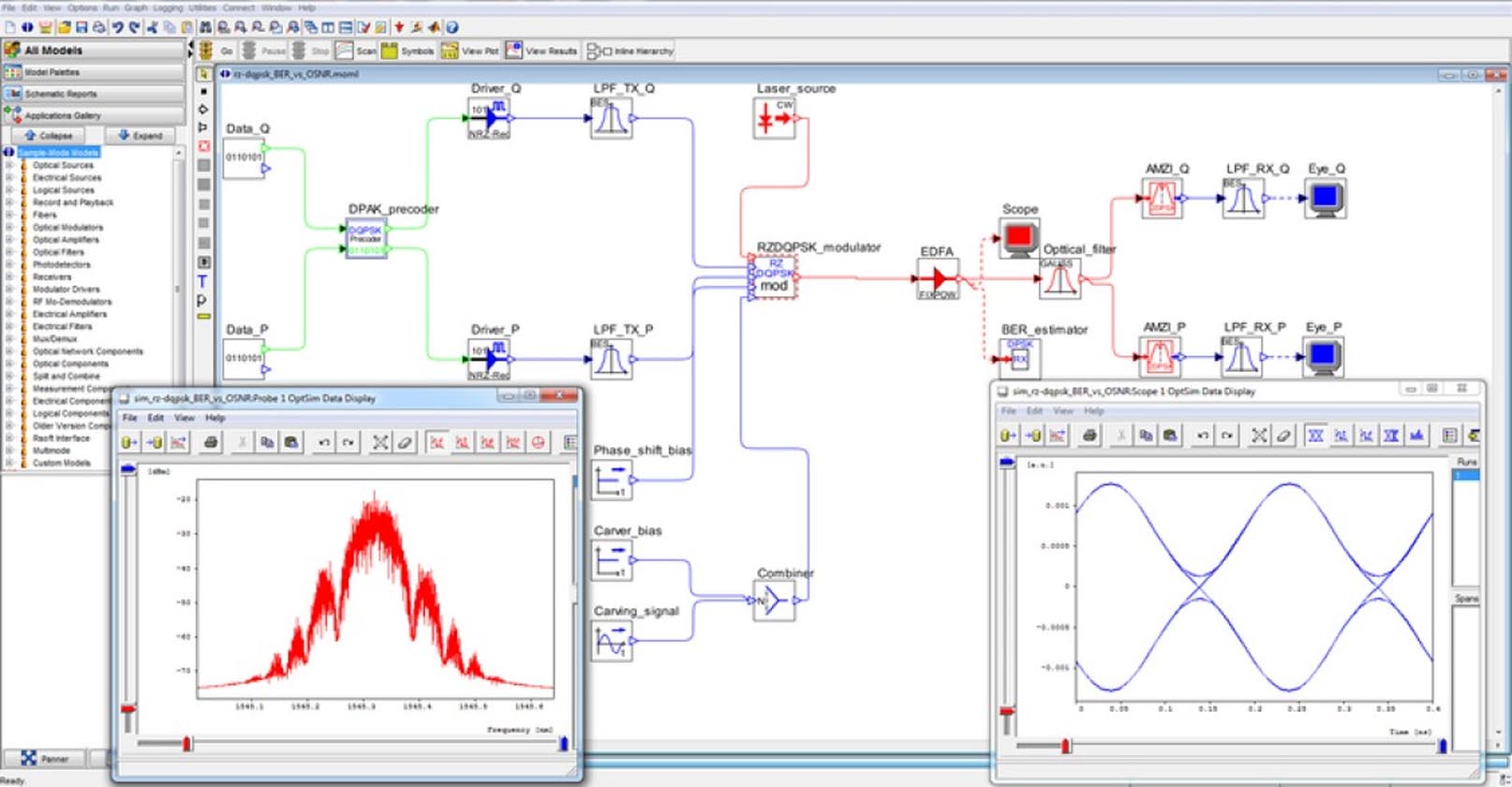
INTERCONNECT provides a powerful environment for circuit and multi-domain system simulation. It enables users to construct hierarchical designs linking optical, electronic, and thermal aspects of a system. This tool facilitates the analysis of complex integrated photonic circuits by leveraging extensive component libraries and enabling behavioral modeling.
Multi-Physics and Process Variation Analysis
Addressing the real-world manufacturing challenges, Synopsys Photonic Solutions integrates multi-physics analysis. This includes electro-optical (EO) and thermo-optical (TO) co-simulations, which are critical for understanding how electrical signals and thermal conditions affect optical performance. Furthermore, the platform supports Monte Carlo manufacturing yield prediction, allowing engineers to assess and mitigate the impact of process variations on device performance and optimize designs for higher production yields.
Physical Layout and Verification Tailored for Photonic Integrated Circuits
The Phoenix Photonic Layout tools within Synopsys Photonic Solutions are specifically developed for the intricacies of photonic integrated circuit (PIC) layout and verification. These tools ensure that designs are manufacturable and perform as intended.
- Supports the creation and management of Parameterized Photonic Components (PPCs), enabling efficient design reuse and scalability.
- Provides photonic-specific Design Rule Checking (DRC) and Layout Versus Schematic (LVS) rules, tailored to the unique requirements of optical devices, which differ significantly from electronic circuits.
- Automates the generation of ports and edge couplers, facilitating seamless integration with optical packaging and fiber connectivity solutions.
Innovations and Enhancements in 2024.09 Release
The Synopsys Photonic Solutions 2024.09 release introduces significant advancements aimed at accelerating design cycles and exploring novel photonic applications. Key updates include:
- AI-based inverse design leveraging OptoCompiler AI for rapid exploration of optimal device structures.
- Support for 3D heterogeneous integration, enabling complex co-packaged optics and advanced system architectures.
- An expanded Quantum Photonics Design Kit (QPDK), providing specialized elements and workflows for quantum computing and sensing applications.
- Introduction of cloud-native scalable simulation jobs, allowing for efficient distribution of workloads across cloud infrastructure.
- Notable GPU-accelerated solver performance improvements, significantly reducing simulation times for computationally intensive tasks.
- Enhanced foundry PDK support, ensuring greater compatibility and accuracy when designing for specific silicon photonics manufacturing processes.
Integration within the Synopsys Ecosystem and Workflow Efficiency
Synopsys Photonic Solutions is designed for seamless integration within the broader Synopsys design ecosystem, offering a unified workflow from concept to manufactured chip. This integration enhances productivity for various engineering roles.
- Direct links to Synopsys PrimeSim for accurate SPICE-based electronic simulation of control circuitry.
- Availability of OptoDesigner for schematic-driven layout, streamlining the layout creation process.
- Integration with Silicon Smart for device characterization, ensuring reliable performance data.
- The cohesive workflow provides substantial benefits for foundry process engineers developing PDKs and product engineers designing complex PICs.
Representative Use Cases of Synopsys Photonic Solutions
Synopsys Photonic Solutions is employed across a range of demanding applications, driving innovation in both academic research and industrial product development.
- Silicon Photonics for Datacom: Designing advanced transceivers and optical interconnects for high-speed data centers and telecommunications networks.
- LiDAR System Simulations: Developing integrated photonic components for next-generation LiDAR sensors used in automotive and robotics applications.
- Quantum Photonics Circuit Design: Facilitating the design and simulation of complex circuits for quantum computing, communication, and sensing platforms using specialized design kits.
- These use cases highlight the software’s versatility and its critical role in enabling cutting-edge photonic technologies across diverse market segments.
Frequently Asked Questions
How does Synopsys Photonic Solutions integrate photonic and electronic simulations?
Synopsys Photonic Solutions uses its INTERCONNECT tool to perform hierarchical, multi-domain simulations that link photonic, electronic, and thermal models, allowing users to analyze integrated systems accurately. This integration helps capture complex interactions in photonic integrated circuits, crucial for designing effective devices.
What new features does the 2024.09 version of Synopsys Photonic Solutions offer?
The 2024.09 release introduces AI-powered photonic inverse design, enhanced 3D heterogeneous integration workflows, an expanded quantum photonics design kit, cloud-native simulation capabilities, and GPU-accelerated solver performance, improving design efficiency and supporting cutting-edge photonics technology.
Which industries benefit the most from Synopsys Photonic Solutions?
Synopsys Photonic Solutions is widely used in telecommunications, data centers, automotive sensing (LiDAR), healthcare photonics, and quantum computing research, supporting design and simulation of integrated photonic circuits across these fields.








Reviews
There are no reviews yet.