

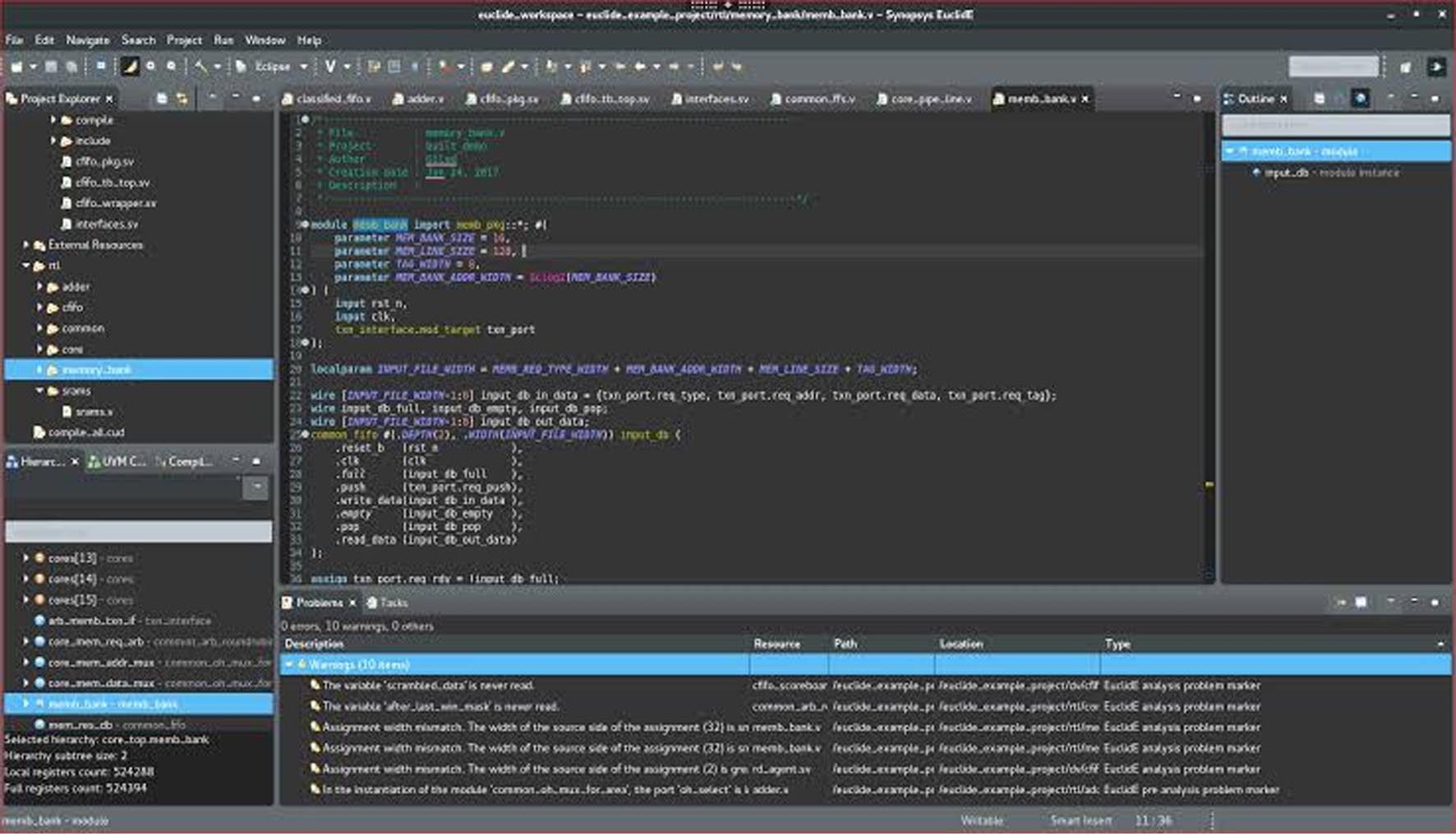
Download Synopsys Euclide – Constraint-Driven Analog Layout Automation Tool
Synopsys Euclide is a specialized technical documentation tool developed by Synopsys, Inc., designed for analog layout automation within the semiconductor industry. This software addresses the intricate challenges of analog and mixed-signal integrated circuit (IC) layout by automating complex tasks, enabling engineers to achieve higher quality layouts more efficiently. The latest 2025.06 update introduces significant advancements, leveraging artificial intelligence and performance optimizations to support the development of cutting-edge analog IC designs.
Revolutionizing Analog IC Layout with Advanced Automation
Analog layout design presents unique difficulties compared to digital ICs, requiring meticulous attention to device matching, symmetry, electromigration, and parasitic sensitivity. Manual creation of these layouts is time-consuming and prone to errors, impacting the overall design cycle. Synopsys Euclide provides a constraint-driven environment that understands and automates these critical analog layout requirements, significantly reducing manual effort and improving layout consistency. The 2025.06 release focuses on enhancing these capabilities with AI-driven functionalities and robust support for the latest semiconductor process nodes.
Constraint-Driven Device Generation and Layout Optimization
The core of Synopsys Euclide’s automation lies in its powerful constraint management system. Engineers define analog layout requirements using a Tcl-based scripting interface, specifying parameters for device matching, differential pairs, symmetry, shielding, and guard ring placement. Euclide then uses these constraints to automatically generate and place analog devices such as transistors, capacitors, and resistors, ensuring adherence to foundry Process Design Kits (PDKs). The software incorporates topology-aware placement algorithms, automatic guard ring insertion, and intelligent routing to optimize layout performance and manufacturability. Real-time design rule checking (DRC) and parasitic sensitivity analysis are integrated to help designers quickly identify and resolve potential issues.
Seamless Technology Migration and Multi-Project Integration
Migrating analog layouts between different semiconductor process nodes can be a complex undertaking, often requiring extensive redesign. Synopsys Euclide simplifies this process by offering robust technology migration capabilities. It can automatically adapt analog layouts for foundry PDKs across various nodes, supporting transitions from mature processes to advanced technologies like 3nm and beyond. The tool ensures that key analog constraints and IP library integrity are preserved during these migrations, facilitating faster adoption of new manufacturing processes and enabling the efficient management of entire IP libraries across multiple technology nodes.
AI-Powered Enhancements and Performance Innovations
Synopsys Euclide introduces state-of-the-art AI features to further accelerate and refine analog layout generation. An AI Engine is incorporated to predict optimal layout topologies and perform generative synthesis, learning from established design patterns. This includes constraint learning directly from existing “golden” layouts, allowing the tool to infer and apply best practices automatically. For enhanced performance, the software now leverages GPU acceleration for design rule checking, significantly reducing computation times for complex layouts. Cloud-native execution capabilities enable distributed processing, allowing for scalable and efficient management of intensive layout tasks on large projects or across distributed teams.
Integration with Cadence Virtuoso and Custom Automation
To ensure a seamless workflow within existing design environments, Synopsys Euclide offers tight integration with the Cadence Virtuoso Layout Suite. This interoperability allows engineers to leverage Euclide’s automation capabilities within their familiar layout implementation platform. Furthermore, the software provides robust API support for Tcl and Python scripting, enabling users to automate custom workflows and develop specialized in-house solutions. Version control system integration, including Git and Perforce, supports team collaboration and design management, while template-based reusable designs help accelerate analog layout processes for common circuit blocks.
Professional Applications and Industry Use Cases
Synopsys Euclide is primarily utilized by analog layout engineers, IC physical designers, and CAD managers within the semiconductor industry. Its advanced automation capabilities are applied to a range of critical tasks, including the rapid generation of complex analog blocks, efficient technology node migration, and the creation of parameterized IP layout libraries. The software is instrumental in handling the unique requirements of advanced semiconductor nodes such as 3nm and GAA transistors, as well as supporting modern packaging technologies like 3D ICs and chiplets. By automating tedious manual processes, Euclide significantly reduces analog layout cycle times, improves layout quality, and enhances overall design productivity.
Frequently Asked Questions
How does Synopsys Euclide improve analog IC layout automation?
Synopsys Euclide automates complex analog layout processes by using a constraint-driven approach that understands analog-specific requirements like symmetry and matching. This reduces manual layout time from weeks to hours while maintaining design accuracy and ensuring adherence to critical analog performance parameters.
What new features are included in Synopsys Euclide?
The 2025.06 release introduces AI-powered layout synthesis and constraint learning, GPU-accelerated design rule checking, enhanced support for advanced semiconductor nodes such as 3nm and GAA, and 3D visualization for complex IC designs, offering significant improvements in automation and performance.
Can Synopsys Euclide handle technology migration between process nodes?
Yes, Euclide automates the migration of analog layouts across process nodes by translating design rules and layer mappings while preserving key analog constraints, supporting transitions from mature to advanced technology nodes seamlessly and ensuring IP compatibility.






Reviews
There are no reviews yet.