
Download Intergraph GT STRUDL v43 – Advanced Structural Analysis and Design Software
Intergraph GT STRUDL v43 is a sophisticated structural analysis and design software developed through a lineage tracing back to Georgia Tech and now integrated into Bentley Systems’ offerings. This application is specifically engineered for civil and structural engineers, particularly those involved in safety-critical sectors like industrial facilities and nuclear power plant design. It provides comprehensive tools to address complex structural challenges requiring high degrees of regulatory compliance and advanced simulation accuracy.
Overview of GT STRUDL and Its Engineering Applications
GT STRUDL stands as a prominent solution in structural engineering, built upon decades of development. Initially pioneered at Georgia Tech, its evolution has seen it become a key component within Bentley Systems’ portfolio. The software is extensively utilized across civil engineering disciplines, serving critical applications in industrial facility design, and uniquely in the stringent requirements of nuclear power plant engineering and other safety-critical structural projects. Its robust capabilities enable engineers to perform detailed analyses and designs for a wide array of structures.
Advanced Structural Analysis and Simulation Capabilities
Comprehensive Finite Element Analysis
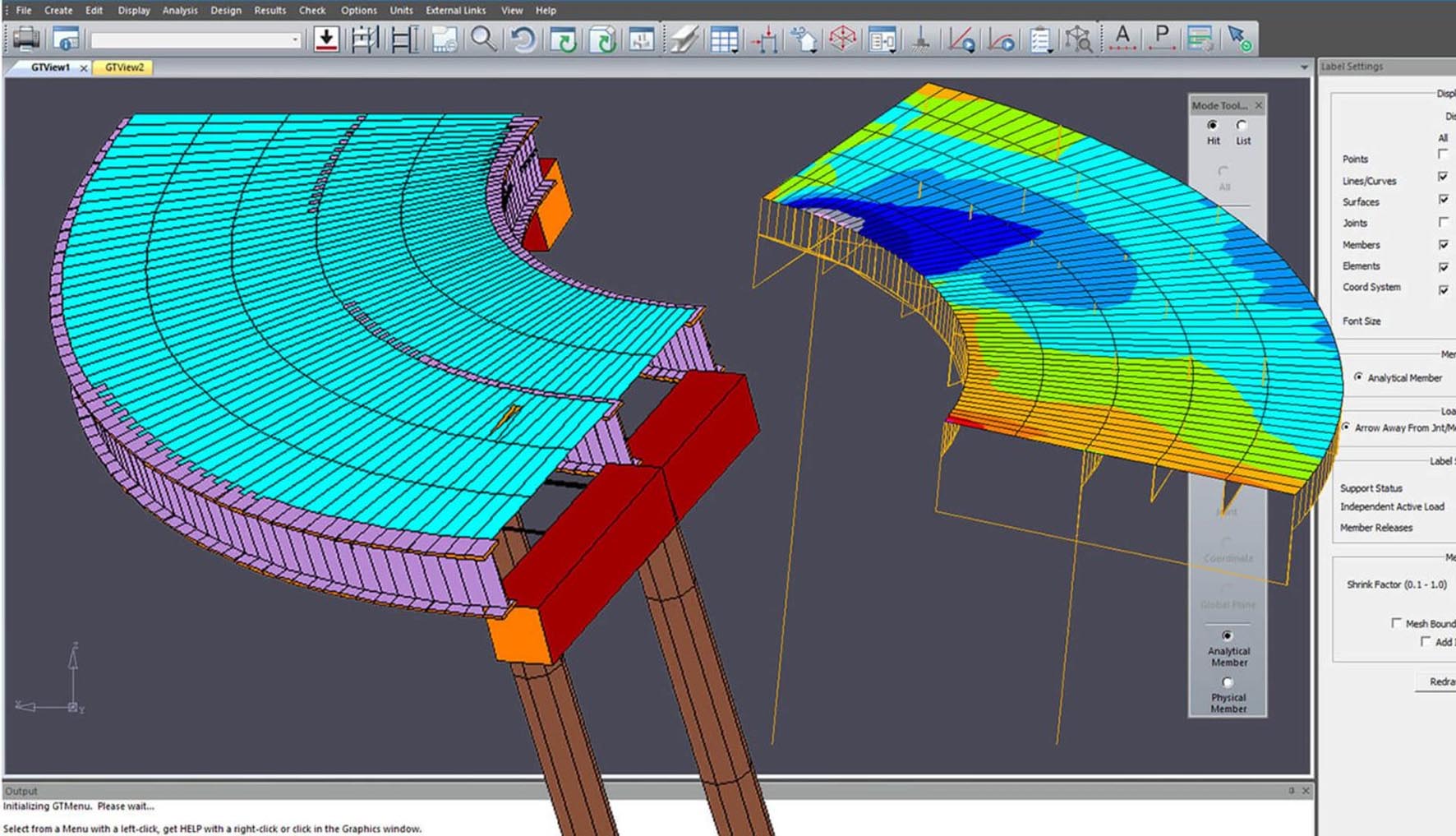
The foundation of GT STRUDL’s analytical power lies in its comprehensive finite element analysis (FEA) engine. This allows for the detailed modeling and simulation of complex structural behaviors, including advanced nonlinear material properties and geometric nonlinearities. Engineers can precisely simulate phenomena such as concrete cracking under stress, the yielding of steel components, large displacement effects that alter structural response, and contact nonlinearity in assembled parts.
Dynamic, Seismic, and Thermal Stress Analysis
GT STRUDL provides specialized modules for analyzing how structures respond to dynamic loads and environmental conditions. Its dynamic analysis capabilities include response spectrum analysis, time history simulations, harmonic analysis, and random vibration assessments. For seismic evaluations, particularly in nuclear engineering, it offers specialized methods to model soil-structure interaction accurately. Additionally, integrated heat transfer modules enable thorough thermal stress assessments, crucial for understanding performance under varying temperature gradients.
Staged Construction and Blast Impact Modeling
This software facilitates the complex analysis of structures undergoing sequential construction phases. Engineers can simulate the impact of loads and material properties as they change over time during erection, ensuring structural integrity at each stage. Furthermore, GT STRUDL is equipped to handle blast and impact analysis, providing engineers with essential tools to design for extreme events and ensure the safety of critical infrastructure against potential catastrophic forces.
Design Code Compliance and Specialized Industry Standards
Adherence to industry-specific design codes and standards is a critical aspect of GT STRUDL’s functionality, especially for regulated industries. The software supports a wide range of international design codes, including ASME, ACI, ASCE, AASHTO, Eurocode, and various nuclear codes from China, India, and the Middle East. It also incorporates standards such as API and AWS for petroleum infrastructure and PCI for precast concrete. Crucially, it is updated to comply with nuclear regulatory guides, including recent updates from the US Nuclear Regulatory Commission (NRC), ensuring that designs meet the highest safety and compliance benchmarks.
Innovations Introduced in Version 43
AI-Driven Mesh Generation and Digital Twin Integration
Version 43 of GT STRUDL incorporates cutting-edge technological advancements to enhance analysis efficiency and real-time monitoring. It features AI-driven algorithms for optimizing finite element mesh generation, leading to more accurate simulations with reduced computational overhead. Furthermore, the software integrates with digital twin concepts, allowing for real-time structural health monitoring through the integration of IoT sensor data, providing unprecedented insights into a structure’s performance throughout its lifecycle.
Performance Enhancements and User Collaboration
Significant performance improvements are realized in GT STRUDL v43 through the implementation of GPU-accelerated solvers. By leveraging NVIDIA CUDA technology, the software achieves notable speed increases, often achieving 3-5x faster computation times for complex nonlinear analyses. Enhancements also extend to user collaboration, with features enabling cloud-based teamwork via the Bentley iTwin platform, and automated report generation tools designed to streamline compliance documentation and project workflows.
Interoperability and Integration with Related Engineering Tools
GT STRUDL v43 emphasizes enhanced interoperability to support seamless integration within broader engineering workflows. It offers robust data exchange capabilities through support for industry-standard formats such as IFC (Industry Foundation Classes), CIS/2 (CIMsteel Integration Standard), and SDNF (Steel Detailing Neutral File). This facilitates smooth data transfer between design, analysis, and detailing applications. Additionally, its integration potential extends to specialized software like those for probabilistic risk assessment, such as @RISK, enabling a more holistic approach to project safety and risk management.
Practical Use Cases in Civil, Industrial, and Nuclear Engineering
The versatility and advanced capabilities of GT STRUDL are demonstrated through its application in numerous real-world engineering scenarios. In the nuclear sector, it is vital for the precise design and validation of critical components such as reactor vessels and containment structures. For industrial facilities, it ensures the structural integrity and safety of complex plant layouts under various operating and emergency conditions. Engineers also utilize GT STRUDL for modeling seismic isolation systems to protect buildings from earthquake damage and for detailed foundation designs that must support heavy loads and withstand challenging geotechnical conditions.
Frequently Asked Questions
What are the main structural analysis capabilities of GT STRUDL v43?
GT STRUDL v43 offers advanced finite element analysis including nonlinear material and geometric effects, dynamic and seismic analysis, staged construction simulation, and thermal stress analysis. Its capabilities ensure precise modeling of complex structural behaviors in safety-critical environments.
How does GT STRUDL support nuclear industry design standards?
GT STRUDL complies with specialized nuclear standards such as ASME Section III, ACI 349, ASCE 4-16, and NRC regulatory guides. Version 43 further supports high-temperature reactor components and latest NRC regulatory updates to ensure compliance for nuclear facility structural design.
What performance improvements does GT STRUDL v43 introduce?
Version 43 enhances performance with GPU-accelerated solvers using NVIDIA CUDA technology, achieving 3-5x speed improvements for nonlinear analysis. It also integrates cloud collaboration features and automated regulatory report generation for workflow efficiency.


Reviews
There are no reviews yet.