

Download OpenSeesPL 2.7.6 – Earthquake Engineering Simulation GUI
OpenSeesPL 2.7.6 is a specialized graphical user interface (GUI) designed to facilitate the complex finite element analysis required for earthquake engineering simulations. Developed as a user-friendly front-end for the powerful OpenSees framework, OpenSeesPL lowers the barrier to entry for engineers and researchers working with nonlinear seismic analysis, particularly in soil-structure interaction problems. It brings visual modeling and analysis setup capabilities to the advanced simulation environment originally created by the Pacific Earthquake Engineering Research (PEER) Center.
Overview of OpenSeesPL and Its Role in Earthquake Engineering
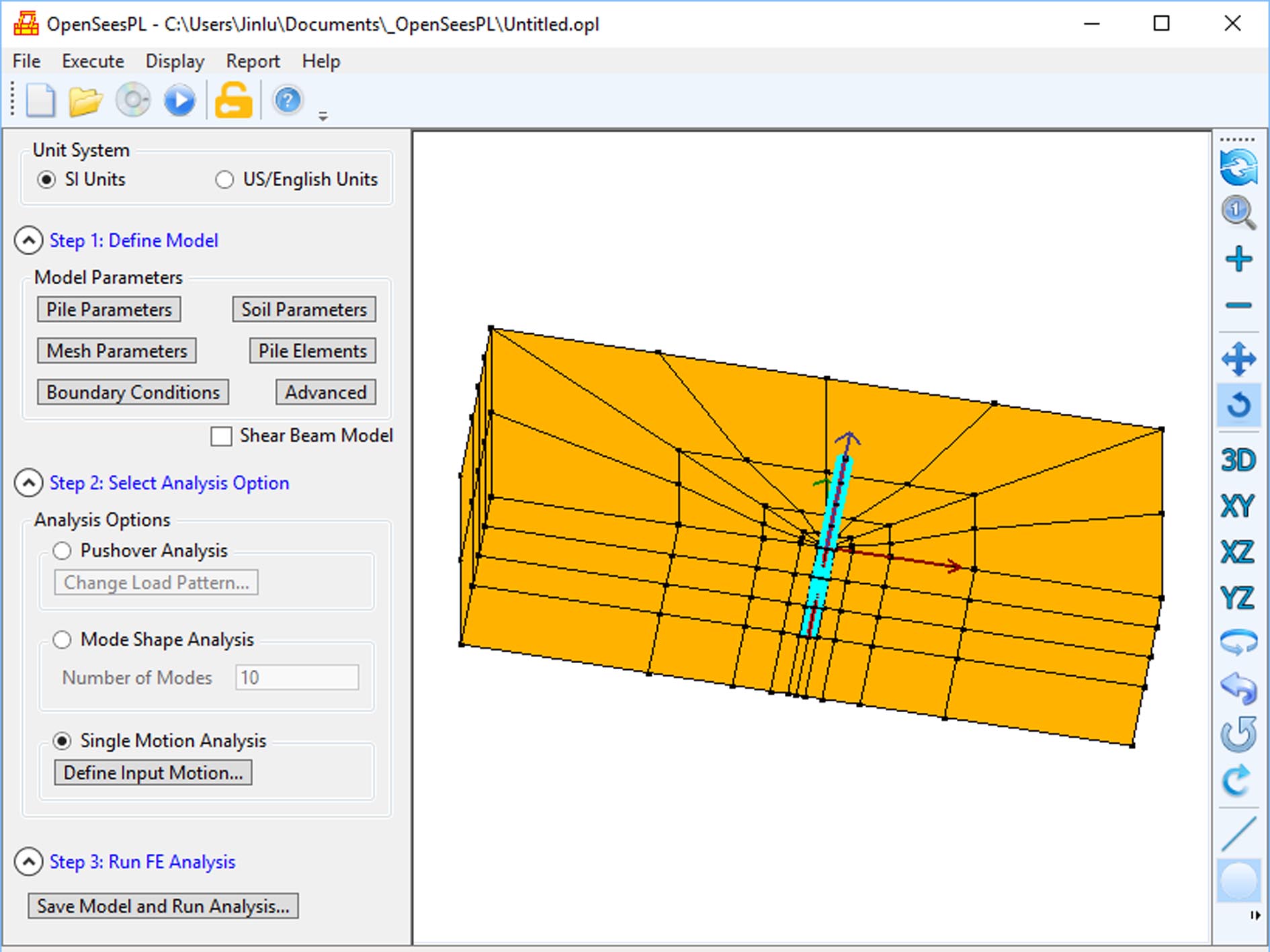
OpenSeesPL serves as a crucial intermediary, translating visual modeling actions into the underlying Tcl scripts that OpenSees utilizes for its sophisticated analyses. This approach allows professionals in structural and geotechnical engineering to leverage the robust capabilities of OpenSees without needing to master its command-line scripting. The software is specifically engineered to handle nonlinear dynamic simulations, a critical aspect of accurately predicting structural and soil behavior under seismic loading conditions. Its development context is closely tied to the evolution of OpenSees, aiming to make advanced earthquake engineering simulation more accessible.
Graphical Model Construction and Specialized Geotechnical Elements
The software features a visual model builder that enables users to construct 2D and 3D finite element models through an intuitive graphical interface. This eliminates the extensive manual Tcl scripting typically required for model definition in the base OpenSees framework. OpenSeesPL provides a library of pre-configured, specialized elements essential for seismic simulations. These include common structural components like beam-columns and trusses, as well as zero-length elements crucial for modeling joints or the interface between soil and structural elements, simplifying the setup for complex geotechnical and structural systems.
Configuring Complex Nonlinear and Dynamic Analyses
Setting up intricate analysis scenarios is streamlined within OpenSeesPL, guided by an Analysis Setup Wizard. Users can configure a variety of analysis types necessary for earthquake engineering, including static analyses, cyclic pushover analyses to evaluate material degradation and ultimate capacity, dynamic time-history analyses to simulate response to recorded or synthetic ground motions, and eigenvalue analyses to determine natural frequencies and mode shapes. The GUI simplifies the definition of boundary conditions, material properties, loads, and solver parameters required for these advanced simulations.
Visualization of Simulation Results and Model Interpretation
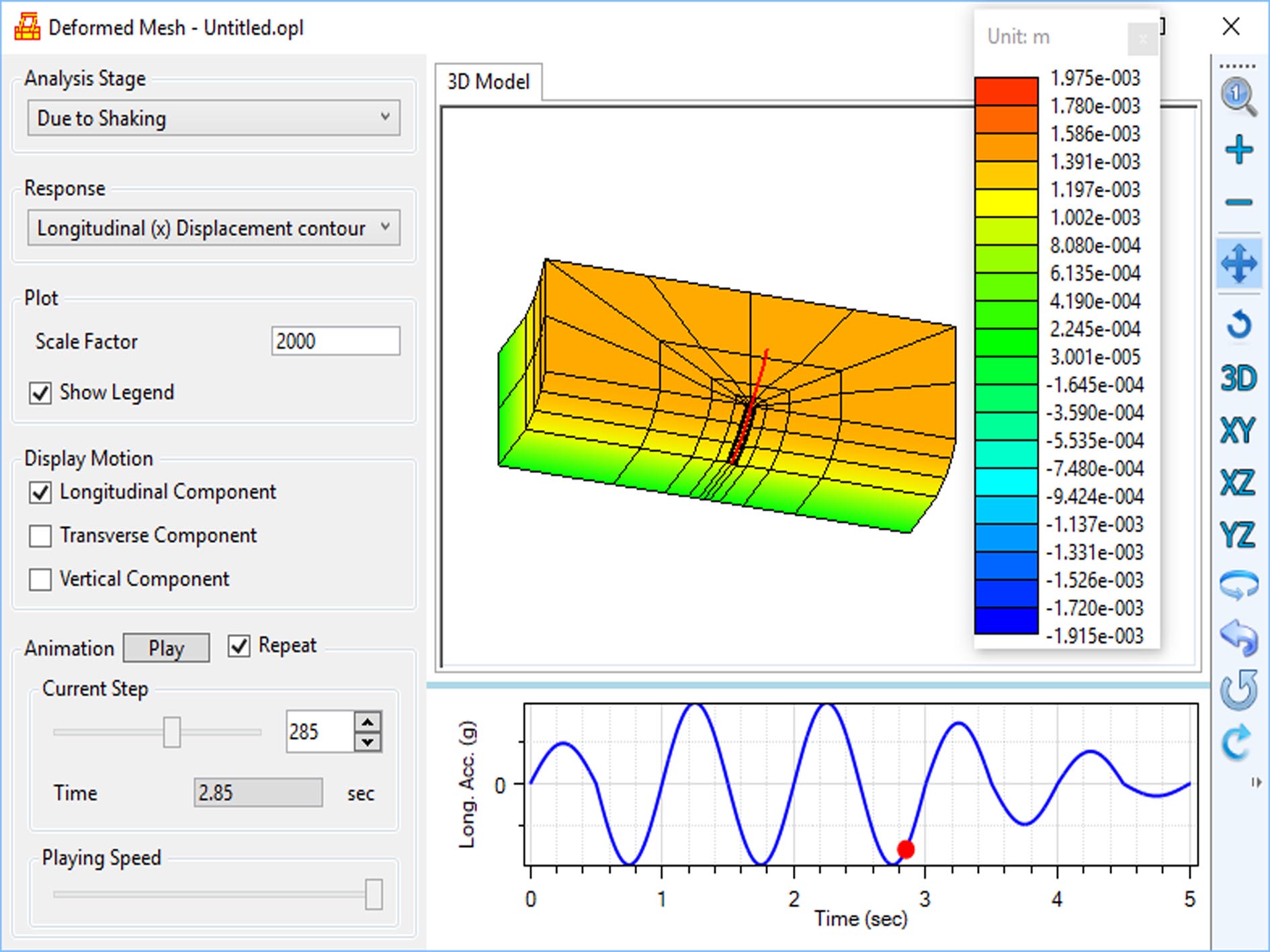
Post-processing and interpretation of simulation outcomes are critical for validating model behavior and understanding structural performance. OpenSeesPL integrates built-in tools for visualizing key results directly. This includes plotting hysteretic curves to assess energy dissipation, displaying deformed shapes to understand structural displacement patterns, and generating stress and strain contour plots to identify critical regions within the finite element model. Direct visual feedback enhances the validation process of complex seismic analyses.
Model Integration and Export for Advanced Simulation Workflows
A key feature of OpenSeesPL is its ability to export the graphically constructed model into native OpenSees Tcl scripts. This export functionality ensures that users can maintain transparency in their simulations and allows for further modifications or integration into more complex workflows leveraging the full power of OpenSees scripting. The software facilitates an efficient workflow for soil-structure interaction modeling by enabling the creation of coupled models that are then translated into executable OpenSees analyses, requiring the underlying OpenSees solver to perform the computation.
Target Users and Practical Application Scenarios
OpenSeesPL is primarily designed for advanced technical users. This includes structural engineers performing seismic retrofitting designs, geotechnical engineers analyzing the behavior of foundations and retaining structures under seismic loading, and academic researchers and graduate students conducting cutting-edge studies in earthquake engineering. Practical application scenarios range from detailed seismic risk assessments of critical infrastructure to in-depth studies of soil-structure interaction phenomena and simulations of building response to extreme seismic events. Its capabilities are well-suited for both advanced analytical work in consultancy and for educational purposes at the graduate level.
Frequently Asked Questions
What is OpenSeesPL and how does it relate to OpenSees?
OpenSeesPL is a graphical user interface developed to simplify the use of OpenSees, an open-source finite element analysis framework for earthquake engineering simulations. It enables users to visually build models, define materials, and set up complex nonlinear seismic analyses without writing Tcl scripts, thus making the powerful OpenSees solver more accessible.
Which types of earthquake engineering analyses can I perform with OpenSeesPL?
OpenSeesPL supports static, cyclic pushover, dynamic time-history, and eigenvalue modal analyses. These capabilities allow engineers to assess structural and soil responses under various seismic loading scenarios, particularly nonlinear behavior, providing a comprehensive tool for seismic performance evaluation.
Can OpenSeesPL be used for soil-structure interaction modeling?
Yes, OpenSeesPL includes streamlined workflows for constructing coupled soil-foundation-structure interaction models, which are critical for realistic seismic performance assessments in geotechnical and structural engineering projects. It simplifies the geometric and material definition for these complex integrated systems.




Reviews
There are no reviews yet.