

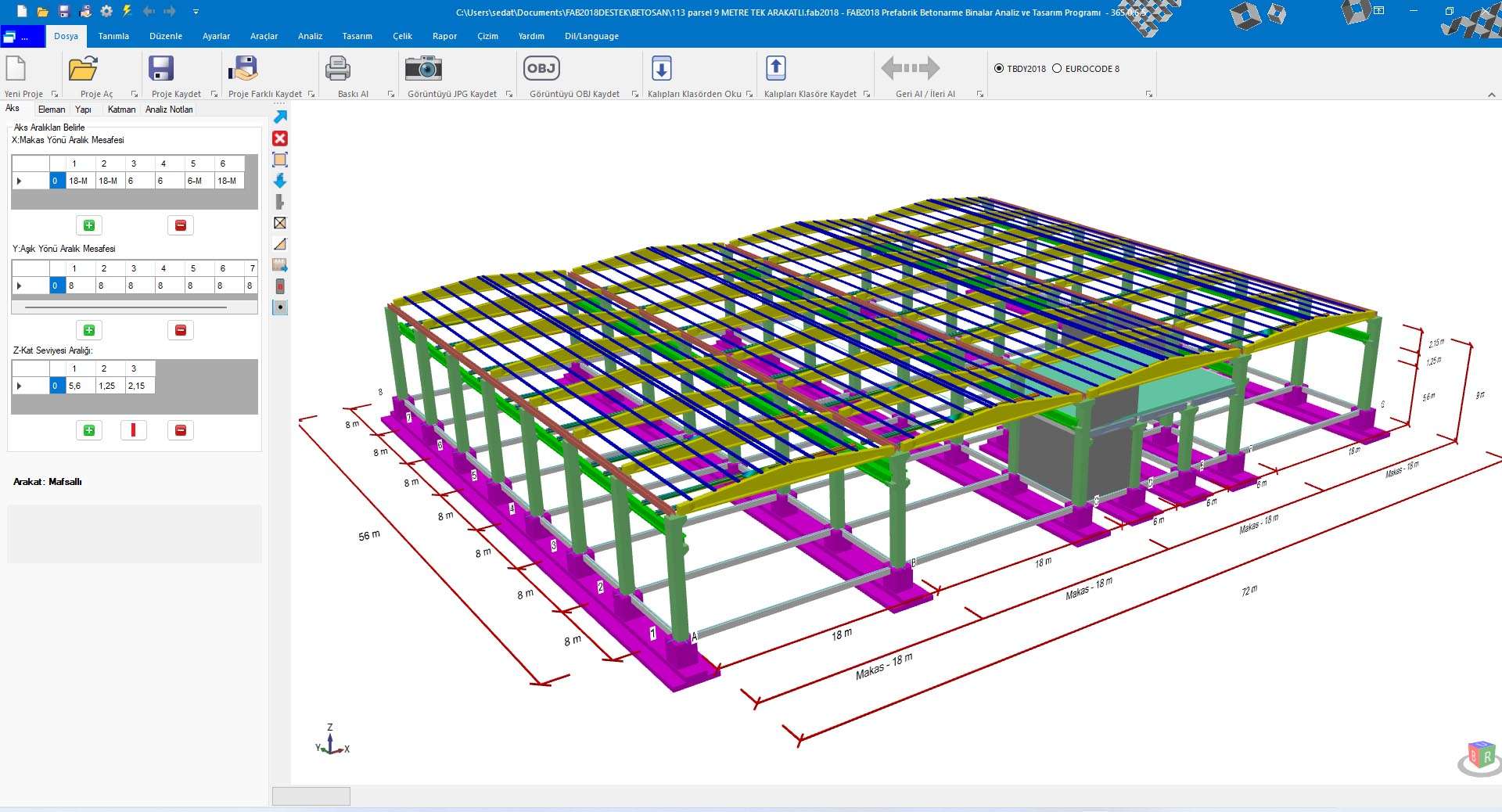
Download FAB 2018 – Advanced Structural Analysis and Design Software for Prefabricated Concrete Buildings
FAB 2018 is specialized structural analysis and design software tailored for prefabricated reinforced concrete buildings. Developed using Microsoft Visual Studio C#/.NET Framework, this tool is essential for civil and structural engineers, precast concrete manufacturers, and construction firms operating within Turkey. It focuses on providing comprehensive solutions for modeling, analysis, design, and documentation compliant with key Turkish building standards and the 2018 Earthquake Regulations.
Purpose and Industry Applications of FAB 2018
FAB 2018 serves as a critical engineering tool within the civil and construction sector, specifically for the design of prefabricated reinforced concrete structures. Its primary applications lie in structural engineering consultancies and precast concrete manufacturing facilities. The software is specifically engineered to meet the stringent requirements of Turkish construction standards, including TS 500, TS 3233, TS 498, and TS 9967, alongside the 2018 Earthquake Regulations. This focus ensures that engineers and designers working on industrial, commercial, and other building projects in Turkey can achieve compliant and safe structural designs.
3D Modeling and Structural Analysis Capabilities
The software features a robust 3D modeling environment that utilizes WPF-based rendering for visualization. Its analytical capabilities are built upon finite element analysis, including the application of shell elements for comprehensive structural representation. FAB 2018 supports both 3D linear static and dynamic analyses, which are crucial for understanding structural behavior under various load conditions. A key aspect of its analytical power is the computation of seismic loads, incorporating advanced methods such as Modal Response Spectrum Analysis. This ensures that designs are rigorously evaluated against earthquake forces, including considerations for torsional effects and P-Delta impacts, as mandated by current earthquake design codes.
Design Features Compliant with Turkish Building Codes
FAB 2018 provides comprehensive design support for both reinforced and prestressed concrete elements, adhering strictly to Turkish national standards. The software facilitates the design of a wide array of structural components essential for prefabricated buildings. This includes elements such as purlins, trusses, gutters, various types of beams (TT plates, hollow slabs, T-beams, inverted T-beams, L-beams, I-beams), columns, and foundations. Additionally, it offers specialized connection design options critical for assembling precast components, such as hinged and rigid mezzanine beam-column joints. The integration of 2018 Earthquake Regulations is a core feature, ensuring that all designs meet the latest seismic safety requirements.
Automated Drawings and Documentation Workflow
Streamlining the transition from design to manufacturing, FAB 2018 automates the generation of essential manufacturing and assembly drawings. This feature significantly reduces the manual effort and potential for errors in creating production-ready documentation. The software supports exporting models and drawings in several industry-standard formats, including OBJ for general 3D data exchange, 3D PDF for easy sharing and review, and crucially, DWG/DXF formats. This direct compatibility ensures seamless integration with AutoCAD and other CAD software, facilitating efficient fabrication and construction workflows for precast concrete components.
Application Examples and Real-World Use Cases
FAB 2018 is employed in a variety of real-world scenarios within the Turkish construction industry. Typical applications include the structural design and analysis of industrial facilities, commercial buildings, and warehouses that utilize prefabricated concrete elements. For precast manufacturers, the software optimizes the design and production cycle by integrating detailed modeling with drawing generation. Furthermore, its advanced seismic analysis capabilities make it indispensable for projects located in earthquake-prone regions, ensuring structural integrity and compliance with critical safety regulations. The software aids engineers in efficiently managing the complexities of precast concrete construction, from initial design to final fabrication drawings.
Software Interface and Usability
Designed with the Turkish engineering professional in mind, FAB 2018 features a bilingual interface that supports both Turkish and English. This dual-language capability ensures accessibility and ease of use for a broad range of users within the local market and potentially for regional export. The software incorporates rapid model creation tools and an intuitive user experience, aiming to accelerate the design process without compromising accuracy. These usability features are tailored to assist busy engineering professionals in efficiently handling complex precast concrete structural projects and documentation requirements.
Frequently Asked Questions
What types of structural elements can be designed using FAB 2018?
FAB 2018 supports design of a wide range of elements including purlins, trusses, gutters, various types of beams (TT plates, hollow slabs, T-beams, inverted T-beams, L-beams, I-beams), columns, foundations, and specialized connections such as hinged and rigid mezzanine beam-column joints.
How does FAB 2018 handle seismic analysis for building safety?
FAB 2018 integrates advanced seismic design features like Modal Response Spectrum Analysis, CQC combination, and torsional moment effects to ensure compliance with 2018 Turkish Earthquake Regulations, enhancing safety by accurate dynamic load assessments.
Can FAB 2018 export files compatible with AutoCAD for manufacturing?
Yes, FAB 2018 generates detailed manufacturing drawings and exports them in standard DWG and DXF formats, ensuring seamless integration with AutoCAD for fabrication and production workflows.


Reviews
There are no reviews yet.