

SHIPMO 2025: Fast Seakeeping Calculations for Ship Motions in Waves
HIPMO 2025 is the Maritime Research Institute Netherlands (MARIN) implementation of strip theory for fast seakeeping calculations . It is the core component of the QSHIP Hydrodynamic Suite, providing rapid prediction of ship motions in a seaway.
SHIPMO is the fastest way to obtain a first reliable impression of ship motions, delivering results in minutes depending on the number of headings, speeds, frequencies, and hull sections . The program is based on the well‑known strip theory, which assumes slender hull forms and linearity of hydrodynamic forces . While SHIPMO is limited to slender ship types due to strip theory assumptions, it has been validated for a wide range of applications and hull forms.
???? Primary Users
This professional seakeeping software is designed for:
-
Naval Architects & Marine Engineers performing initial design seakeeping assessments
-
Ship Designers & Classification Societies comparing hull form performance in waves
-
Research & Development Teams evaluating roll stabilizer effectiveness
-
Shipyards & Vessel Operators predicting operational workability limits
-
Offshore & Marine Consultants assessing vessel motions for mission suitability
⚡ Key Features & Capabilities
???? Core Analysis Capabilities
Motion Predictions (6 DOF):
-
Surge, sway, heave, roll, pitch, yaw Response Amplitude Operators (RAOs)
Internal Loads:
-
Transverse and vertical shear forces
-
Bending moments (vertical and horizontal)
-
Torsional moment at transverse cuts
Response at Reference Points:
-
Relative vertical motion and velocity
-
Absolute motions, velocities, and accelerations
????️ Advanced Modeling
Hull Representation:
-
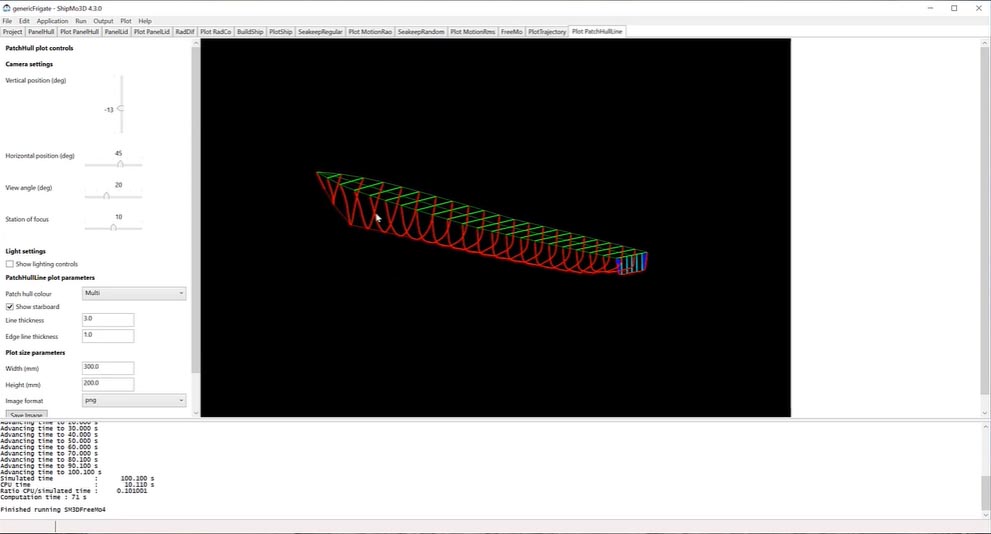
Arbitrary number of sections (typically 20-40 frames) approximates hull form
-
Each section shape approximated by line elements
-
Assumes no direct hydrodynamic interaction between sections
Appendage Contributions:
-
Bilge keels, skegs, fins (passive and active)
-
Rudders, anti‑roll tanks
-
Viscous roll damping (IKEDA, FDS, Nobel Denton methods)
Added Resistance in Waves:
-
Four approximation methods: Gerritsma/Beukelman, Boese, Salvesen, and combined approaches
Multihull Support:
-
Accommodates catamarans and trimarans
???? Wave & Environment Modeling
Regular Waves:
-
User-defined wave directions, frequencies, water depth
Irregular Waves:
-
Significant wave height and wave period
-
Wave spectra (JONSWAP, Pierson-Moskowitz, etc.)
-
Multi-directional spectra (expanded capabilities)
???? Input Requirements
| Input Type | Required Data |
|---|---|
| Hull Geometry | Body plan, draft at aft and fore perpendiculars |
| Mass Properties | Mass distribution, radii of gyration, transverse metacentric height (GM) |
| Appendages | Bilge keels, skegs, fins, rudders |
| Operating Conditions | Ship speeds, water depth |
| Wave Conditions | Wave directions, frequencies, significant wave height, wave period |
???? Output Capabilities
All results are available as Response Amplitude Operators (RAOs) in the frequency domain . SHIPMO interfaces with WASCO (workability analysis software) for efficient handling of wave climate and motion criteria integration .
???? What’s New in SHIPMO 2025
SHIPMO continues as a core component of the QSHIP Hydrodynamic Suite. Current developments include :
-
Integration with QSHIP for workability analysis and downtime calculations based on exceedance of user-defined criteria (accelerations, seasickness levels)
-
Continued refinement of potential flow methods within MARIN’s software ecosystem
MARIN provides downloadable documentation for the latest version and previous versions of SHIPMO, with both online and offline (PDF) formats available .





Reviews
There are no reviews yet.