

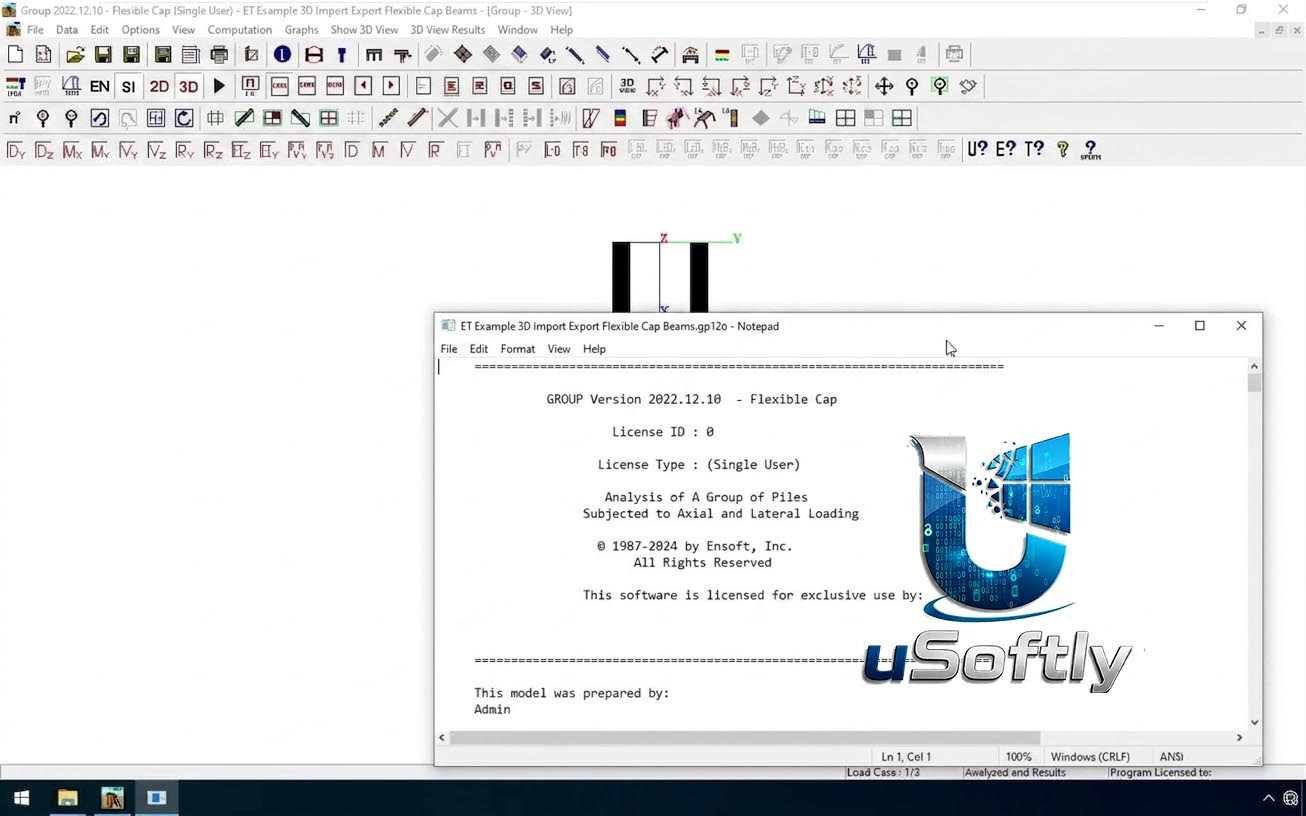
Ensoft Group Flexible Cap 2022.12.10 – Comprehensive 3D Pile Group Analysis Software for Combined Axial, Lateral, and Torsional Loadings
GROUP is a well-known software for analyzing the behavior of pile groups subjected to combined axial, lateral and torsional loadings . The program computes the distribution of loads (vertical, lateral, and overturning moment in up to three orthogonal axes) applied from multiple locations in a rigid or flexible pile cap to piles arranged in a group .
The program internally generates the nonlinear response of the soil in the form of t-z and Q-w curves for axial loading, p-y curves for lateral loading, and T-q curves for torsional loading . A solution requires iteration to accommodate the nonlinear response of each pile in the group model, ensuring compatibility of deformations and equilibrium of forces between applied external loads and the reactions of each pile head .
GROUP 2022.12.10 is an update from the 2022 release cycle. Ensoft’s version numbers consist of three parts: the year of initial release, the data file format version, and the update/revision number . The 2022.12.10 designation indicates this is from the 2022 release cycle. The software is available through Ensoft’s distribution channels and includes extensive documentation, user manuals, and example files.
Primary Users
Ensoft Group 2022.12.10 is designed for geotechnical engineers, structural engineers, and foundation design specialists who need to analyze the complex behavior of pile groups under combined loadings. It serves professionals who:
-
Design pile foundations for buildings, bridges, and offshore structures where load distribution among piles is critical
-
Analyze pile groups subjected to axial, lateral, and torsional loads applied from any location on the pile cap
-
Evaluate pile-soil-pile interaction (group effects) for closely-spaced piles using p-multipliers
-
Model complex foundation systems with up to 1000 vertical and battered piles in a single analysis
-
Perform push-over analysis and generate foundation stiffness matrices for soil-structure interaction studies
Key Features & Capabilities
Soil Response Curves
GROUP generates nonlinear soil response curves internally or allows user input:
-
p-y Curves: Lateral soil resistance for various soil types including soft clay, stiff clay, sand, liquefied sand, weak rock, and massive rock . Built-in methods include Matlock Soft Clay, Reese Stiff Clay, API Sand, and O’Neil Sand .
-
t-z and Q-w Curves: Axial load transfer and tip resistance curves for vertical pile capacity analysis .
-
T-q Curves: Torsional soil resistance for piles subjected to torque loading .
Pile Sections and Materials
-
Predefined Sections: Circular (hollow or full), rectangular, wide-flange, and AISC sections from built-in library
-
Nonlinear Sections: Reinforced concrete sections with rebar, circular steel tubes, prestressed square/octagonal sections, and user-defined EI
-
Tapered Sections: Option to define tapered sections along pile length
Loading and Analysis
-
Combined Loadings: Axial, lateral, and torsional loads applied at any position on the pile cap
-
Distributed Lateral Loads: Along the length of any pile using local or global axes
-
Soil Movement: Input profile of soil movements (slope instability, lateral spreading, seepage) as additional loading
-
Load Combinations: User-defined load factors with maximum and minimum envelope computation
-
Push-Over Analysis: Advanced nonlinear analysis capability
Modeling Capabilities
-
Pile Group Layout: Up to 1000 vertical and/or battered piles in the same model
-
Pile-Cap Connection: Pinned, fixed, or elastically restrained with user-defined rotational spring stiffness
-
Flexible Pile Cap: Modeled using plate elements and/or beam elements
-
Group Effects: User-specified p-multipliers for pile-soil-pile interaction in closely-spaced piles
Output and Reporting
-
Individual Pile Results: Bending moment, shear force, mobilized sectional properties, and curvature for each pile
-
Graphical Output: 3D visualization of pile group, contoured graphics of stresses, and p-y curve plots
-
Export Options: Loading, layout, and graphs to preformatted spreadsheets
-
Response File: Text file with equivalent nonlinear springs for soil-structure interaction analyses
Performance
-
Parallel Processing: Uses multiple cores for considerable reduction in computing time on large models
-
64-bit Programming: Efficient memory handling for large-scale analyses


Reviews
There are no reviews yet.